

Microsoft's Monarch Option: Renting an Off-Grid Gigawatt AI Data Center from a Neocloud
A non-binding LOI for 1.35 GW on a West Virginia campus Microsoft won't own: a behind-the-meter 2.16 GW natural-gas microgrid, "H"-shaped data centers, NVIDIA Vera Rubin silicon, built by a neocloud.

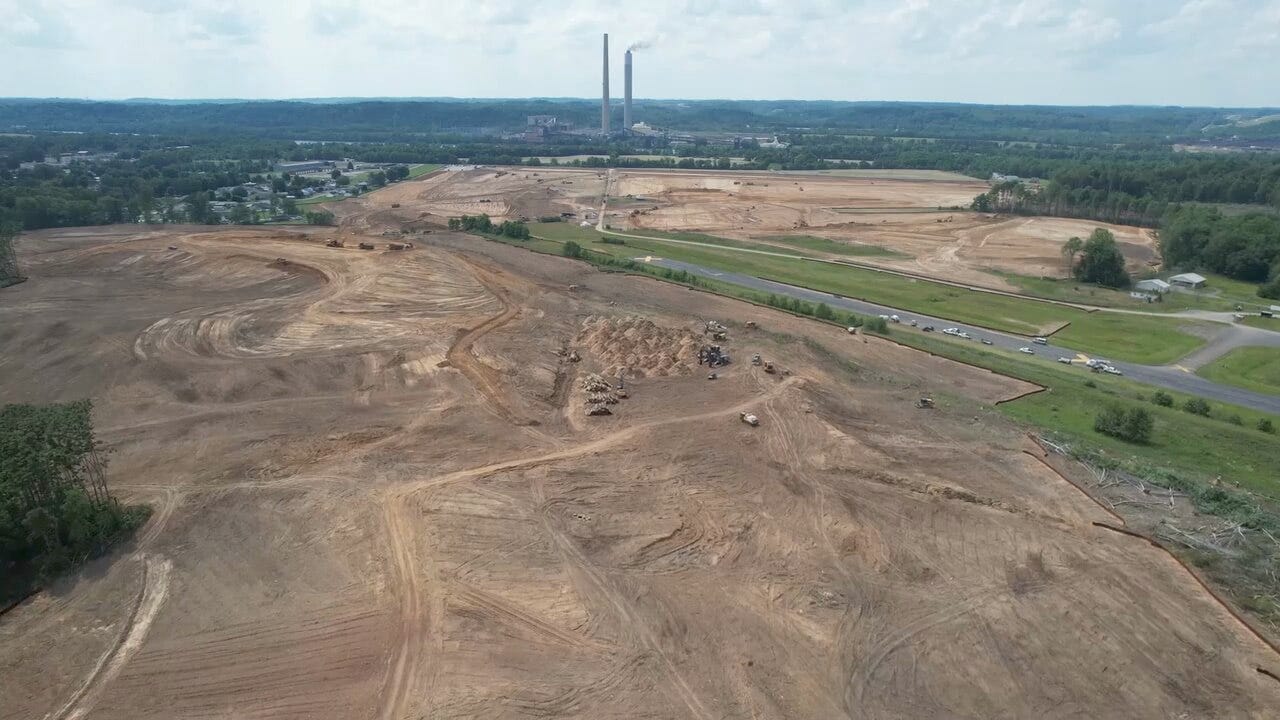
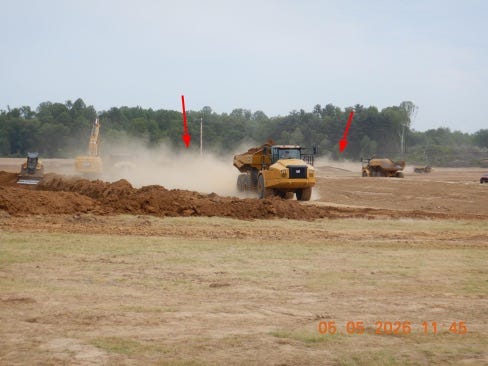
On March 16, 2026, at NVIDIA’s GTC conference, Microsoft and a UK company most of the data center industry had never heard of announced a deal: 1.35 gigawatts of AI compute, to be delivered on NVIDIA’s next-generation Vera Rubin systems, at a campus called Monarch on the banks of the Ohio River in Mason County, West Virginia. Weeks later, a state inspector drove out to the site and logged what he saw — “large dust clouds” rising off a greenfield site that, until that spring, had spent three years on the books as a hydrogen plant.
It is an unlikely address. West Virginia has almost no data center industry — none of the hyperscale clusters of neighboring Virginia or Ohio — and that near-blank slate is part of the story: the state spent 2025 rewriting its laws to court exactly this kind of project.
Microsoft owns none of it. Not the land, not the gas plant that will power the campus, not the buildings, and not the GPUs. The owner-operator is Nscale, a “neocloud” — a GPU-rental specialist — that will build Monarch, run it, and sell Microsoft the compute that comes out the other end. Microsoft is the anchor tenant. It is a posture Microsoft has become increasingly comfortable with for its AI data centers, as shown by the 20-year triple-net leases it signed at its Fairwater Atlanta facility, and it is why Monarch is worth a close look.
The stakes are large in both directions. Because the land is undeveloped, Nscale must fund the build, which it markets as “more than $20 billion in planned capital investment” — the cost of the campus and its power plant, not the chips inside.
Source: Nscale.
The servers are a separate, larger layer: at recent NVIDIA NVL72 rack prices, roughly $50 billion for about a gigawatt of compute, a cost Nscale procures and expects to recover through Microsoft’s multi-year compute payments.
The campus ultimately targets 2 GW online by the first half of 2028 and roughly 8 GW by 2031. Against that ambition sits a thin contractual reality: the Microsoft commitment is a non-binding letter of intent, the site is greenfield, and the entire first phase rests on a single customer.
This piece walks the Microsoft wager in order: why a hyperscaler rents an entire gigawatt instead of building it, the neocloud and the deal behind it, the off-grid gas plant that is the real product, the campus and the cluster it will house, the water it will and won’t use, the fiscal bargain West Virginia struck to land it, and the stack of permits that still stands between Monarch and first power.
I. The Wager: Microsoft Rents the Whole Stack
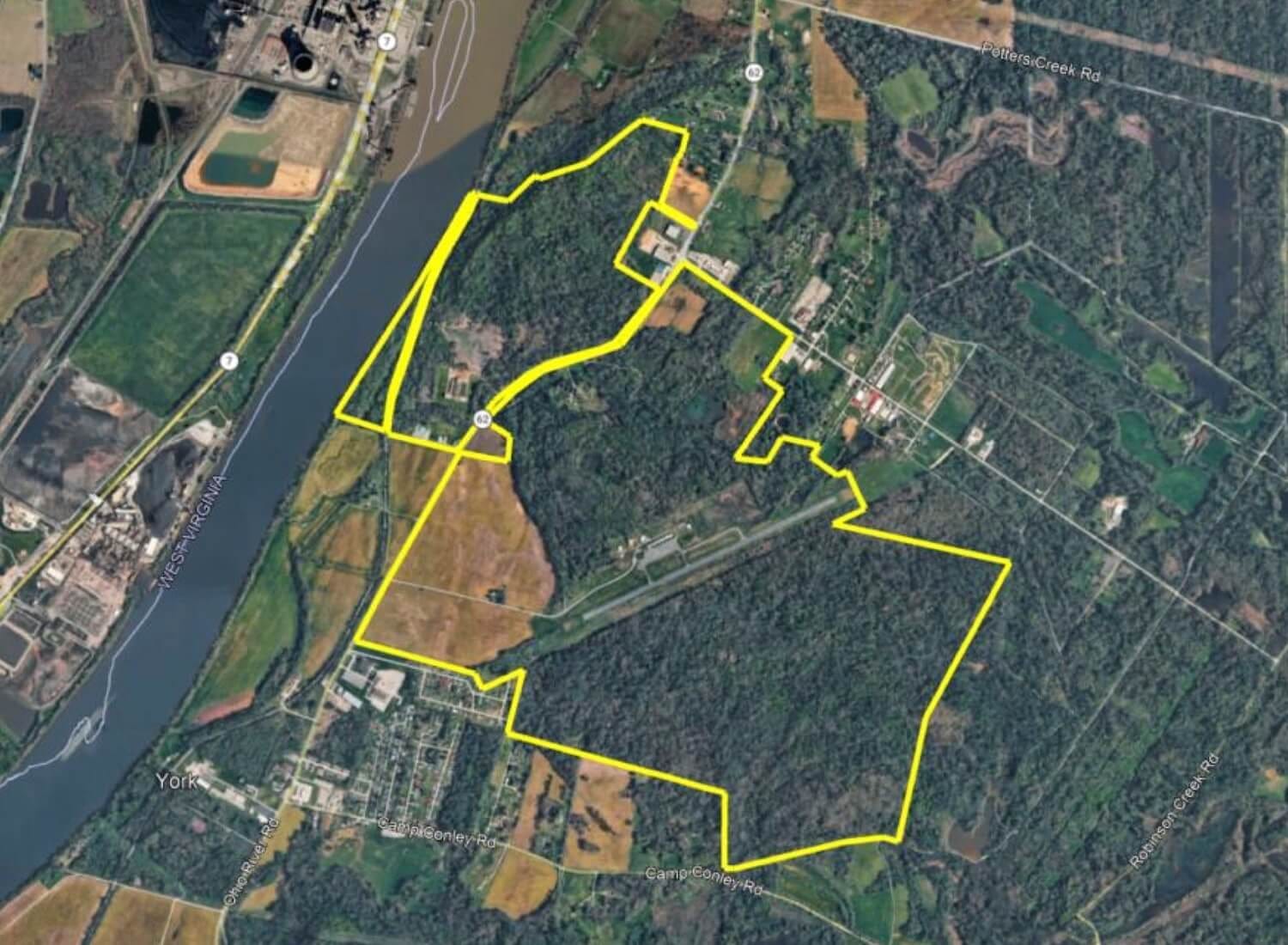
The Monarch campus will rise at 5533 Ohio River Road just north of Point Pleasant in Mason County, West Virginia.
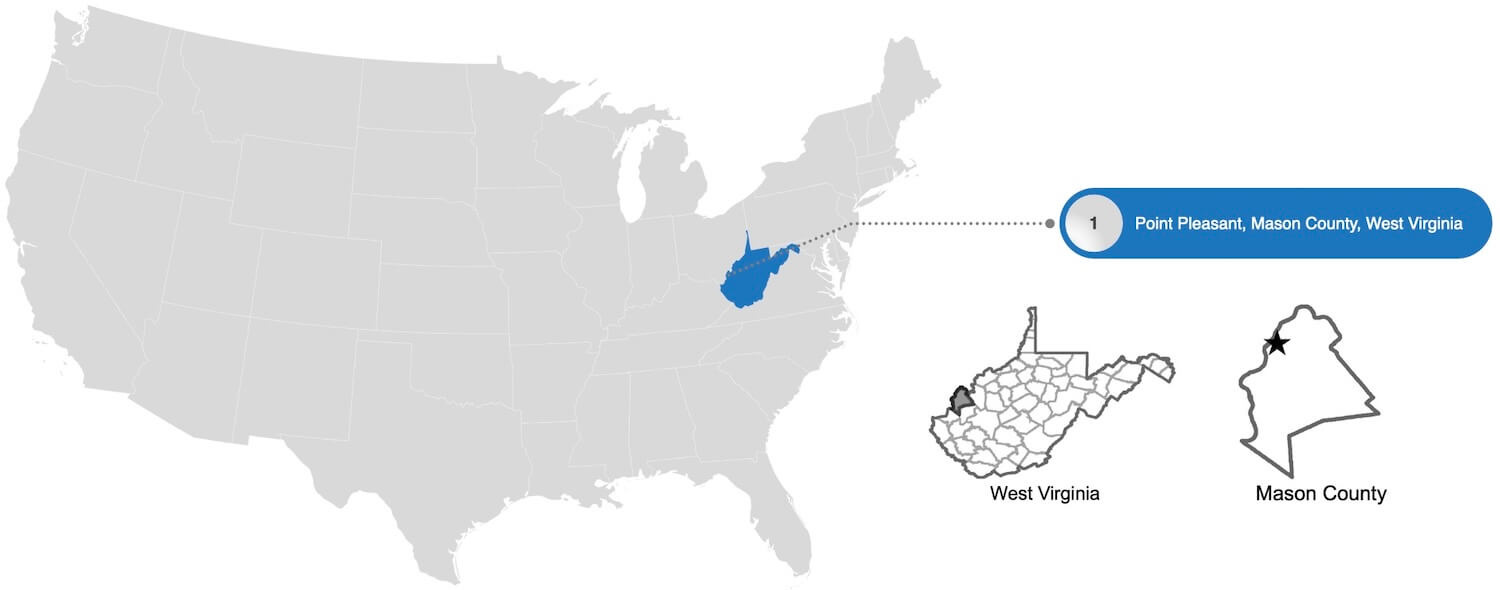
It is situated on the banks of the Ohio River — at the state’s western edge, where the river forms the line between West Virginia and Ohio.
Most of the AI infrastructure Measured AI has covered is, underneath, a story about ownership. At AWS’s New Carlisle campus, Amazon owns the land, the buildings, the chips, and the network, and points all of it at one customer. At xAI’s Colossus cluster, the company went a step further and built its own grid rather than wait on the utility. Monarch is the third corner of that triangle, and the most counterintuitive: Microsoft owns nothing.
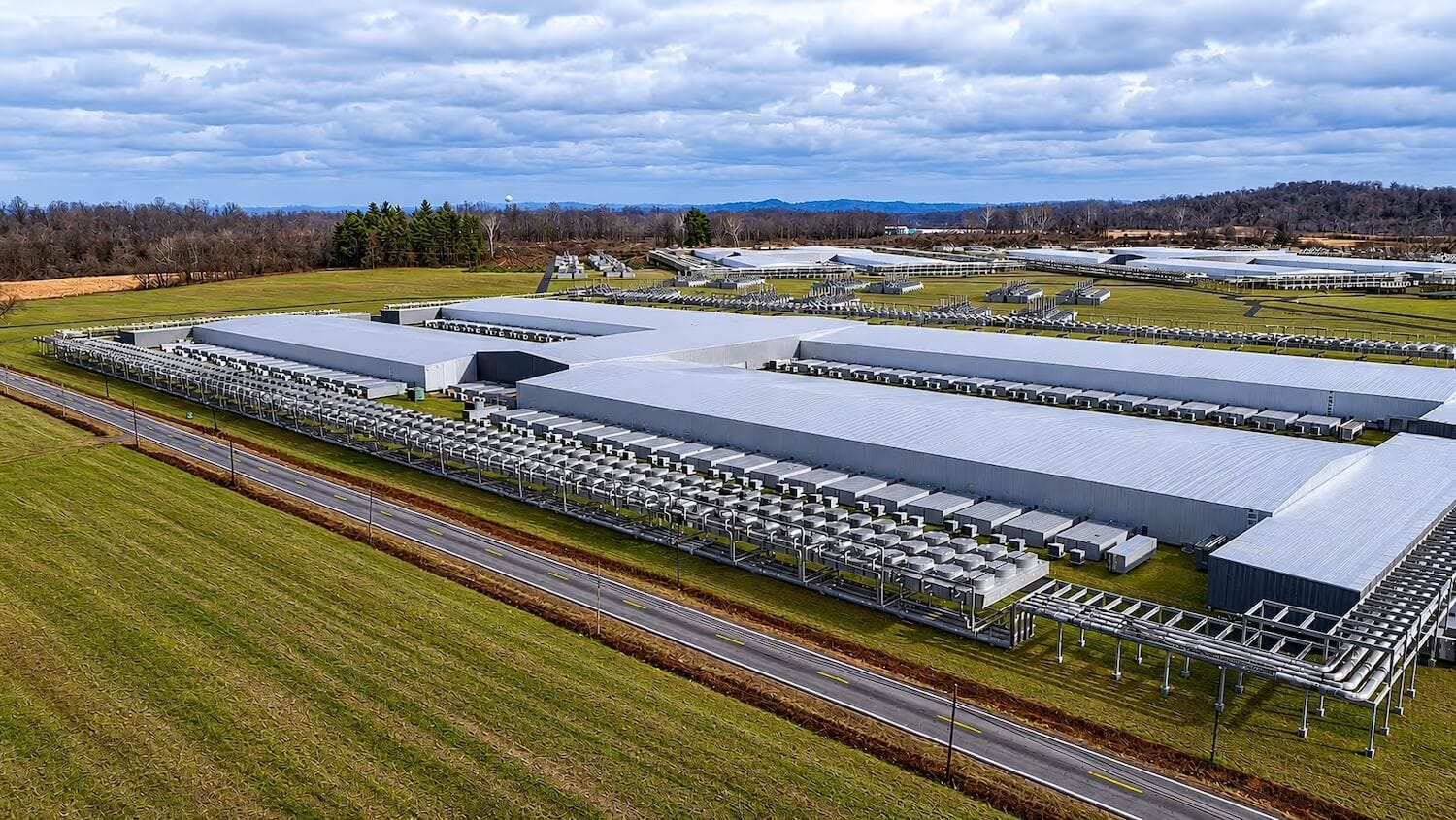
Microsoft has signed a non-binding letter of intent to rent the entire 1.35 GW first phase of an off-grid, gas-powered campus that Nscale will build, own, and operate. It is the hyperscaler bet inverted — not vertical integration, but near-total outsourcing of the stack, with the grid, the gas plant, the buildings, and the GPUs all carried by someone else.
Source: Nscale.
The Inversion — Outsourcing the Stack
Renting is not new for Microsoft; renting everything is the escalation. Microsoft’s head of business development and ventures, Jon Tinter, has described the company’s capacity strategy as a blend of “owned datacenters, leased facilities, and strategic collaborations” — three legs, of which Monarch is the purest expression of the third. The scale of that third leg is already substantial.
Nscale has become Microsoft’s largest single GPU-leasing counterparty, at around $46 billion in commitments:
The Monarch LOI is incremental to that ~$46 billion, not part of it.
Why rent the whole stack rather than build it? The deal structure and what is being built show Microsoft’s rationale:
The LOI is non-binding. Microsoft has committed to nothing it cannot step away from, while the capital at risk in the build — the $20 billion-plus Nscale must spend, the gas plant, the permits — sits on Nscale’s balance sheet, partly backstopped by guarantees from NVIDIA. This is an asymmetric structure: Microsoft holds an option on the capacity it reserved, and Nscale and its financiers hold the construction risk.
Renting buys geography and time. Monarch places NVIDIA’s newest generation Vera Rubin systems in a jurisdiction engineered for speed-to-power — cheap Appalachian gas, a statute that lets the campus skip the grid — without consuming Microsoft’s own interconnection queue or self-build pipeline.
Renting keeps a large liability off Microsoft’s own books. The Monarch power plant’s potential-to-emit runs to 11 million tons of CO2-equivalent per year, and the facility is a major source under federal Prevention of Significant Deterioration rules — a permitting posture that has already drawn organized local opposition. That permitted ceiling alone is roughly 77 times Microsoft’s entire FY24 direct-emissions (Scope 1) footprint. Microsoft pulls data centers it leases and operates into its own Scope 1 and 2; Monarch’s combustion stays out of both, because Nscale owns and operates the generation and sells compute as a service. That leaves the plant-level exposure and the regulatory fight on Nscale’s ledger — but not the carbon itself, which still lands in Microsoft’s Scope 3, the column its carbon-negative pledge also covers.
The Anchor — One Tenant, the Whole Phase
The clearest sign of how committed the two sides are is also the clearest risk. Microsoft’s 1.35 GW equals Nscale’s entire marketed Phase 1 compute — the sellable output of the ~2 GW of generation coming online by 2028 — all of it underwritten by one anchor customer rather than a diversified roster of hyperscalers. Before Nscale acquired the site, Amazon, Meta, and Fluidstack were all reported to have looked at Monarch; none transacted. The compute Microsoft has reserved will be delivered, per the LOI, as “multi-year compute services, alongside a long-term data center lease structure,” in multiple tranches beginning in late 2027.
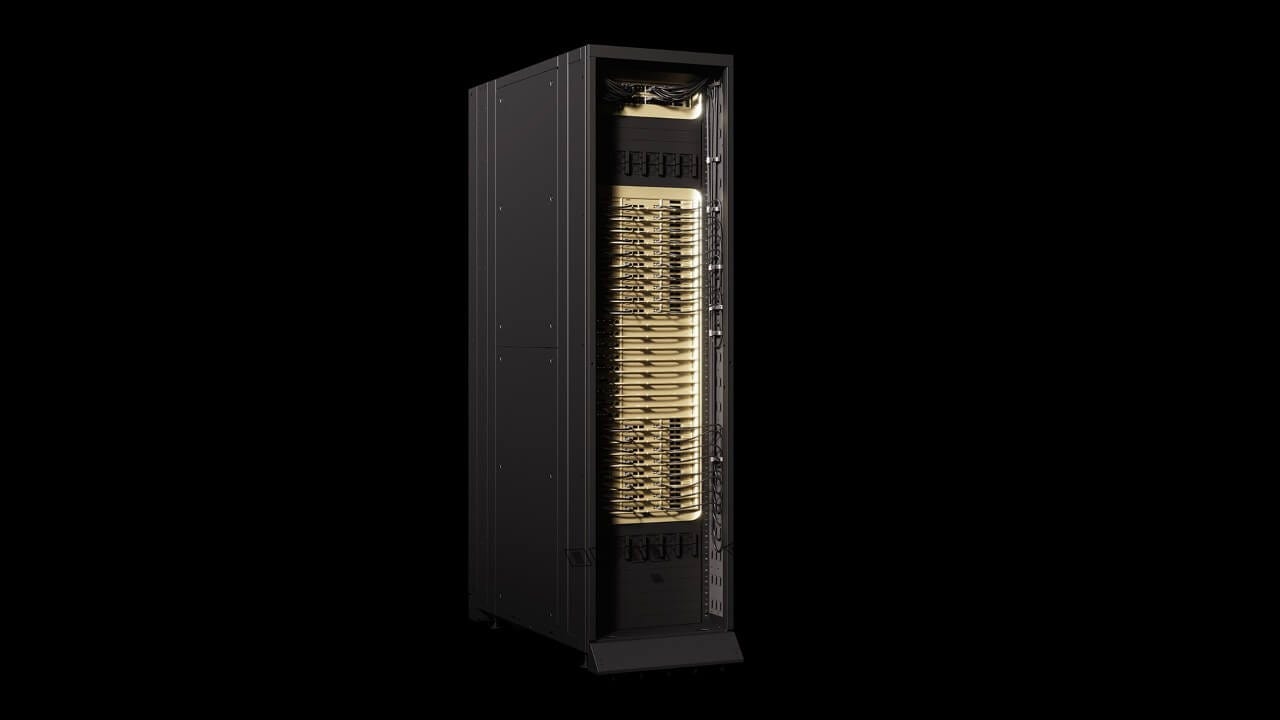
Microsoft also claims to be the first hyperscaler to “power on” a Vera Rubin NVL72 system, which makes Monarch a showcase as much as a supply line.
Source: NVIDIA.
The tenant explains the demand. The owner explains the build — and that is a stranger story.
II. The Neocloud and the Deal: Nscale Owns Everything
Behind a hyperscaler that owns nothing stands a neocloud that owns everything. Nscale is a vertically integrated owner-operator: it builds and runs the underlying data center, supplies the GPUs and the software orchestration layer on top, and sells the resulting compute capacity. That integration is the pitch — one counterparty for land, power, hardware, and software — and it is why a company few in the industry could have named a year ago is now Microsoft’s largest GPU-leasing partner.
Nscale — One Owner, From Land to Orchestration
Monarch is Nscale’s flagship, and it arrived by acquisition rather than origination. In mid-March 2026, announced at GTC, Nscale agreed to buy American Intelligence & Power Corporation (AIP Corp) — the developer that held the up to 2,250-acre campus, its permits, and its power agreements — and folded AIP and its backers into a new “Nscale Energy & Power” division headquartered in Houston, Texas.
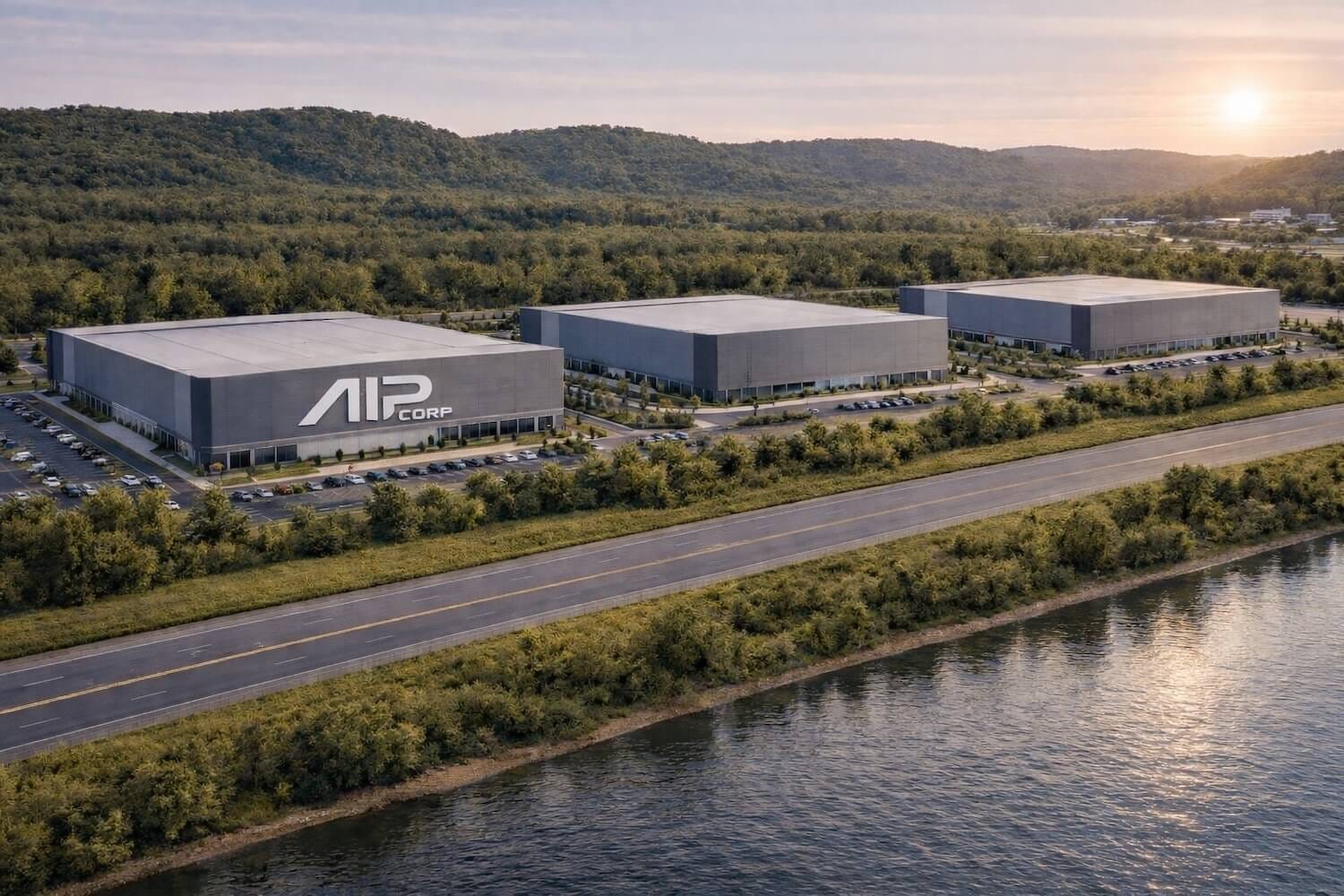
Rendering of AIP Corp’s prior data center design for the Monarch Cloud Campus in West Virginia. Source: AIP Corp.
AIP itself was a new joint venture of two energy and venture firms, Fidelis New Energy and 8090 Industries, with the project backed by LuminArx Capital Management. The campus traces back to “more than three years of development led by Fidelis.” That development began as something else entirely — a hydrogen venture, the “Mountaineer GigaSystem,” that drew West Virginia economic-development support back in July 2023, before a May 2026 filing recorded the project’s shift “from hydrogen production to the immediate establishment of advanced computing data centers.”
Ultimately, a hydrogen developer’s site became a neocloud’s flagship AI data center campus, and because the land was undeveloped, Nscale must now pay to build it — the “more than $20 billion” of planned capital investment it markets.
The Money — Series C and the NVIDIA Backstop
Nscale’s ability to make that commitment rests on a capital base assembled at remarkable speed and on a familiar backer. The company closed a $2 billion Series C in March 2026 at a $14.6 billion valuation — co-led by Aker ASA and 8090, the same 8090 that is half of the AIP venture that originated Monarch. This Series C round was billed as the largest such round in European history, with investments from Astra Capital Management, Citadel, Dell, Jane Street, Lenovo, Linden Advisors, Nokia, NVIDIA, and Point72.
NVIDIA sits at the center of the structure: it is Nscale’s largest preferred shareholder, with a stake of “more than 10%,” and it has separately agreed to guarantee up to $860 million of Nscale’s lease obligations for a 240 MW AI data center in Ward County, Texas. As 8090’s co-founder put it, “AI leadership is not a software problem. It is an energy and infrastructure problem.”
That structure is the neocloud model in miniature, and the model is the reason Monarch matters beyond Microsoft. Nscale is one of a cohort of “neoclouds” — GPU-rental specialists including CoreWeave, Crusoe, Core Scientific, Lambda, and Nebius — in a sector that, per Synergy Research, exited 2025 at roughly a $36 billion annual run-rate — fourth-quarter revenue of $9 billion, up 223% year over year.
The economics are capital-dominated, with GPU lifecycles around four years, and they are de-risked by exactly the kind of long anchor-tenant contract and hyperscaler backstop on display here. The “Microsoft-leases-from-a-neocloud” arrangement is not a one-off; Monarch is the template at its most leveraged, which is what makes its single piece of physical infrastructure — the power plant — the part worth understanding in detail.
III. Power Is the Product: The Behind-the-Meter Gas Microgrid
What Microsoft is really buying at Monarch is not real estate or even chips — it is power, delivered faster than any grid could promise. The campus generates all of its own electricity on-site and, by design, draws nothing from the public grid. Everything else at Monarch is downstream of that one choice.
Islanded by Law — HB 2014 and Speed-to-Power
Monarch is a behind-the-meter, islanded natural-gas microgrid that “generates all of its own power on-site, fully independent of the public electric grid.” That is not just an engineering decision; it is a legal one. West Virginia’s House Bill 2014, the “Power Generation and Consumption Act,” lets the campus operate as “its own islanded utility with special microgrid status,” and the air-permit application states plainly that the plant “will not be connected or capable of selling electricity to the local utility power grid.” There is no conventional interconnection.
As a certified microgrid, the campus is exempt from Public Service Commission jurisdiction over rates, certificates of convenience and necessity, and conditions of service, and from net-metering and interconnection standards; it may export no more than 10% of what it generates, and only to the wholesale market. A future grid tie-in for that capped export is contemplated, but the campus runs solely on the microgrid at launch.
The point of all of this is time. The developers cast islanded-utility status as a way to “significantly reduce the time to power,” and have marketed the site as “America’s first AI-dedicated, unregulated electric utility built to serve hyperscalers faster than the grid.” It is the same logic Measured AI traced in its Grid Bypass analysis — when interconnection queues run 4–7 years, on-site generation is not an ideological choice but a mathematical one — taken to its endpoint. Monarch is not on the grid. By law, it is its own grid.
The Generation Fleet — 864 Engines, 2.16 GW
The plant that delivers this is built from reciprocating engines, not turbines. The WVDEP air permit specifies 864 Caterpillar G3520K natural-gas reciprocating internal combustion engines, each driving a 2.5 MW generator, for 2.16 GW installed.
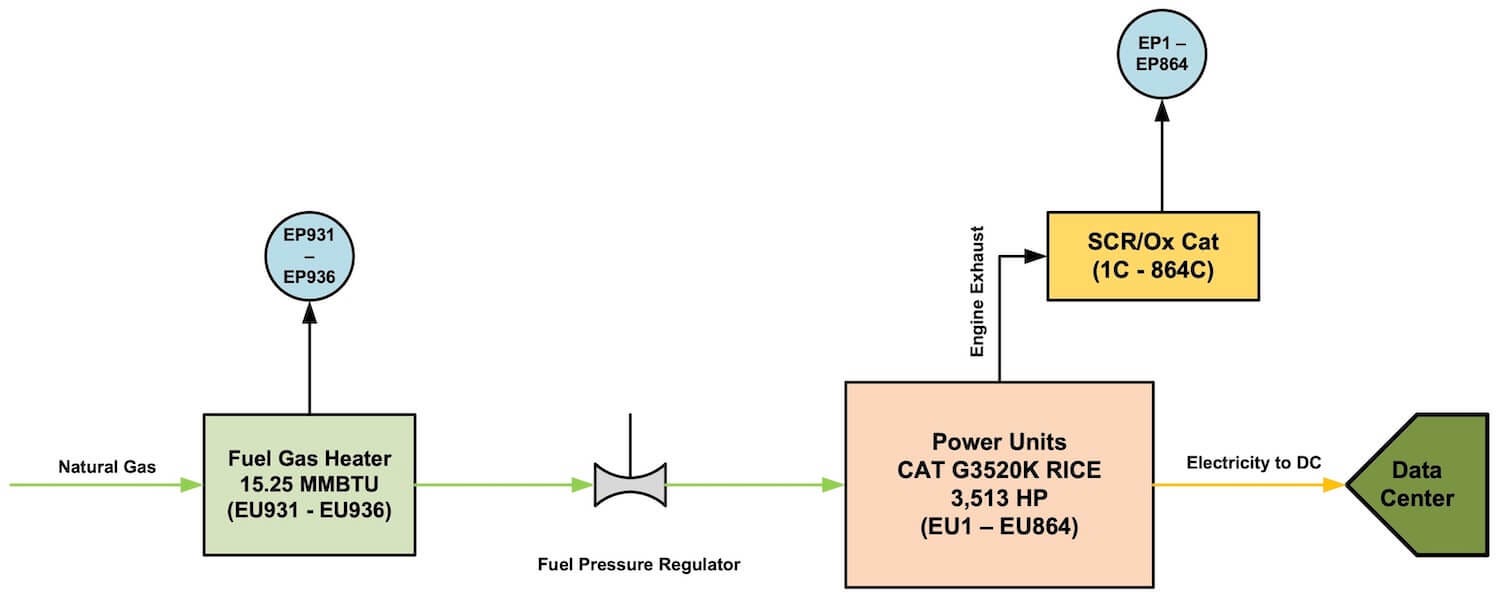
The prime-power train, one of 864 identical units: pipeline gas is preheated and pressure-regulated, burned in a Caterpillar G3520K genset, and its exhaust scrubbed by a dedicated SCR and oxidation catalyst before release. Source: WVDEP.
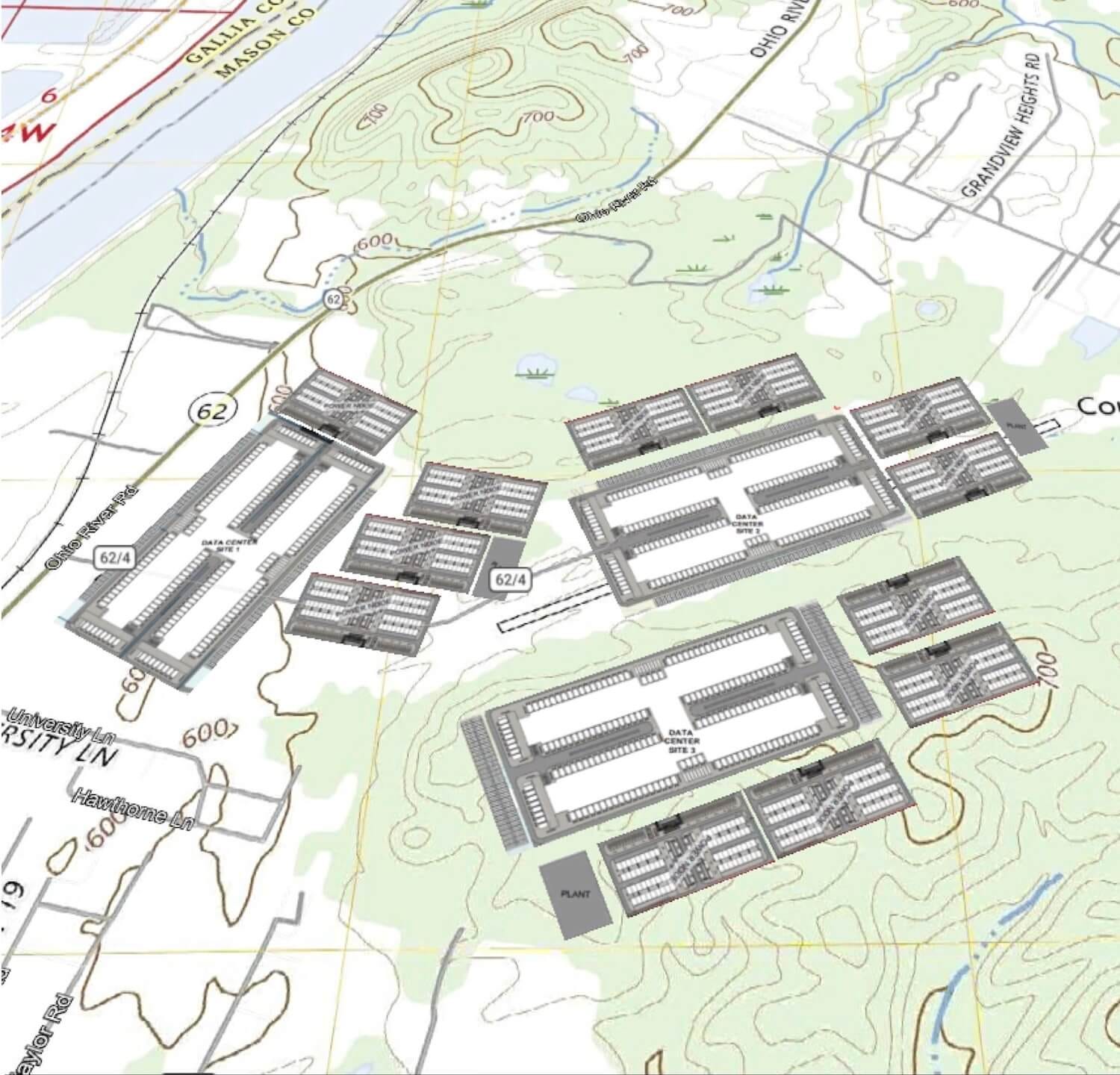
They sit on 12 power nodes of 72 engines each — four nodes powering each of the three “H”-shaped data center buildings, or 288 engines per data center building.
Each power node = 72 engines = 180 MW installed (eight engine halls of nine engines).
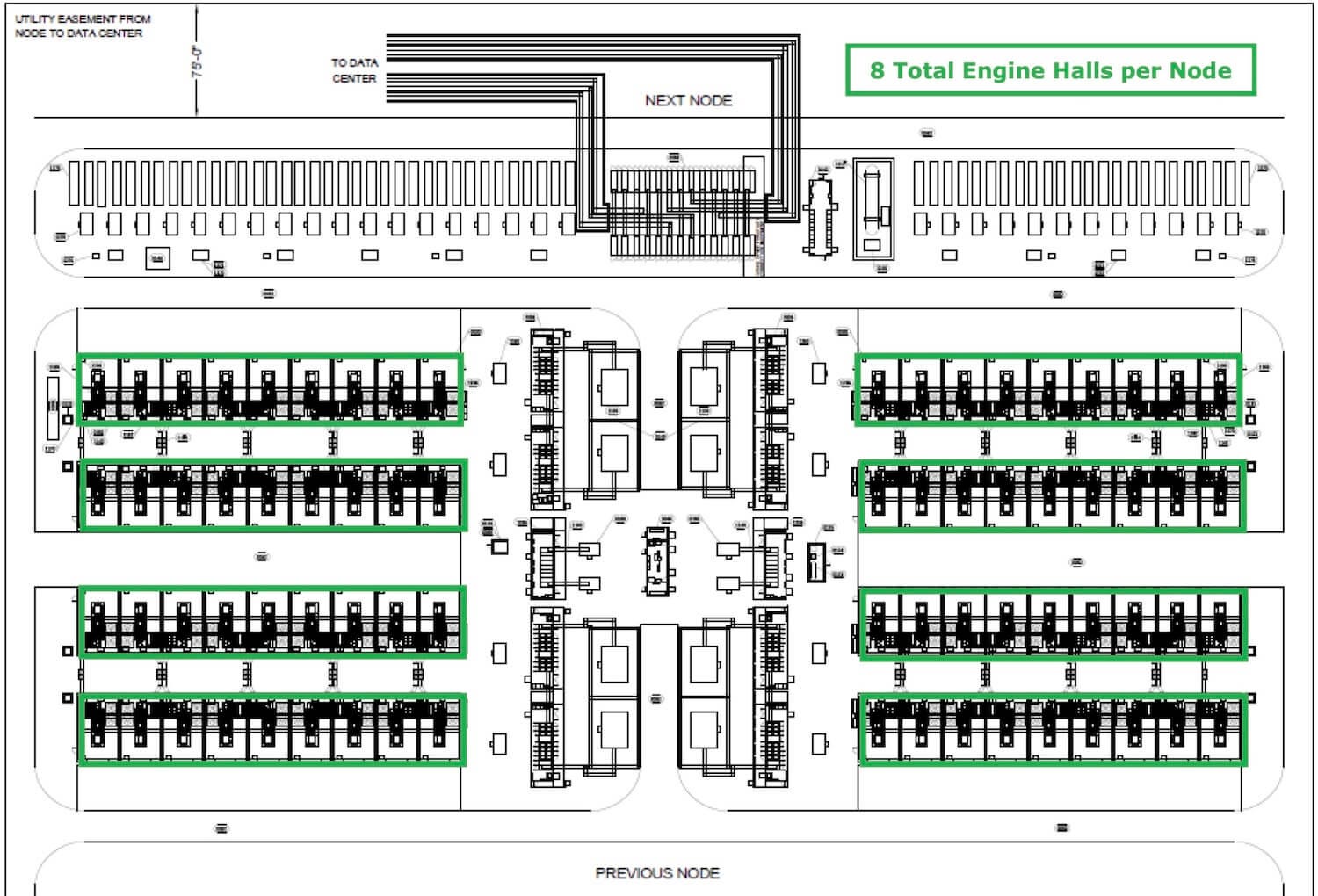
One of the 12 power nodes: eight engine halls of nine engines each (72 gensets, ~180 MW), arrayed around central electrical and mechanical equipment and routed toward the data center and the adjacent nodes. Source: WVDEP.
Total site peak demand is approximately 1.8 GW — about 0.36 GW below the 2.16 GW installed, the ~17% headroom built into the fleet.
Caterpillar agreed to supply 2 GW of fast-response G3500 series gas gensets for the initial phase, with deliveries scheduled September 2026 through August 2027 via dealer Boyd CAT and vendor financing from Caterpillar Financial.
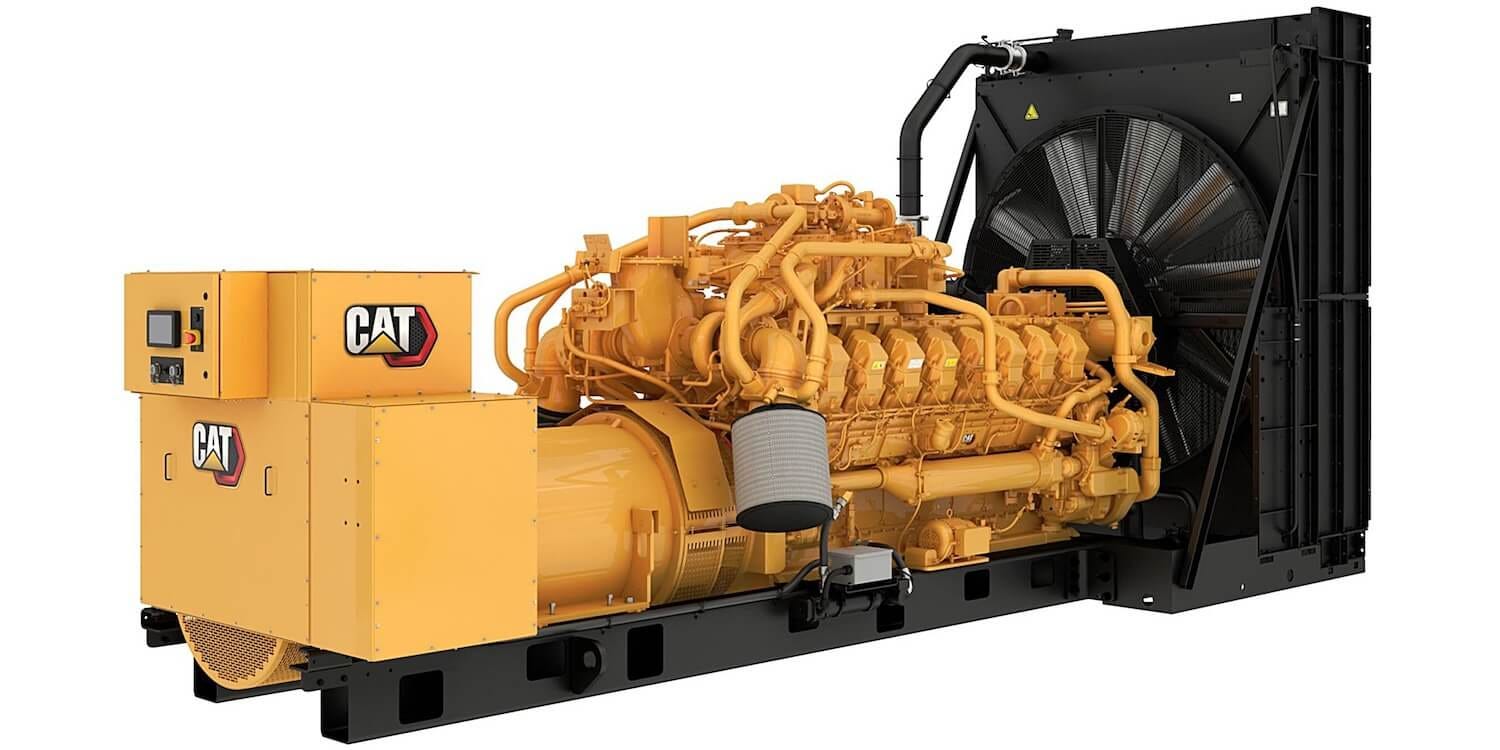
Source: Caterpillar.
Caterpillar notes the units can “ramp from zero to full load in approximately seven seconds.” That speed matters because AI training does not draw power smoothly.
Battery Storage — Smoothing the AI Load
To this end, the gensets are paired with battery energy storage to manage the rapid load fluctuations associated with AI workloads, with battery power delivery expected to begin in 2026. For this off-grid data center campus, battery storage does two distinct jobs — riding through outages and smoothing the load before it ever reaches the generation.
That second job — load smoothing — is the key advantage of using battery energy storage for AI data centers, and it is the rationale most specific to a data center campus like Monarch. Synchronized AI training does not draw power evenly: hundreds of thousands of GPUs step in and out of computation in lockstep, producing extreme power jitter with 10–20 MW shifts several times per second. A battery energy storage system wired in parallel counter-cycles against that load, discharging on the spikes and charging on the dips so the source sees a smooth draw.
Backup and Emissions — The Major-Source Footprint
Behind the prime fleet sits a separate emergency tier and a large emissions footprint. This backup power equipment includes 48 Caterpillar C175-20 diesel emergency engines (16 per data center building), 12 Generac SD-1000 diesel units, six Clarke diesel fire-water-pump engines, and six natural-gas fuel-gas heaters.
The emergency and fire-pump units are modeled at 100 hours per year, while the prime fleet’s potential emissions assume 8,725 operating hours annually. Each prime engine carries a clean-emission module: selective catalytic reduction, stated to cut nitrogen oxides by 98%, paired with an oxidation catalyst cutting carbon monoxide 98% and formaldehyde 95%.
Each of the 864 reciprocating engines vents through its own stack, but the stacks are grouped tightly in twos and fours between the engine halls, so they are viewed as roughly 240 merged exhaust points rather than 864 — a distributed array of hundreds of small stacks.
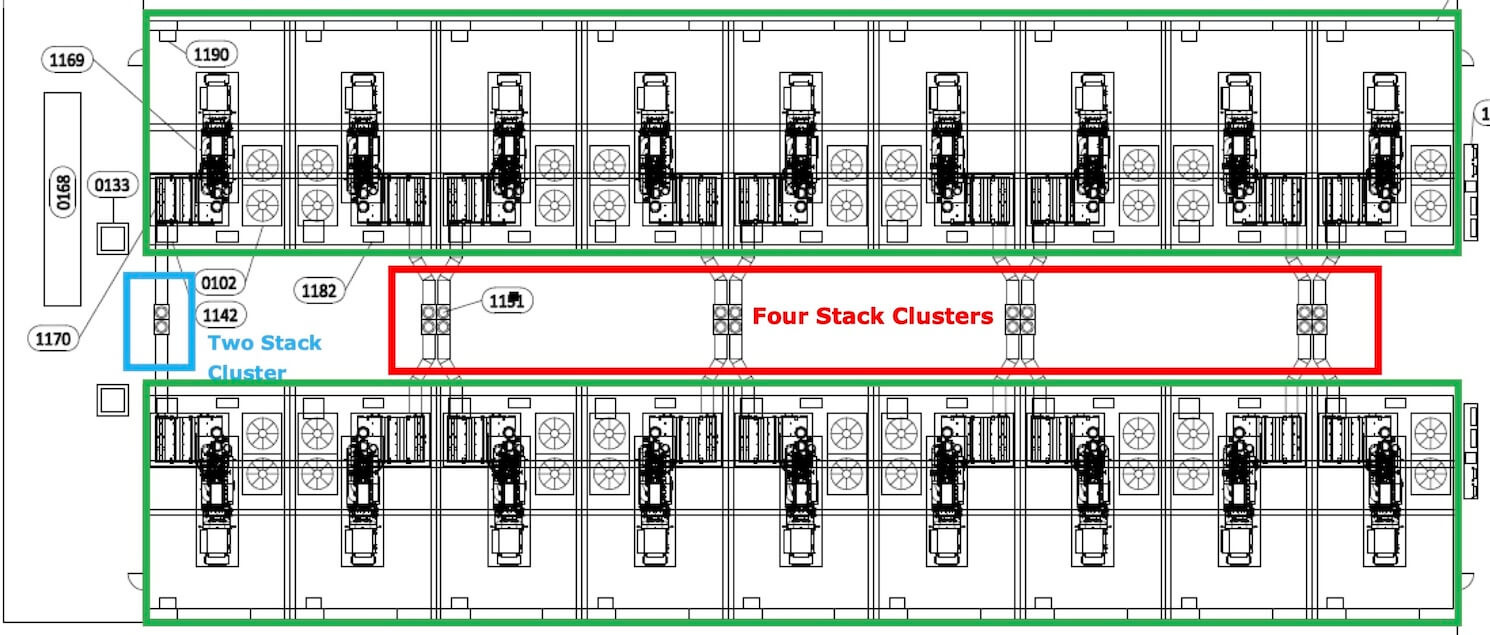
Paired engine halls in close-up: the exhaust stacks are co-located in two- and four-stack clusters — the basis for the permit’s ~240 merged-stack sources. Source: WVDEP.
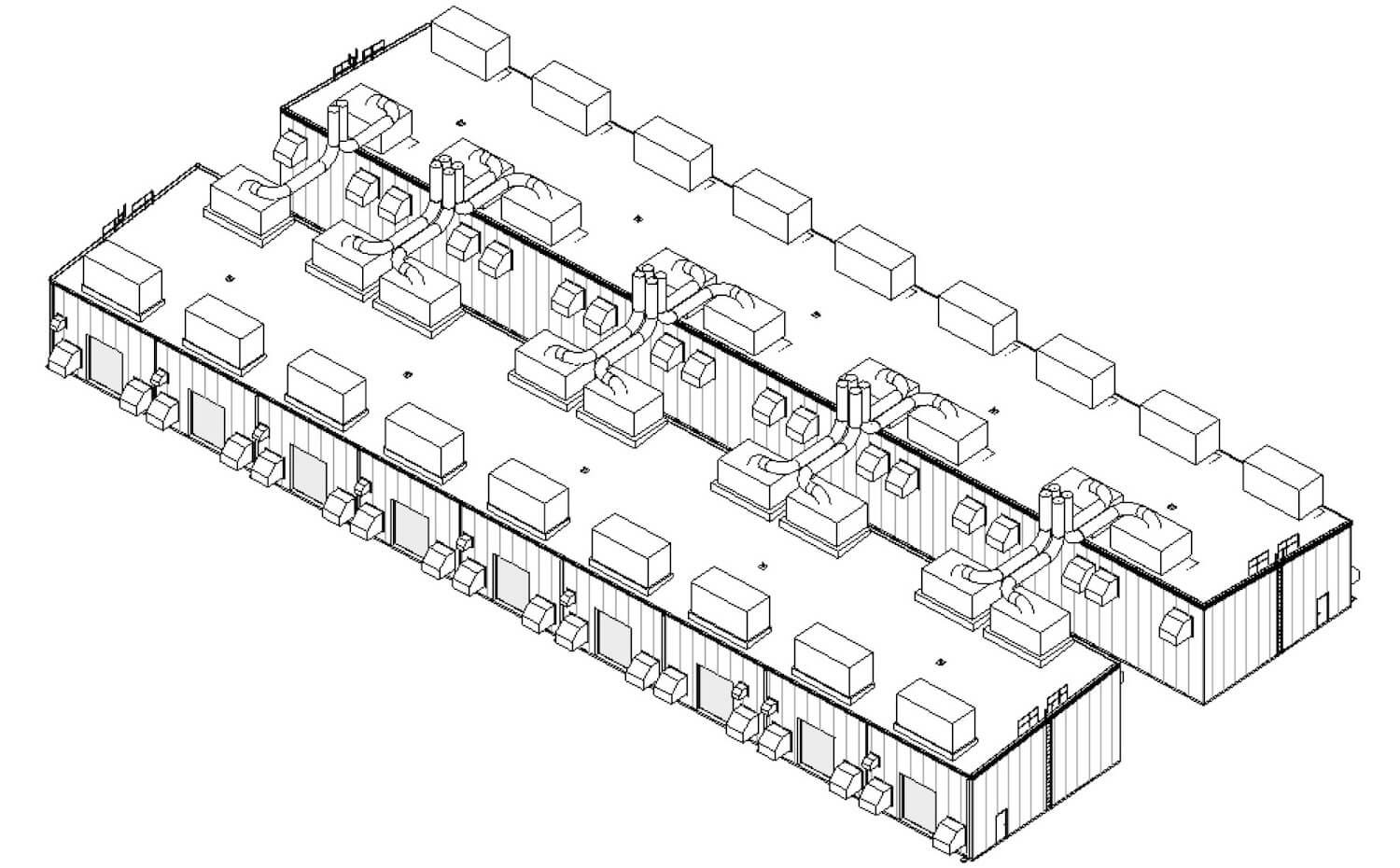
The power node in three dimensions: paired engine halls lined with gensets, rooftop equipment, and the central exhaust stacks rising above the roofline. Source: WVDEP.
Even so, the totals are those of a major source. Facility-wide potential-to-emit is NOx 506.01, CO 1,043.73, SO2 47.79, PM2.5 38.85, and 619.76 tons per year of hazardous air pollutants — the HAP figure formaldehyde-dominated, enough to make the site a major HAP source — with volatile organic compounds stated two ways (382.91 tpy on one basis, carried as 899.00 tpy on the ozone-precursor basis used for PSD) and greenhouse gases at 11 million tons per year of CO2-equivalent.
Notably, the enabling law imposes no obligation to clean any of this up at the source: HB 2014 removed the requirement that microgrid power come from renewables, and the only emissions-offset plan Nscale describes — carbon sequestration — is aspirational, with no tonnage, timeline, or operator attached.
The Gas Supply — The Prosperity Line
A gas plant this large needs a dedicated fuel artery, and Monarch’s is a new lateral with an old trunk behind it. The lateral is Hope Gas’s “Prosperity Line,” announced March 3, 2026 alongside West Virginia Governor Patrick Morrisey. Hope Gas, the regulated West Virginia utility, will invest in and operate it; the permit names Monarch Cloud Campus, LLC as applicant and an AIP affiliate, M2 WV Midstream, LLC, as facility company.
The first phase is a 30-mile line running from Putnam County’s Southern Terminus north into Mason County’s Northern Terminus to the plant just north of Point Pleasant, following the corridor of West Virginia Route 62, the Ohio River, and the CSX railroad.
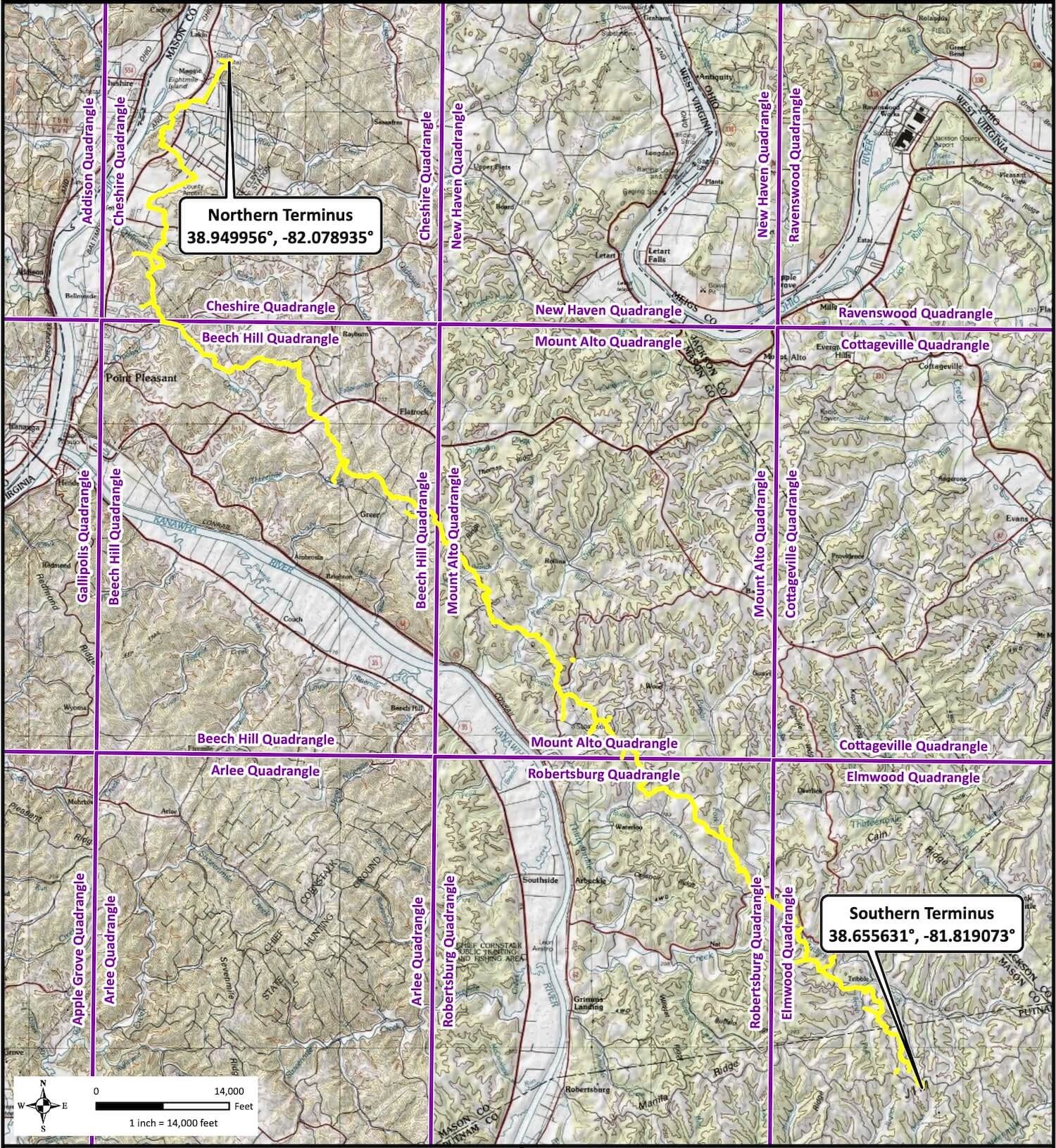
Source: WVDEP.
The permit authorizes both a 24-inch and a 30-inch line — routine for a system that pairs a larger trunk with a smaller delivery lateral — across a 556.5-acre earth-disturbance corridor. It is a $250 million Hope Gas investment supporting roughly 600 building-trades jobs, built by open-trench construction with dam-and-pump stream crossings, begun in April 2026 and targeted for completion by the end of 2026.
Where the gas ultimately comes from has not been announced publicly. Public statements stop at Appalachian Marcellus-Utica gas sourced from West Virginia. The most likely upstream interconnect is a tap on Columbia Gas Transmission’s Mountaineer XPress (MXP) natural-gas pipeline, the FERC-certificated interstate line whose 164.5-mile, 36-inch mainline carries about 2.66 Bcf/d and runs directly through both Mason and Putnam Counties.
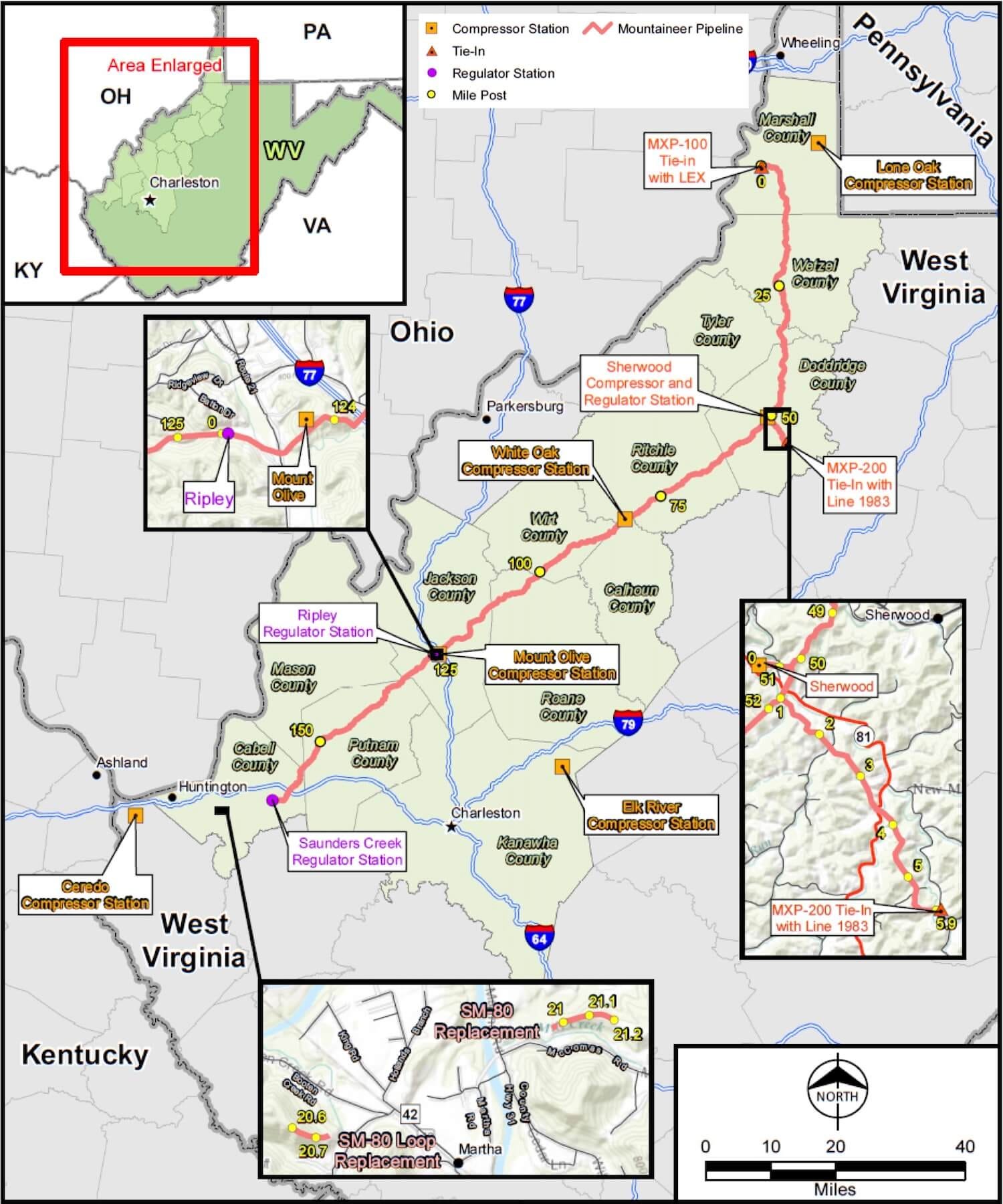
Source: FERC.
Three things point to MXP:
Geography: MXP is the only high-capacity interstate line WVDEP places in both counties.
Pressure: Gas arrives at the plant at transmission-class ~1,200–1,400 psig, consistent with an interstate tap rather than a distribution main.
Capacity: A ~2 GW plant burns on the order of 0.3–0.4 Bcf/d, a small fraction of MXP’s throughput, though the line is roughly 98% subscribed, so Monarch would run on a transportation contract.
At the Monarch plant, gas is stepped down from that transmission pressure to under 150 psig at three pressure-letdown stations, each preheated by the six fuel-gas heaters, before feeding the 864 engines.
The plant is the campus’s heart; the buildings around it are where the plan becomes visible on the ground.
IV. Site and Build: The Campus in Acres and Phases
On the ground, the wager is about 1,100 acres of West Virginia farmland.
Source: WVDEP.
The buildout is phased: 2 GW online by the first half of 2028, rising to roughly 8 GW by 2031. The building shape is the developer’s AI data center design, not Microsoft’s. The site sits at 5533 Ohio River Road in Mason County, along West Virginia Route 62 about 5.5 miles north of Point Pleasant, with the Ohio River forming the West Virginia–Ohio line just to the west.
The Site — Greenfield Acres, Built in Phases
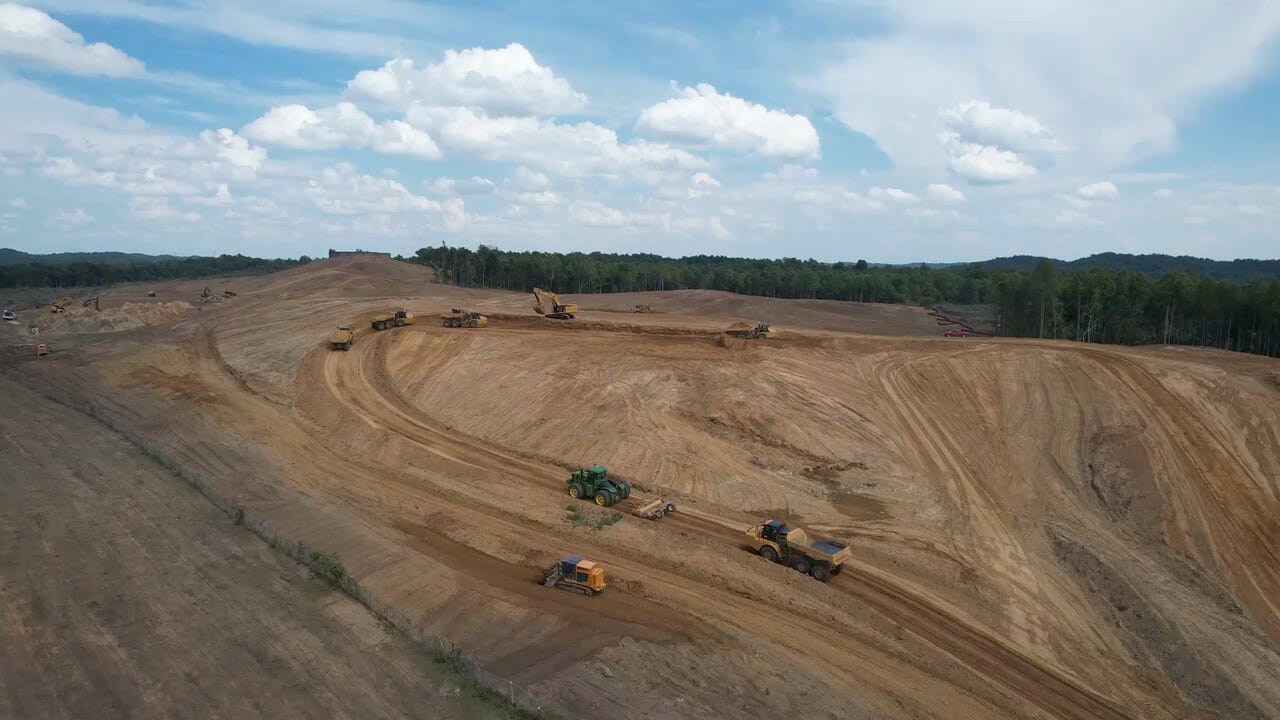
Company sources market a site of “up to 2,250 acres” — which is also the maximum parcel allowed under West Virginia’s data center statute — while the air-quality permit covers only an “approximate 1,100-acre site.” Either way it is one of the largest available AI data center sites in the country, and it is greenfield: there is nothing there to retrofit.
Construction is underway — the same May 5, 2026 inspection that logged “large dust clouds” came amid dust, silt-fence, and flooding complaints across late April and May 2026.
Source: WVDEP.
The on-site power plant’s pad is the furthest along: “Power Generation Pad South,” an 80.8-acre pad, was filed in January and issued in March 2026.
The “H” — Wings Around a Core, by the Developer
The defining feature of the campus is a building shape. Each of the three data centers is built as four wings and a central core forming an “H.” These are the same wings that the 12 power nodes feed, four per building.
Source: WVDEP.
Each of the three data center buildings comprises ~1.7 million square feet of built area, for a total of ~5 million square feet of built data center area across the campus. Each of the four wings requires nominally 150 MW at peak, or roughly 600 MW per data center building.
The “H” configuration is a purpose-built-for-AI geometry — repeatable high-density wings, each its own power-and-cooling domain, radiating off a shared core that concentrates networking, electrical distribution, and liquid-cooling plant — and it is a layout that can be commissioned one wing at a time.
It is also, pointedly, not Microsoft’s. Microsoft does not use a four-wings-plus-core “H” at any of its own Fairwater AI data centers, which solve the cluster problem differently — three large rectangular buildings in Wisconsin, two-story buildings in Atlanta. The “H” is the developer’s design.
V. Compute and Network: The Vera Rubin Cluster
The compute block is built entirely on NVIDIA Vera Rubin NVL72 systems — merchant hardware, bought off the shelf like the rest of the stack. The cleanest way to read the cluster is to climb it one rung at a time, from the chip to the campus.
The Chip and the Rack — Vera Rubin and the NVL72
Vera Rubin is the rack generation after Blackwell — “Vera” succeeds NVIDIA’s Grace CPU, “Rubin” the Blackwell GPU. The chips assemble into the NVL72 rack, which pairs 36 CPUs and 72 GPUs and is 100% liquid-cooled.
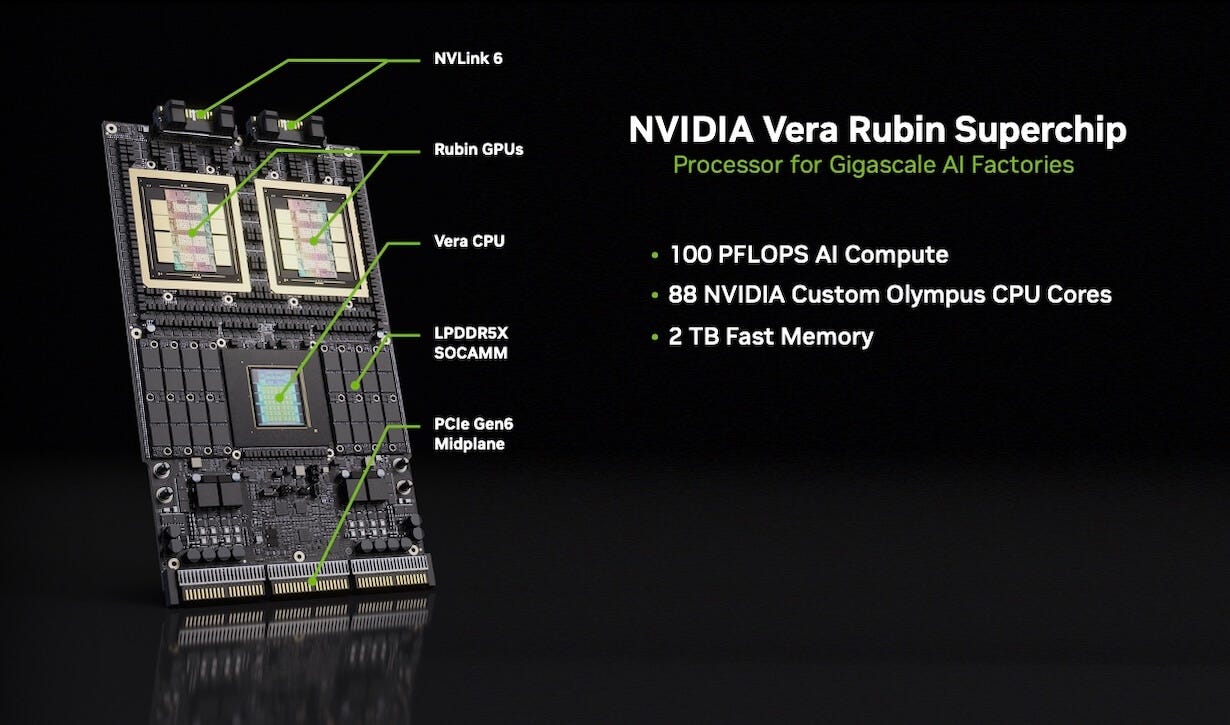
The Vera Rubin superchip pairs two Rubin GPUs with one Vera CPU on a single board; 36 of them make up the 72-GPU NVL72 rack. Source: NVIDIA.
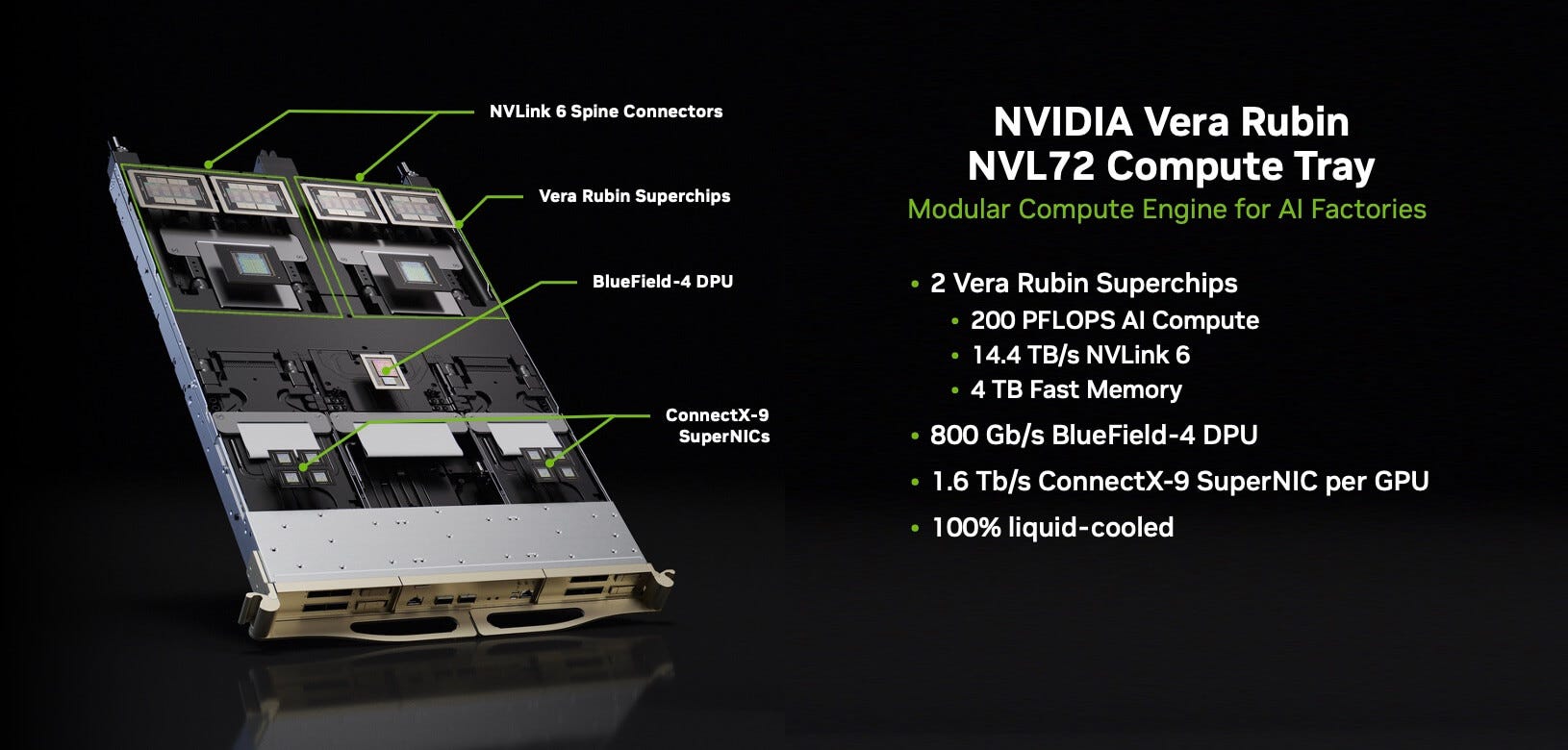
The 100%-liquid-cooled NVL72 compute tray: two Vera Rubin superchips on a cable-free modular assembly, the unit that stacks into the rack. Source: NVIDIA.
What matters for Monarch is not the spec sheet but the power it implies. NVL72 rack power runs 180–220 kW, up from 120–140 kW for the current GB200/GB300 generation — a 50–80% rise that flows straight through to coolant flow, distribution units, and the shift toward 800 VDC (volts direct current) power.
From Rack to Campus — Thousands of Racks, One Fabric
Stacked up, those racks are what the “H” exists to hold. Applying the generic 180–220 kW per rack to the capacity Microsoft reserved implies on the order of 6,000–7,500 NVL72 racks, since that capacity is marketed compute that carries cooling and distribution overhead. The reason to gather them into wings around a core is physical: an AI training run is one coherent job, and scale-up networks are bounded by copper connectivity distances, so keeping every hall within short reach of a shared networking spine is the whole game.
It is the same instinct behind Stargate housing a single cluster across eight connected buildings, and behind Microsoft’s own framing of a “singular AI supercomputer underpinned by a single, flat networking infrastructure.” Monarch’s four wings, fed by four power nodes and cooled as one closed loop, are that idea expressed in a single building.
VI. Cooling and Water: Closed-Loop, Fill-Once
The water story, like the gas plant, is engineered to defuse the one fight that could stall the campus. Monarch is built to consume almost no municipal water, a political choice as much as an engineering one: in a county where water capacity is already a live issue, the ability to promise that the data centers will not touch the drinking supply is worth as much as any efficiency number.
Cooling Architecture — Closed Loops, Chip to Air
Heat leaves Monarch through closed loops. The data centers run chilled-water plants that reject their heat to air through closed-circuit (dry) coolers rather than evaporative cooling towers, while the on-site gas engines shed heat through dry radiators. Because both reject to air, the water loops recirculate with no continuous evaporative makeup. Inside the halls, the Vera Rubin racks are themselves 100% liquid-cooled, so the building’s thermal design is liquid all the way from the chip to the heat-rejection plant. The cooling loops are closed-loop systems with minimal water makeup — a fill-once character rather than a continuous withdrawal.
The Water Posture — Zero Drinking Water, and the County
The headline claim is specific, and so is its fine print. Nscale states the cooling systems are closed-loop with zero drinking water consumption, promising that “Monarch will not use Mason County’s drinking water supply for cooling operations,” and the joint Microsoft announcement adds a “high-efficiency design that consumes less water with no impact on municipal water supply or residential users.” That zero applies to municipal and drinking water — not to all water: Fidelis’s own launch materials tout “industrial water access to enable large-scale operations,” so the campus does draw process water even as it avoids the public drinking supply.
The site drains toward a tributary of the Ohio River — the nearest surface water sits about 295 feet north of the site’s South pad — and falls inside both the Point Pleasant Water Works wellhead-protection area and the Mason County Public Service District’s Crab Creek source-water-protection area, in a watershed WVDEP has confirmed as impaired though with no Tier 3 streams. Meanwhile, local water infrastructure is already mobilizing around the project: the county has studied doubling the Lakin Water Treatment Plant’s capacity and identified five projects under a $68.3 million capital plan.
VII. Fiscal and the Law: What West Virginia Traded for the Wager
West Virginia didn’t just permit the owner-operator model — it wrote a fiscal regime around it, one that decides who can be charged for a plant the public will never own and bars the tax breaks data centers usually receive. The same law that lets Monarch island its power sets those terms.
That regime was a recruiting tool. West Virginia entered the AI build-out with almost no data center industry — a scattering of small facilities, none of them hyperscale — and set out to build one by statute. HB 2014’s own findings pitch the state as offering “the least restrictive regulatory environment in the Nation,” written against the “national security vulnerability” of so much American compute concentrated in Loudoun County, Virginia. Monarch, at up to 8 GW, is the largest project the effort has landed; Google has since bought land for a campus in neighboring Putnam County, and real estate developer Penzance has announced a roughly $4 billion campus in Berkeley County. The market is real but early, and every entrant carries the same power, permitting, and community-response risk Monarch does.
The Project Economics — Capex, Revenue, and Jobs
The economic case Nscale markets is large and, so far, projected rather than committed: more than $20 billion in planned capital investment, $80-plus million in new annual tax revenue (itemized as $40 million for Mason County schools, $9 million for county services and infrastructure, $23 million for statewide income-tax relief, and $8 million for water and power improvements), and thousands of temporary construction jobs plus hundreds of permanent operational roles in Phase 1.
Source: Nscale.
The Tax Treatment — No Holiday, No PILOT
Unusually, the project does not come with a property-tax holiday: under HB 2014, operators pay ad valorem real and personal property tax at the same millage as any other business, with no blanket exemption. What the law does bar is payments-in-lieu-of-taxes and tax-increment financing for the microgrid’s generation and distribution property — treatment available only where at least 75% of the output serves the data center load — under a special-valuation article that sunsets December 31, 2055.
Where a positive tax increment does arise, the statute splits it: 50% to the state Personal Income Tax Reduction Fund, 30% to the situs county, 10% to all counties per capita, and 5% each to an economic-enhancement fund and a grid-stabilization fund.
Ratepayer and Local Preemption — Insulation Both Ways
The law’s other half is about insulation — of the public from the project’s costs, and of the project from local control. West Virginia law has the state “occupy the whole field,” barring counties and municipalities from limiting a certified microgrid district or high-impact data center and exempting projects from local zoning and building-code enforcement. On the cost side, utility customers outside the district “shall not bear any construction or operational costs” of utility property built solely to serve inside it — the statutory basis for Nscale’s claim that “state law prohibits passing any project costs on to ratepayers.” It is a regime built to move fast and to keep the public ledger clean, which is also why the only friction left is regulatory.
VIII. What to Watch

Source: Nscale.
Monarch is, for now, a marketed gigawatt and a greenfield with dust on it. The next two years will show whether the hyperscaler-owns-nothing model holds. The markers, roughly in order:
Caterpillar genset deliveries — September 2026 through August 2027. The 2 GW of fast-response gas engines are the long-pole item; the delivery window is the real schedule for first power.
The Prosperity Line — main line targeted for completion by the end of 2026. No gas, no plant; watch for final WVDEP action on the still-pending WVR312628 permit.
Microsoft’s first tranche — late 2027. The non-binding LOI converts to reality (or doesn’t) when the first Vera Rubin capacity is actually delivered and taken.
2 GW online by the first half of 2028; roughly 8 GW by 2031. The phasing targets that turn a single anchor lease into a flagship campus.
Measured AI provides institutional-grade analysis of the physical infrastructure powering AI data centers. For access to our full research library, regulatory intelligence, and weekly briefings, visit MeasuredAI.com.
Brave LEO AI adds:
Nscale is backed by a syndicate of strategic and financial investors, with Nvidia, Dell Technologies, Nokia, Aker ASA, and 8090 Industries serving as key backers for its global operations, including its Monarch Compute Campus in West Virginia.
The company’s broader investor base includes:
Financial Institutions & Asset Managers: Goldman Sachs, J.P. Morgan, Morgan Stanley, Bank of America, Blue Owl Capital, Citadel, Point72, G Squared, 10x Capital, and Linden Advisors.
Technology & Industrial Partners: Dell Technologies, Nvidia, Nokia, and Lenovo.
Other Strategic Investors: 8090 Industries, Aker ASA, Fidelity Management & Research, and Astra Capital Management.
For its specific West Virginia project, Nscale partnered with Fidelis New Energy and 8090 Industries through the acquisition of American Intelligence & Power Corp. (AIPCorp)**. Microsoft also signed a letter of intent to provide 1.35 GW of compute capacity at the site, marking a major commercial anchor for the development.