

Meta's Prometheus and Google's Central Ohio AI Cluster: Rivals Across the Road
Two of the largest AI-capable data center footprints in the U.S. sit across Beech Road in New Albany — a primer on the campuses, accelerators, power, and grid behind 1 GW each by 2026.

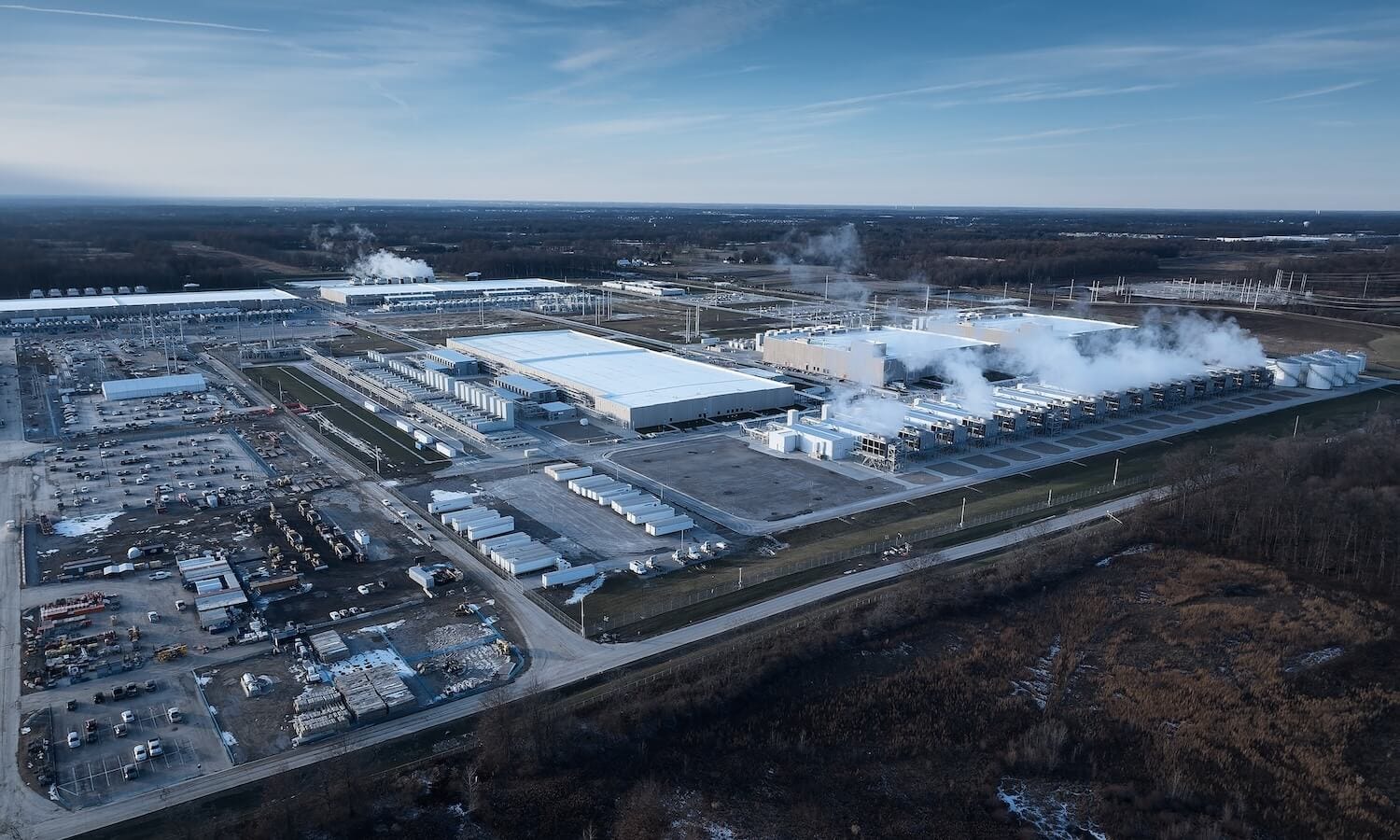
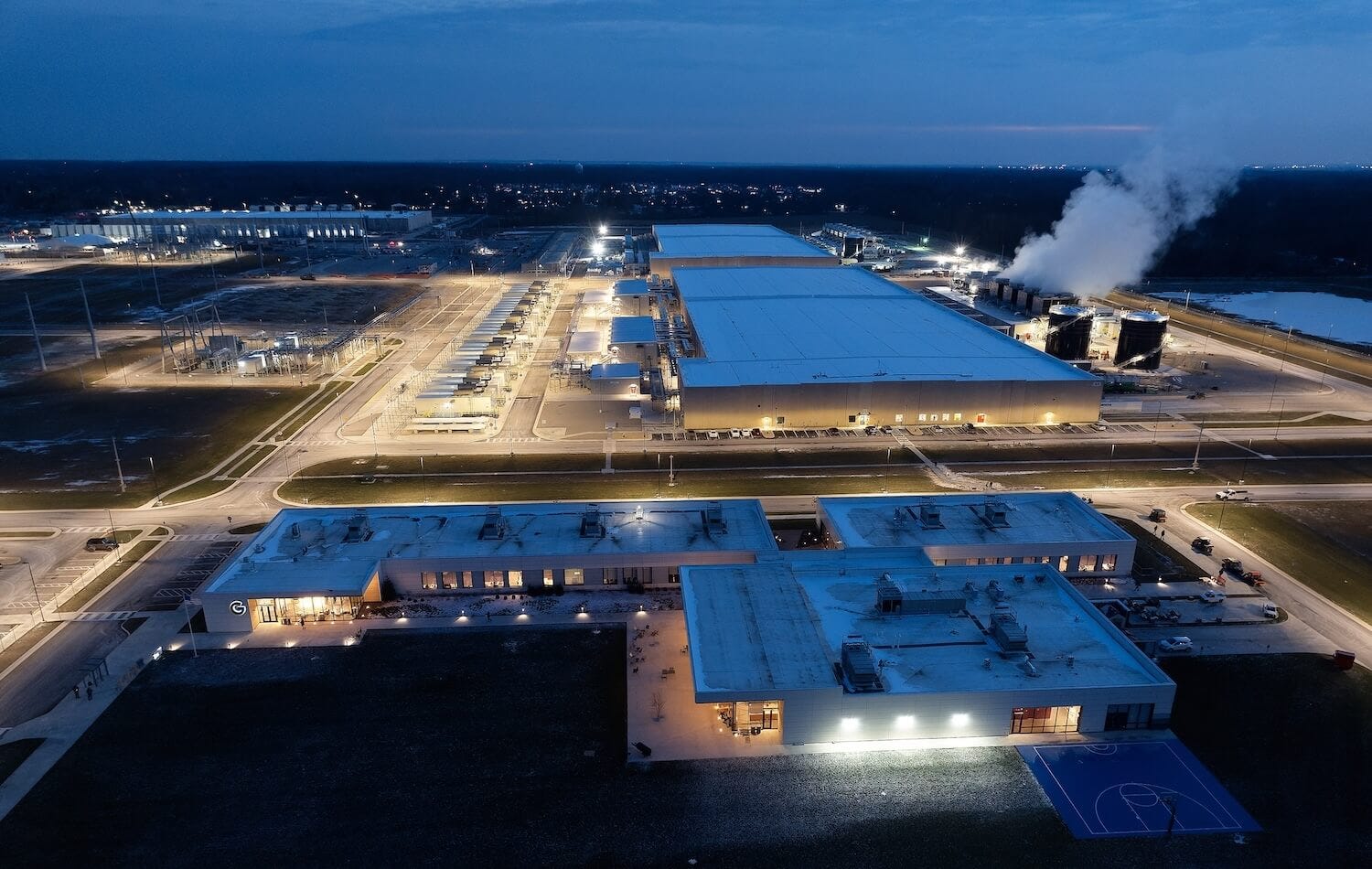
Meta and Google operate two of the largest AI-capable data center footprints in the United States in and around New Albany, Ohio. Meta’s New Albany campus and Prometheus AI cluster cover 1,540+ acres in Licking County and Google’s four-campus Central Ohio cluster spans 1,100+ acres across Licking, Franklin, and Fairfield counties. The two anchor sites — Meta at 1500 Beech Road and Google at 1101 Beech Road SW — sit directly across Beech Road from one another.
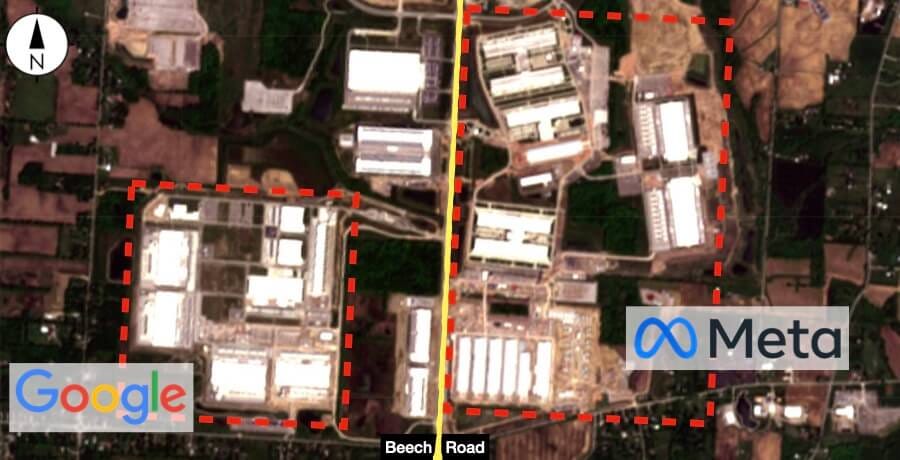
Source: EOS Data Analytics - May 2026.
Both Meta and Google’s data centers sit inside AEP Ohio’s service territory within the PJM Interconnection footprint, fall under Ohio’s data center sales-tax statute (ORC §122.175), and are subject to AEP Ohio’s 85% minimum-demand tariff, approved by the Public Utilities Commission of Ohio (PUCO). In Central Ohio, both target 1 GW of operational AI compute by the end of 2026.
This primer catalogs each operator’s campuses, accelerator hardware, cooling and power arrangements, renewable and nuclear energy procurement, and sustainability disclosures, alongside the shared grid, tariff, and tax context.
Campus Profile, Side-by-Side
Meta — New Albany + Prometheus
Meta’s New Albany campus and Prometheus AI cluster will reach 1 gigawatt spanning multiple data center buildings; more than 500 MW of AI compute is already installed. Prometheus is Meta’s first gigawatt-scale AI cluster. Meta’s disclosed successor, Hyperion (Richland Parish, Louisiana), is targeted at up to 5 GW beginning in 2028. Since breaking ground in 2017, Meta has invested $1.5 billion+ in the New Albany campus.
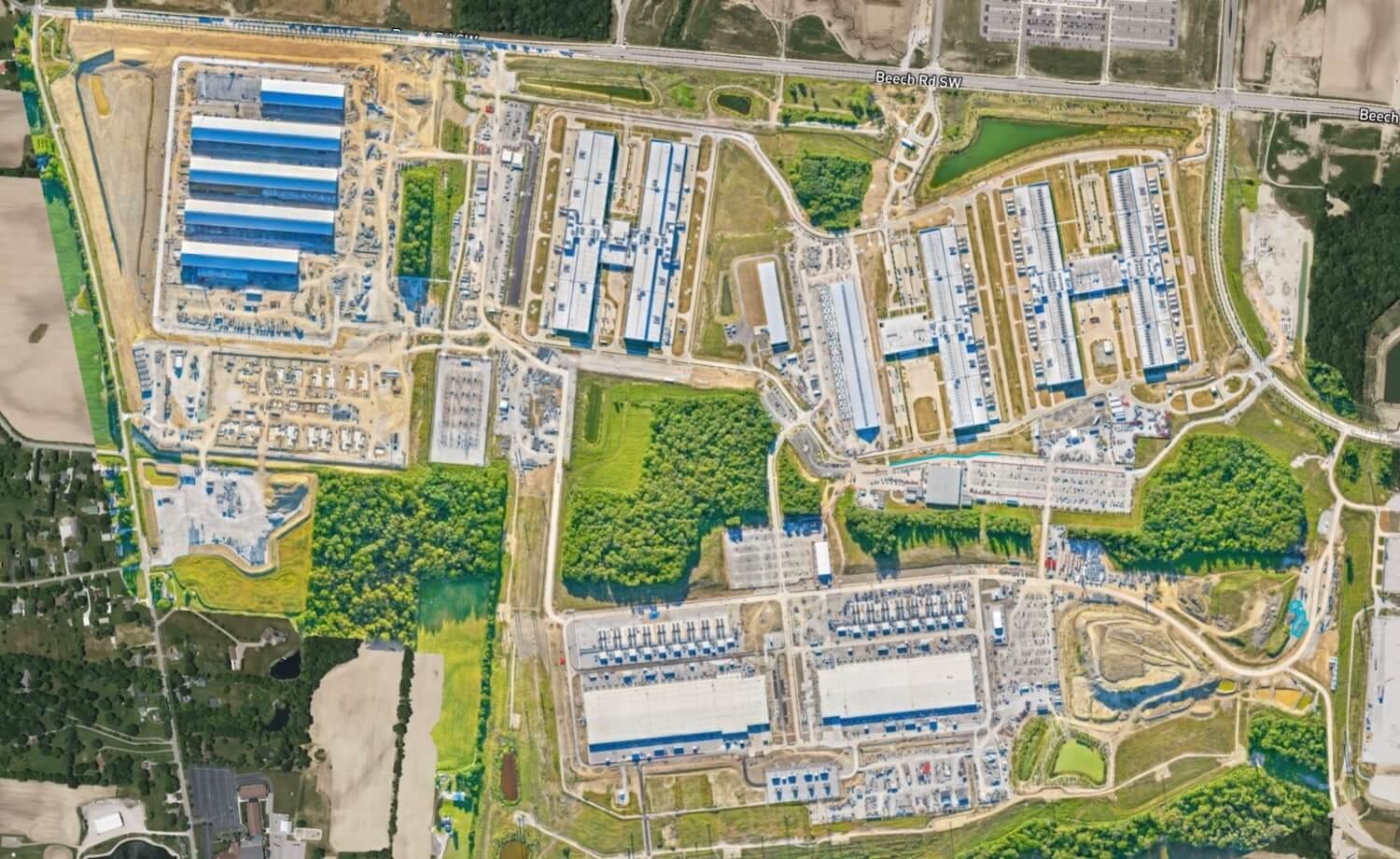
Source: Meta Platforms.
Cluster Scale Trajectory
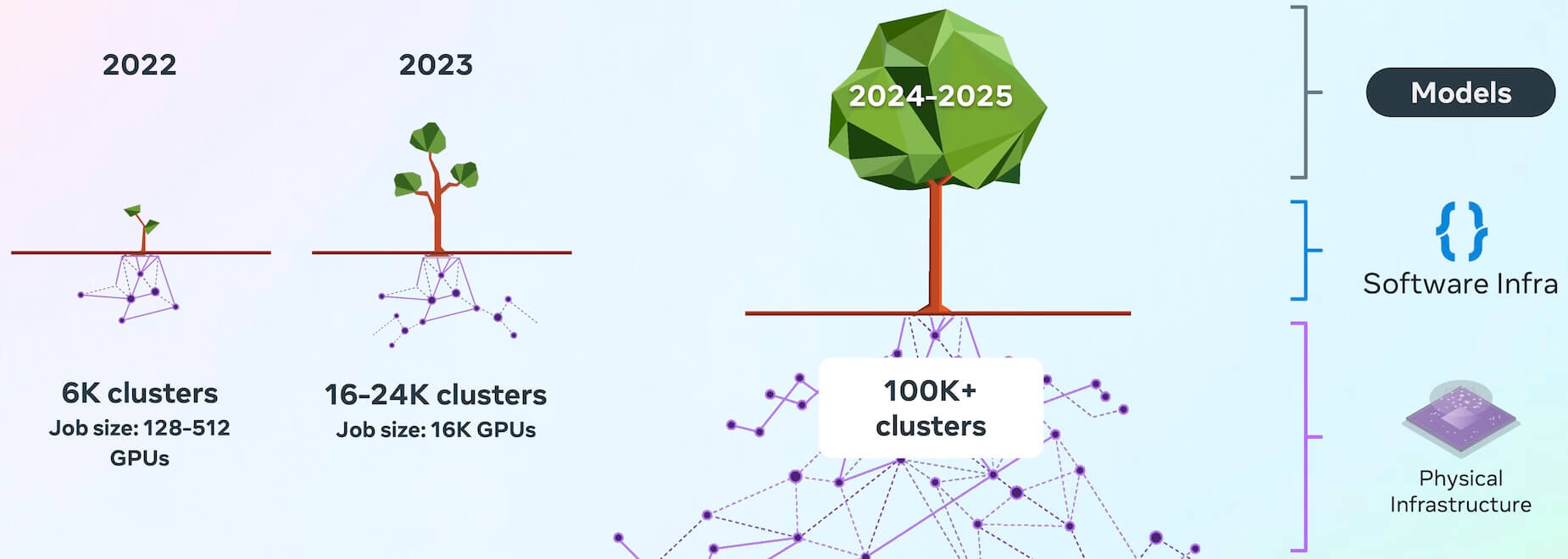
Meta’s AI clusters have compounded in scale over the past years:
Source: Meta Platforms.
2022: ~6,000-GPU clusters; training jobs of 128–512 GPUs.
2023: 16,000–24,000-GPU clusters; training jobs at 16,000 GPUs. Meta built two 24,000 H100 clusters in late 2023 (one InfiniBand, one RoCE) — among the largest in the world at the time. Later that year, a single 129,000 H100 cluster was assembled in months by emptying out five production data center buildings — Meta’s first multi-building AI cluster and the architectural precedent for Prometheus.
2024–2025: 100,000+ GPU clusters as the standard unit of AI-infrastructure planning.
2025 and beyond: multi-million-GPU, multi-region scale clusters — Meta’s publicly disclosed next trajectory step, where a single training fabric spans more than one geographic data center region. The Twine and MAST long-distance extensions described under Networking below are part of the enabling stack.
Locations and Land Holdings
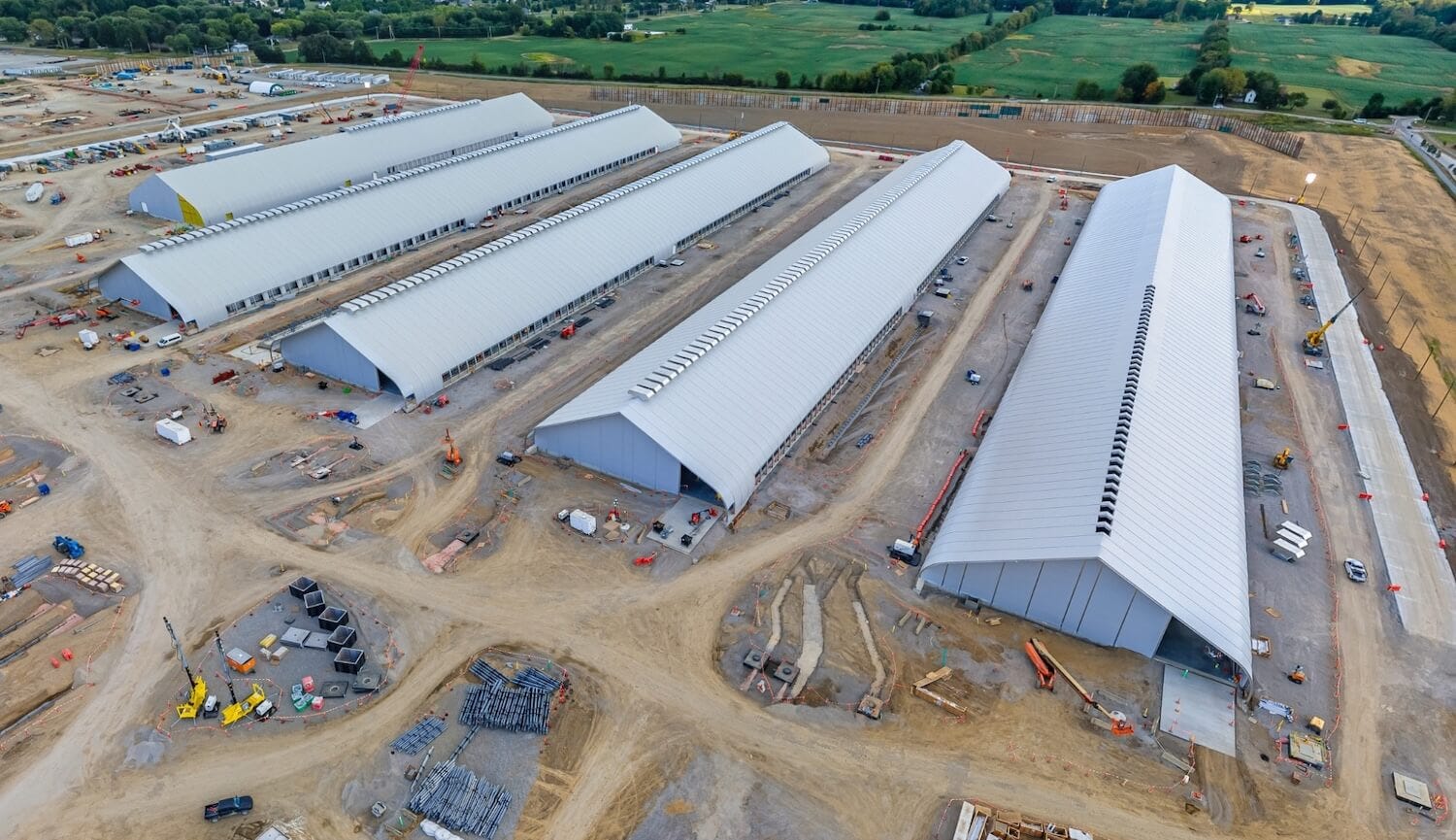
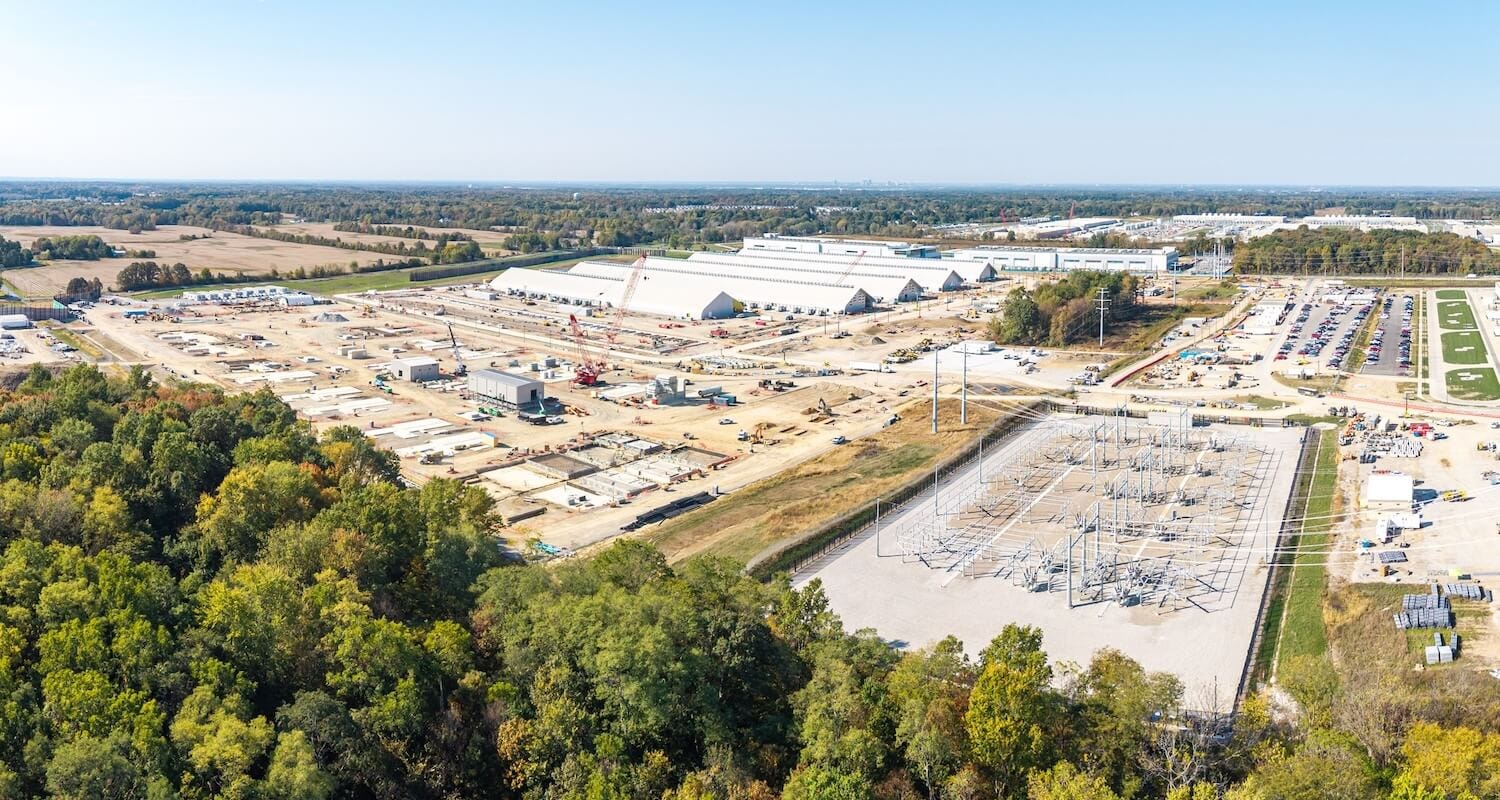
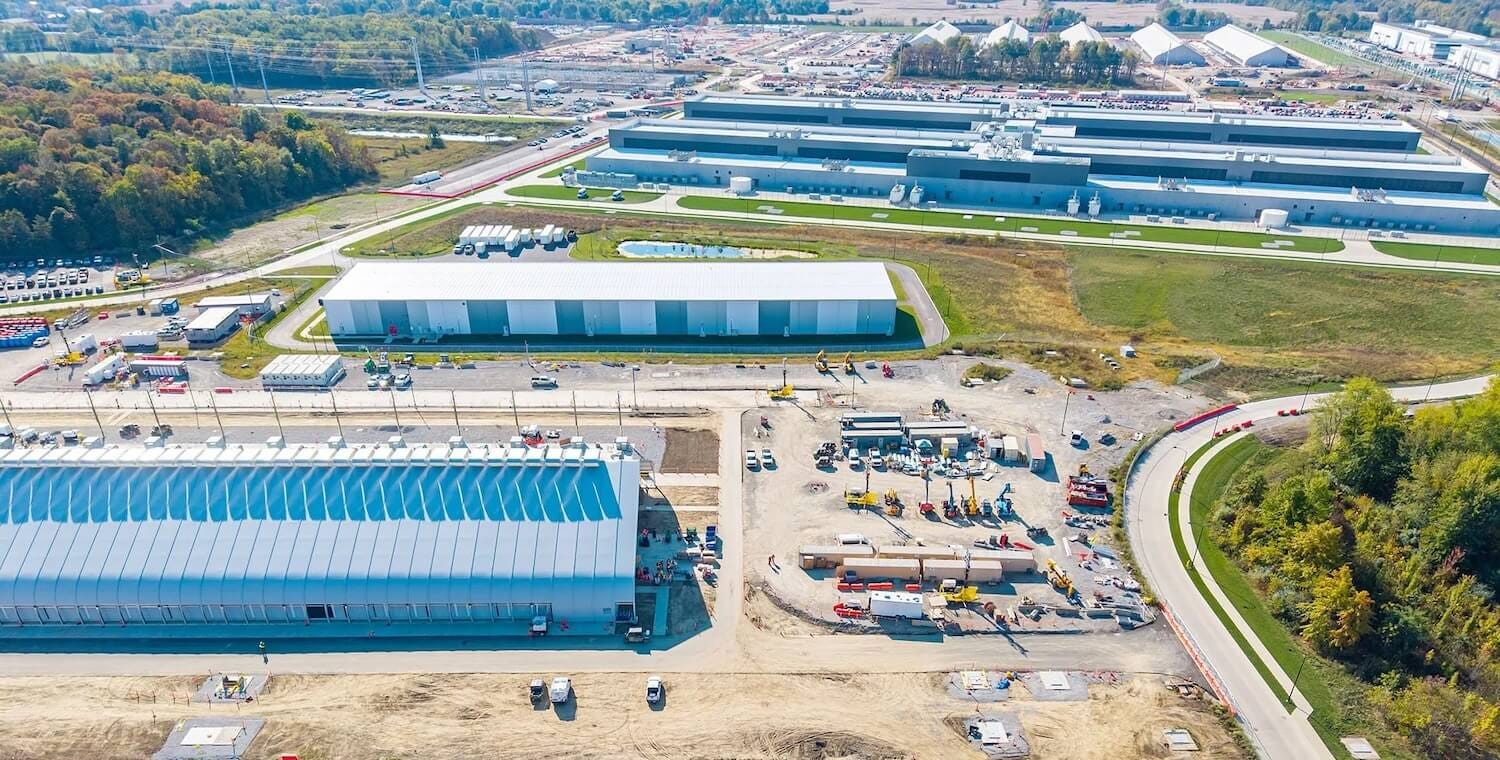
1500 Beech Road, New Albany (Licking County) comprises 740 acres (entity: Sidecat, LLC) and houses 12 data centers: 5 traditional buildings (2.5 million sq ft) plus 7 weatherproof tents (1.3 million sq ft) — the Prometheus AI cluster.
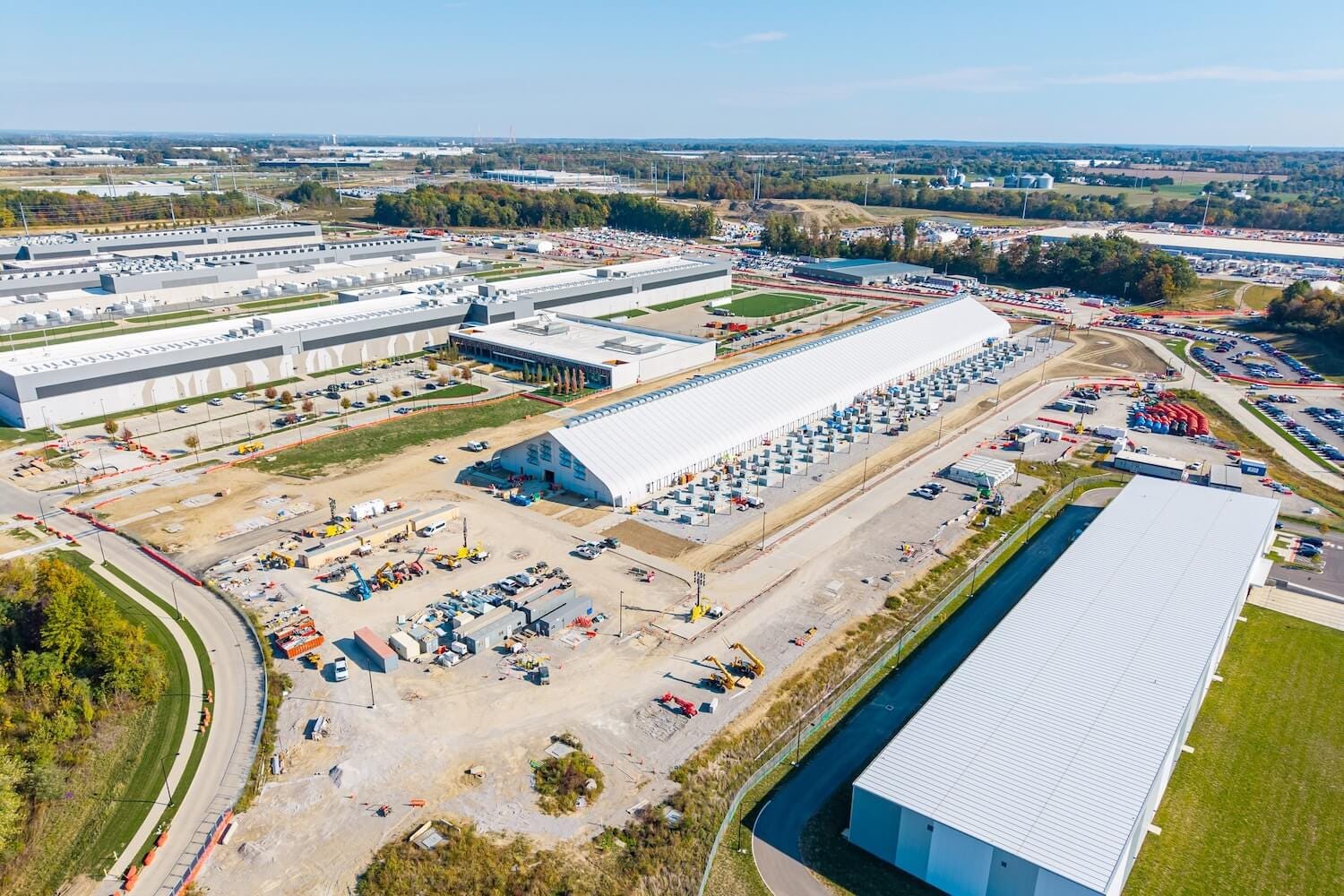
Source: Meta Platforms.
Three building types coexist on-site:
Legacy H-shape Halls — Meta’s original campus typology.
High-Density AI-Optimized Halls — purpose-built for GPU clusters with denser power-per-square-foot.
Weatherproof Tents — Meta’s “rapid deployment structure” or “advanced fabric structure.” These are long rectangular buildings with an aluminum substructure clad in puncture-proof, waterproof fabric, a pitched, mushroom-shaped roof, and hurricane-rated engineering. The format enables buildout in months instead of the traditional four-year construction timeline.
Source: Meta Platforms.
Beyond the on-campus footprint, Prometheus also incorporates regionally proximal colocation and cloud service provider capacity, knit into the training cluster over the Backend Aggregation (BAG) network described below. Combining purpose-built halls, rapid-deployment tents, and external regional capacity in a single cluster is the assembly choice that enabled Meta to reach 1 GW well inside a conventional buildout timeline.
Meta also owns 801 acres of additional undeveloped land in Central Ohio, including:
114.7 acres at 3439–3445 Clover Valley Road, New Albany.
373.4 acres at 12685 Green Chapel Road NW and 0 Miller Road, Johnstown.
180.6 acres at 11351 Jug Street and 11810 Beaver Road, Johnstown.
131.9 acres on a 14-parcel Jug Street / Mink Street / Beaver Road assemblage, Johnstown.
These land parcels provide Meta with further runway to grow its Central Ohio data center presence. Notably, the 373-acre Green Chapel Road land sits adjacent to the Green Chapel substation identified in the next section as Meta’s three-year interim AEP interconnection point.
Onsite Gas Generation: Socrates South
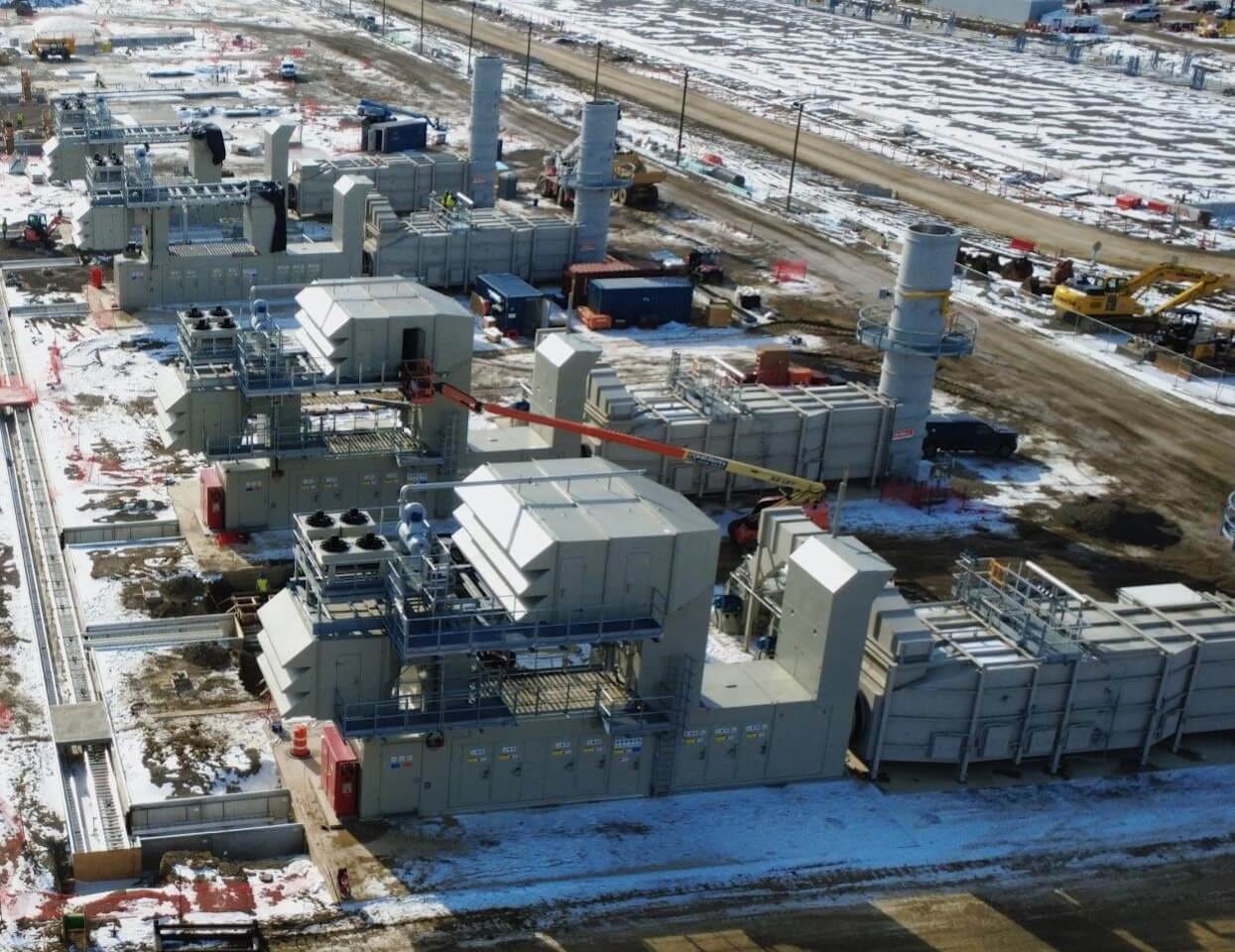
Meta’s New Albany campus is supplied by Williams Companies’ “Socrates South” behind-the-meter (BTM) natural-gas generation project — a ~$1.6 billion facility on Morse Road approved by the Ohio Power Siting Board (OPSB).
Source: Williams Companies.
The plant is fed by two 24-inch gas pipelines, one of which is the Aristotle South Pipeline — a 17.9-mile, 1,015 psig MAOP (Maximum Allowable Operating Pressure) transmission line operated by Williams. Power routes directly to Meta’s adjacent campus through on-site internal and switching substations, with no PJM grid interconnection (per OPSB Condition 14).
Socrates South is a single 200 MW behind-the-meter facility — OPSB Condition 13 caps net output at 200 MW. A separate Williams BTM project, Socrates North, sits ~4.5 miles away in the same New Albany International Business Park; together the two projects total 400 MW, but they are docketed and built independently. Socrates South’s ~307.5 MW nameplate primary fleet comprises 30 units across multiple OEMs:
3 × Solar Titan 250 combustion turbines (23 MW each = 69 MW).
9 × Solar Titan 130 / PGM 130 combustion turbines (17 MW each = 153 MW).
3 × Siemens SGT400 combustion turbines (16 MW each = 48 MW).
15 × Caterpillar G3520 lean-burn reciprocating engines (2.5 MW each = 37.5 MW).
The fleet is designed to deliver 258 MW at design ambient (95 °F) and 200 MW firm under an N+1+1 redundancy architecture (one operational unit plus two independent reserves). Each unit is equipped with selective catalytic reduction (SCR) for NOₓ (nitrogen oxides) and an oxidation catalyst for CO (carbon monoxide) and VOC (volatile organic compounds). Combustion turbines are air-cooled and reciprocating engines use closed-loop cooling, so no process cooling water is required.
Black-start power was originally provided by 8 × Caterpillar C15 diesel generators (500 kW each, 14,400 gallons of on-site ultra-low-sulfur diesel — for cold-starting Socrates South only, not load support). However, in late 2025, some of those diesel black-start generators were replaced with Tesla Megapack batteries.
Construction of the Socrates South natural-gas generation project commenced in June 2025. Construction is targeted for completion in November 2026 with in-service before the end of 2026 — landing in the same calendar window as Meta’s stated 1 GW AI compute target.
Green Chapel Substation Tap
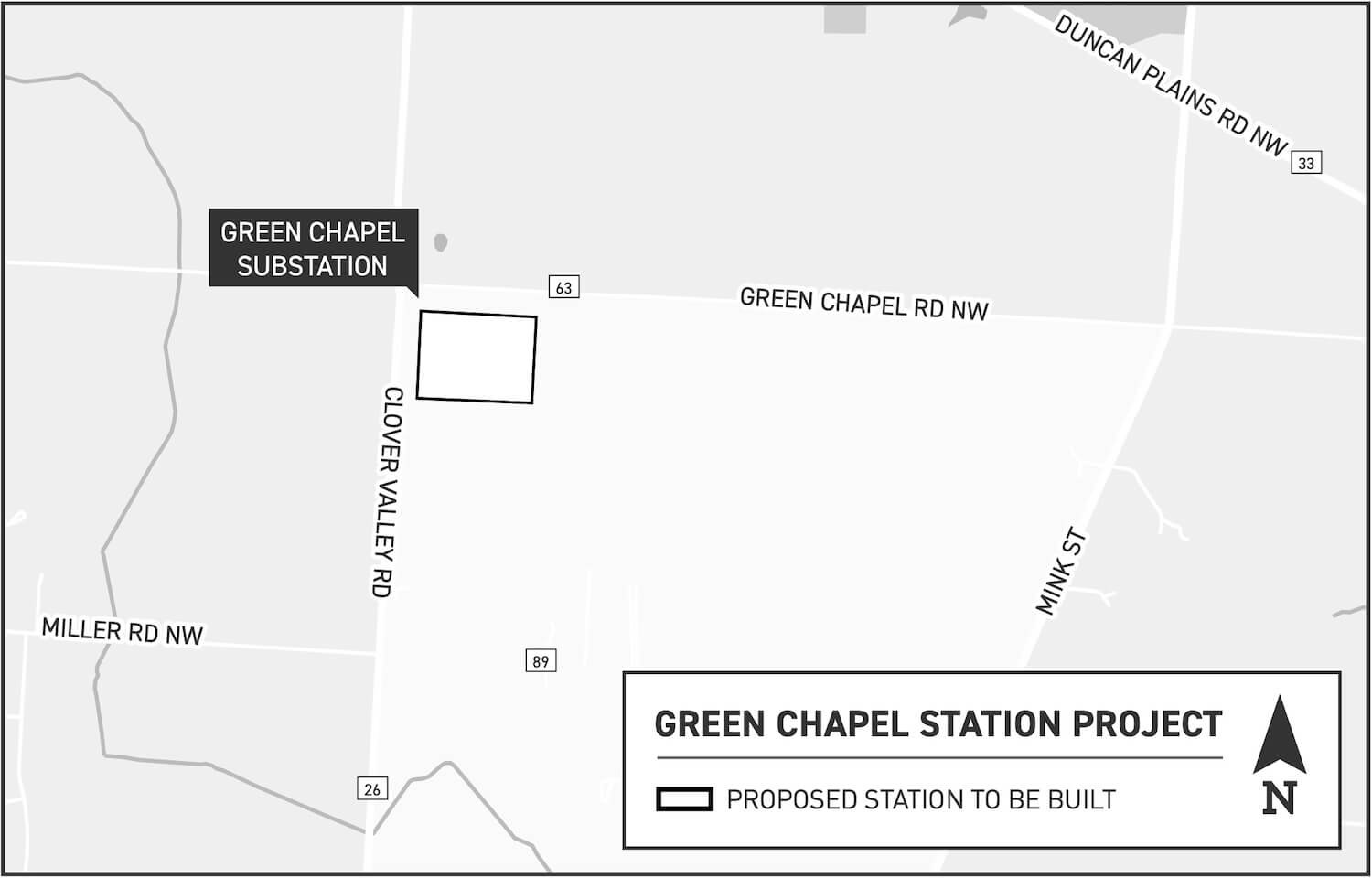
The Green Chapel substation — a 15-acre greenfield facility on a 40-acre AEP-owned parcel at the intersection of Clover Valley Road and Green Chapel Road NW in Jersey Township, Licking County — was originally filed in 2023 for Intel Corporation, which had contracted for up to 500 MW at 34.5 kV to serve its planned Licking County semiconductor fab.
Source: AEP Ohio.
The station was engineered around an ultimate 1.56 GW peak demand, with six 225 MVA 138/34.5 kV transformers (five in service, one spare) and nineteen 138 kV circuit breakers in a breaker-and-half bus configuration. Construction was substantially complete by August 2025 at an installed cost of ~$84.7 million — roughly $10 million under the original $95.1 million estimate.
In 2025, Intel announced a project delay and its service start slipped to 2031. AEP Ohio agreed to monetize the idle Intel-built substation through Meta’s separate large-load arrangement, and Meta’s adjacent 373-acre Green Chapel Road NW parcel (acquired September 2025) made the substation a natural interconnection point.
Meta’s three-year interim arrangement runs from January 1, 2026 through December 31, 2028, drawing up to 250 MW under AEP Ohio’s Schedule DCT (Data Center Tariff) as “New Load,” delivered at 34.5 kV, 4-wire, 3-phase. Capacity ramps from 120 MW by March 1, 2026 to the full 250 MW effective April 1, 2026, with the 85% minimum-demand charge applying throughout the term. AEP Ohio is constructing four temporary 34.5 kV distribution lines from the substation to the Meta site; Meta pays 100% of installation and subsequent removal costs, plus AEP’s costs of energizing the interim service.
Accelerator Hardware and Configurations
The Prometheus cluster houses Nvidia Blackwell GB200 and GB300 GPU systems plus their networking fabric for AI training. The deployment is split between two configurations:
Catalina (GB200)
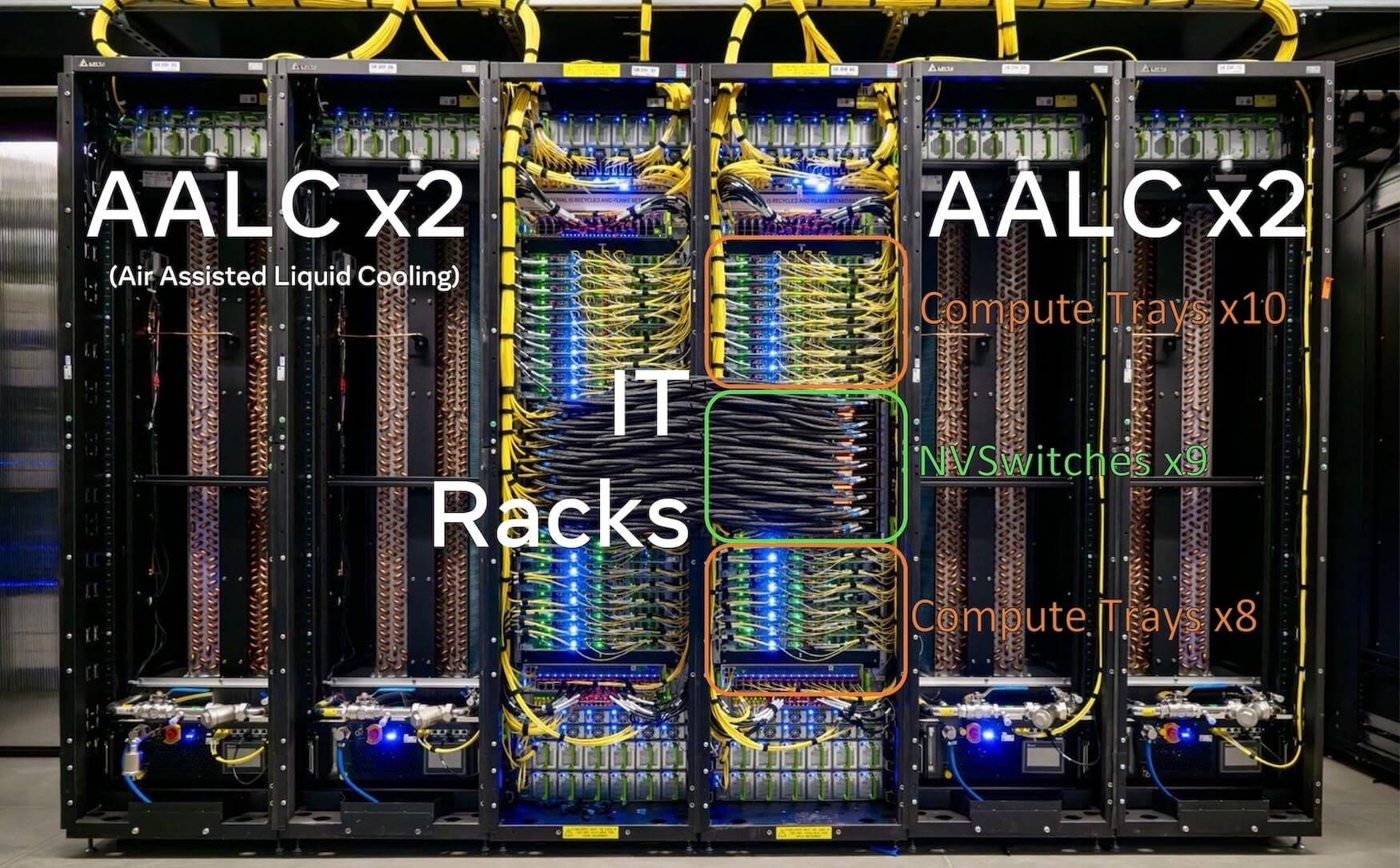
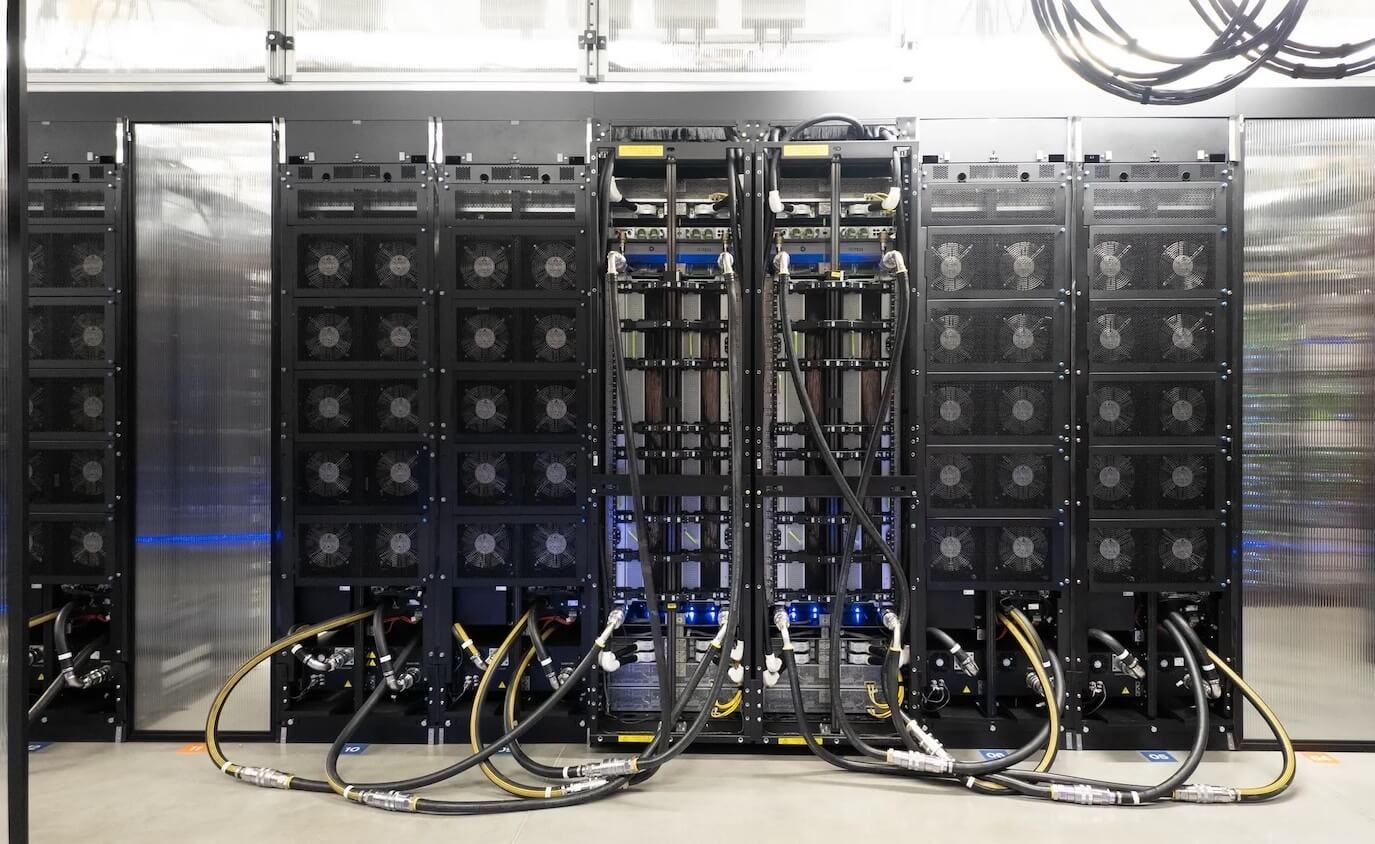
The GB200 deployment unit is Meta’s Catalina open-design pod, published through the Open Compute Project (OCP): six racks total — two GPU racks holding 72 Blackwell GPUs (~140 kW combined) flanked by four air-assisted liquid cooling (AALC) racks — producing ~360 PFLOPS of FP16 compute. Catalina splits 72 Blackwells across two 36-GPU IT racks cross-cabled into the NVL36×2 configuration.
Source: Meta Platforms.
Clemente (GB300)
A second open-design pod, Clemente, runs alongside Catalina at Prometheus on the newer Nvidia GB300 generation. Clemente concentrates 72 GPUs into a single IT rack — doubling the per-rack GPU density. The IT rack is paired with a companion Open Rack v3 high-power “HPR” rack that houses the PSUs, battery-backup units (BBUs), and network switches feeding the GPU rack, plus three AALC racks in air-cooled retrofits (omitted entirely in halls with facility liquid cooling).
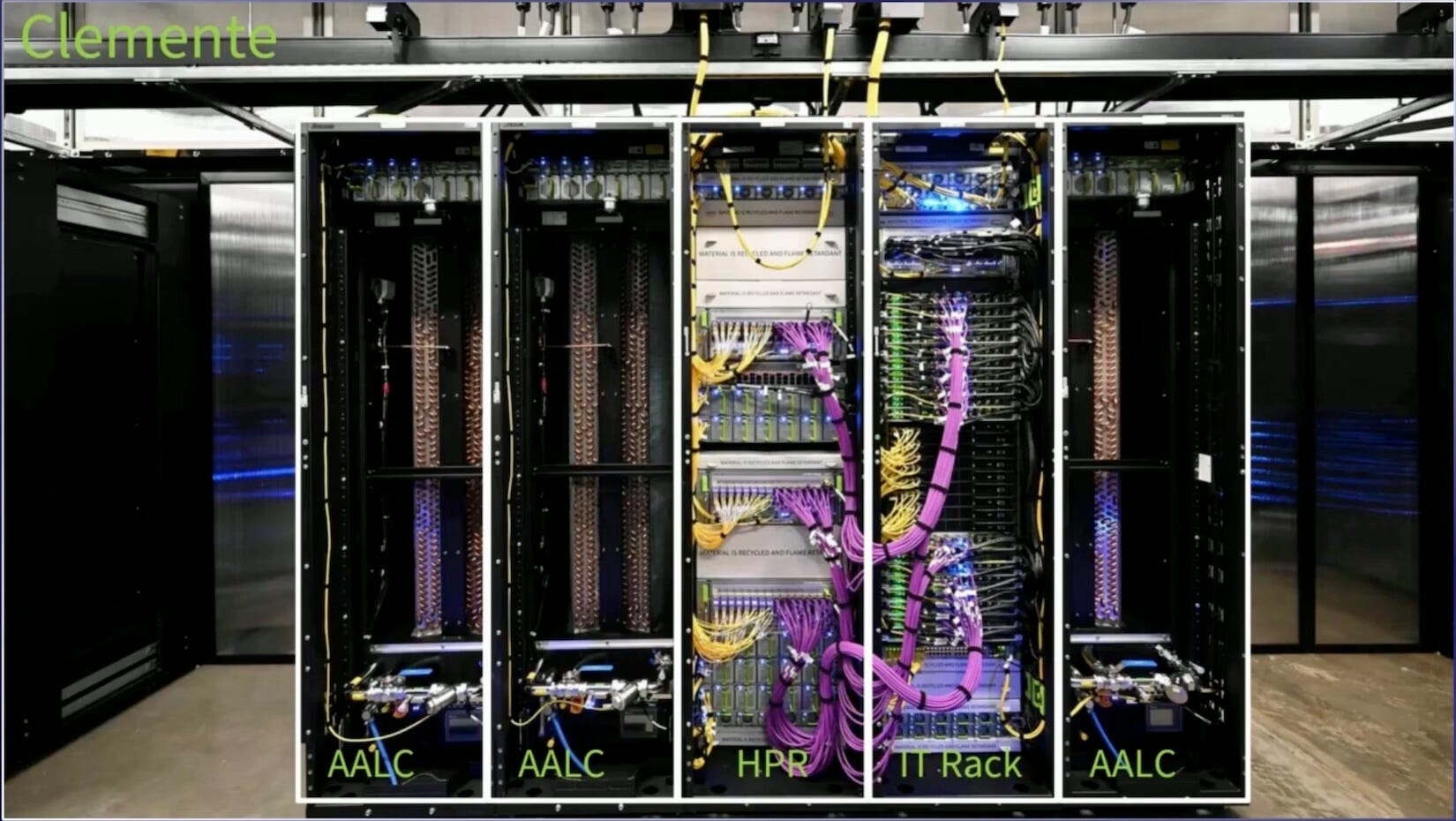
Source: Meta Platforms.
MTIA, AMD MI300, and Google TPUs
Beyond Nvidia, Meta’s accelerator footprint is multi-vendor:
MTIA (Meta Training and Inference Accelerator), Meta’s custom silicon, is deployed at scale across the data center fleet — primarily serving ads, ranking, and recommendation inference. This custom silicon includes MTIA v1/MTIA 100 (2023), MTIA 200 (2024), and MTIA 300–500 (2026).
AMD MI300: Meta uses the AMD MI300/MI300X for AI inference, especially LLM inference.
TPUs: Meta signed a multi-year, multibillion-dollar deal to rent Google’s tensor processing units (TPUs) for AI model training. Google is also discussing selling TPUs to Meta for use in Meta’s own data centers as soon as 2027.
Storage and Supporting Compute
Training Muse and Llama-scale models demands as much storage and general-purpose compute capacity as it does accelerators. Prometheus runs the following platform mix:
Grand Canyon — hard-drive-based platform for bulk training-data storage.
Olympic and Yosemite v3.5 Crater Lake — flash-based storage platforms, optimized for latency-sensitive access.
Yosemite v3.5 Half Dome and Yosemite v4 — general-purpose compute platforms supporting cluster management, sharing a modular base with tray-level customization for specific roles.
Pairing bulk hard disk drives (HDDs) with flash lets Meta size capacity, latency, and total cost of ownership (TCO) independently across the data pipeline.
Networking and Cluster Management
Meta uses a custom backend network interface card (NIC) rather than Nvidia’s ConnectX-7 in DPU (Data Processing Unit) mode or BlueField-3 for the frontend.
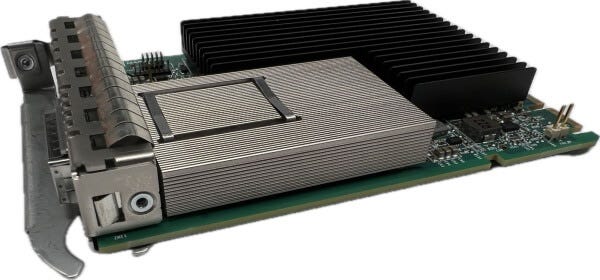
Source: Meta Platforms.
Backend Aggregation (BAG)
Networking across the cluster is built on Backend Aggregation (BAG) — the topology that enables gigawatt-scale Prometheus across tens of thousands of GPUs per cluster, with inter-BAG capacity reaching 16–48 Pbps per region pair. BAG runs a hub-and-spoke architecture: one BAG Hub interconnects multiple BAG spokes over n×800G links, with a choice between a planar one-to-one connection or a spread topology that distributes links across planes for path diversity.
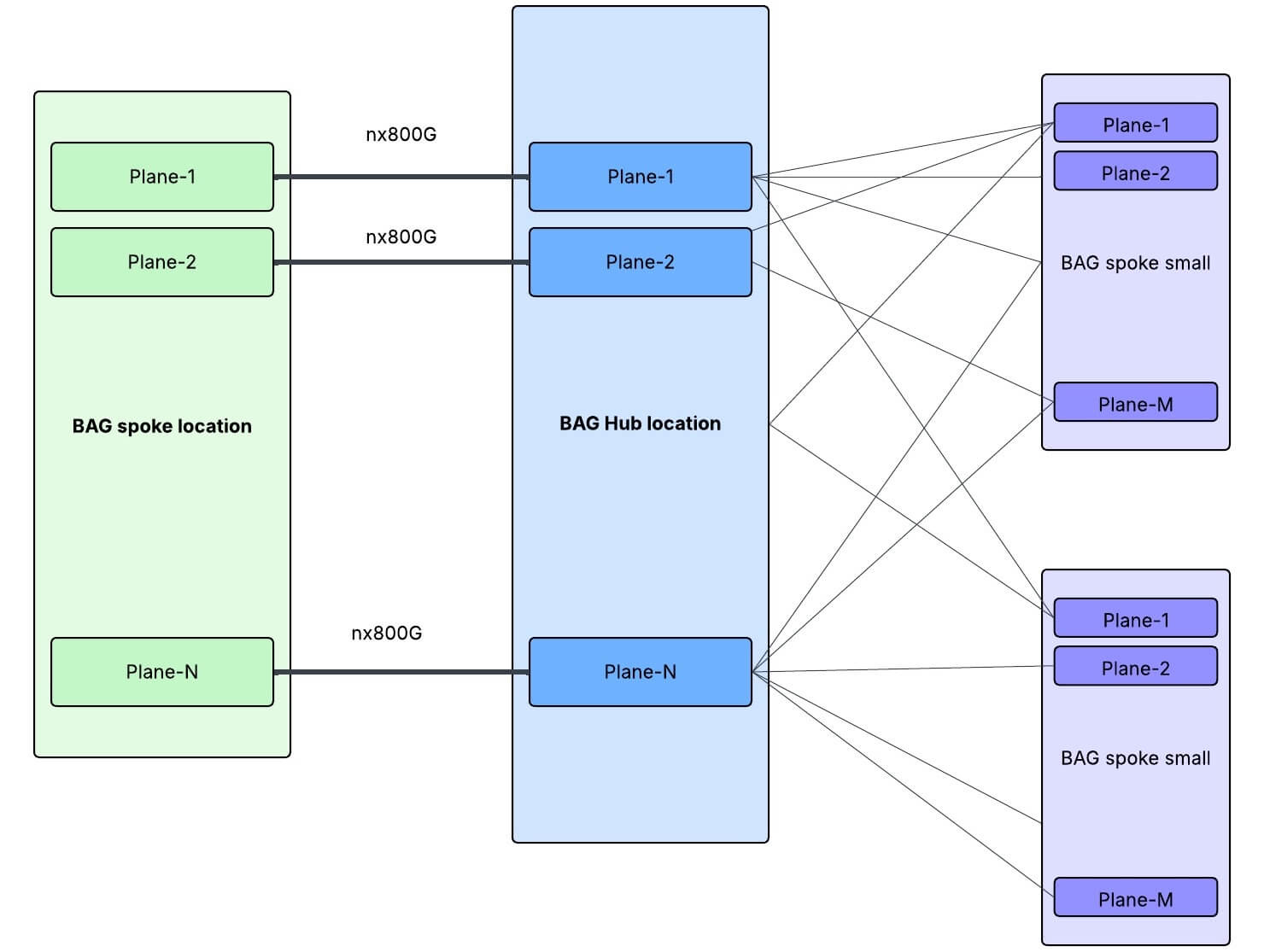
Source: Meta Platforms.
The BAG super-spine runs on Broadcom Jericho3 line cards with deep buffers selected to keep links lossless under Priority Flow Control (PFC).
Underneath BAG, Prometheus runs two open-fabric technologies in parallel.
Disaggregated Scheduled Fabric (DSF)
The Disaggregated Scheduled Fabric (DSF) — deep-buffer, cell-fabric — is built on Broadcom Jericho3-AI and Ramon3 switches and has evolved to a dual-stage architecture, non-blocking across 18,432 GPUs per L2 zone, with four AI zones per building.
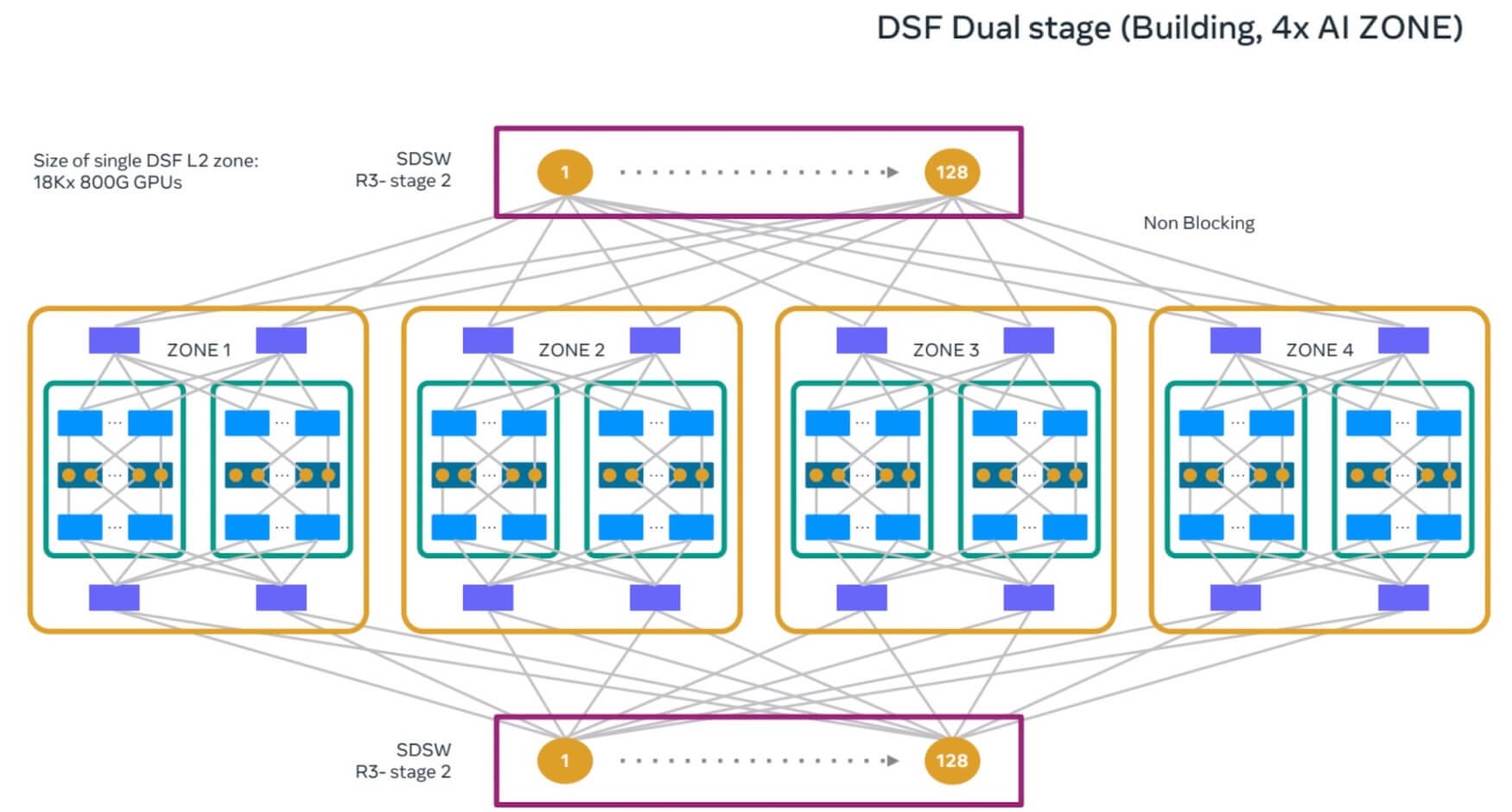
Source: Meta Platforms.
Non-Scheduled Fabric (NSF)
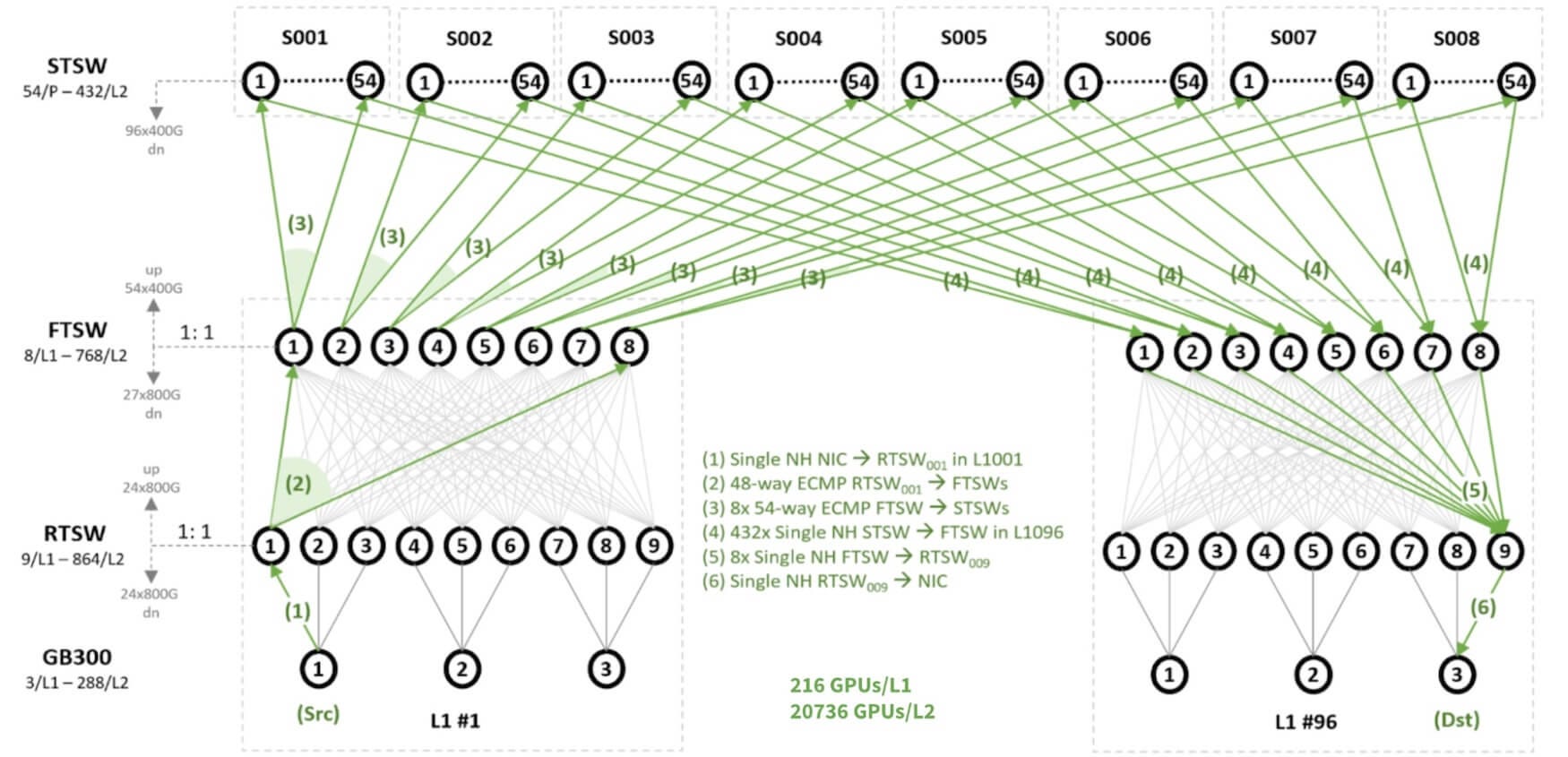
The Non-Scheduled Fabric (NSF) — shallow-buffer, TCO-efficient — is a three-tier topology (STSW / FTSW / RTSW) with adaptive routing, scaling to 20,736 GB300 GPUs per L2.
Source: Meta Platforms.
NSF runs on Meta’s portfolio of three 51.2 Tbps OCP switches — all on FBOSS, spanning three ASIC vendors: Minipack3 (Broadcom Tomahawk5), Cisco 8501 (Cisco Silicon One G200), and Minipack3N (Nvidia Spectrum-4, Meta-designed and Accton-manufactured).
Cluster Management: Twine and MAST
Meta’s cluster manager Twine and training-job scheduler MAST are being extended to coordinate long-distance training across geographically distributed buildings — relevant because Prometheus spans multiple buildings and adjacent colocation.
This multi-fabric, multi-platform approach reflects a key design principle: with the evolving accelerator roadmap, network design must take an N+1-generation perspective — by the time a building comes online, multiple new accelerator generations may already be available. Prometheus’s networking is therefore built for flexibility across data center types and accelerator types, so each building can be configured to extract maximum accelerator density from its specific power, cooling, and floorplate constraints.
Cooling Architecture
Cooling follows the requirements of the GB200 platform: direct-to-chip liquid cooling is mandated, with Bianca-style boards at 2,700 W per board liquid-cooled by design. Liquid-to-liquid water infrastructure can be deployed on-site. Where Meta retrofits GB200 racks into legacy halls without a facility water loop, the Catalina pod pairs the two GPU racks with four AALC racks that reject heat to air; purpose-built AI halls run on facility liquid cooling directly.
Source: Meta Platforms.
Production Workloads and AI Training
Beyond AI training, the campus supports Meta AI, Instagram, and WhatsApp, plus recommender systems and ads — not a single-purpose training facility. Meta has identified Prometheus as the training site for Llama (now officially retired), the Muse models, and “superintelligence” research.
Emissions and Energy Footprint
Per Meta’s 2025 Environmental Data Index (reporting fiscal year 2024) for New Albany, Ohio:
Market-based Scope 1 + 2 operational GHG emissions: 584 metric tons CO₂e
Scope 2 emissions, market-based: 0 metric tons CO₂e
Scope 2 emissions, location-based: 216,600 metric tons CO₂e
Electricity consumption: 521,217 MWh
Water withdrawal: 86 megaliters
Source: Meta Platforms.
Meta’s 584 tCO₂e operational GHG emissions disclosure remains separate from the legal structure of the Socrates South arrangement. Williams’s operating entity Will-Power OH, LLC and Meta’s offtaker Sidecat, LLC are treated as separate stationary sources under OAC 3745-31-01(S)(10) by contractual agreement, so Socrates South’s emissions accrue to Will-Power rather than to Meta. At Title V major / PSD minor classification, Socrates South’s facility-wide Potential to Emit is approximately 1,514,024 tpy CO₂e, plus 238.6 tpy NOₓ, 222.8 tpy CO, 122.7 tpy SO₂, 90.3 tpy PM, 104.1 tpy VOC, and 34.1 tpy HAP — none of which flow into Meta’s New Albany Scope 1 + 2 reporting.
Renewable Energy Portfolio
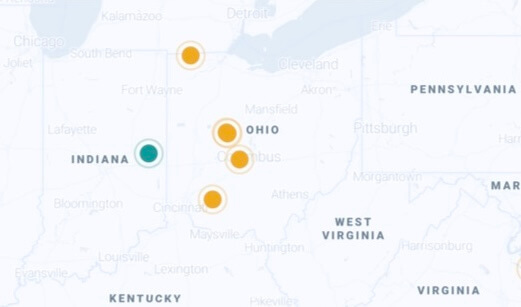
Meta states that the New Albany site’s electricity use is matched with 100% clean and renewable energy, with over 800 MW of renewable energy within and supporting Ohio added by Meta’s solar and wind projects. Meta’s contracted Ohio solar plus Indiana wind on the same electrical grid as New Albany:
Source: Meta Platforms.
Of the 836 MW nameplate, 396 MW is operating today (Arche, Hardin, Headwaters II) and 440 MW is contracted for late-2027 commissioning (Pleasant Prairie, Yellow Wood).
All five projects were procured under long-term power purchase agreements (PPAs); the Hardin and Headwaters II contracts were signed prior to construction, with the Headwaters II PPA executed with EDP Renewables.
Nuclear Procurement
In January 2026, Meta announced agreements with three nuclear partners — Vistra, TerraPower, and Oklo — alongside an additional agreement with Constellation Energy, unlocking up to 6.6 GW of clean energy by 2035. The announcement explicitly identifies the Prometheus AI cluster in New Albany, Ohio as a beneficiary; all projects feed the PJM grid that serves the campus.
Only the Oklo Aurora Powerhouse in Pike County, Ohio sits inside the same PJM transmission zone (AEP) as New Albany.
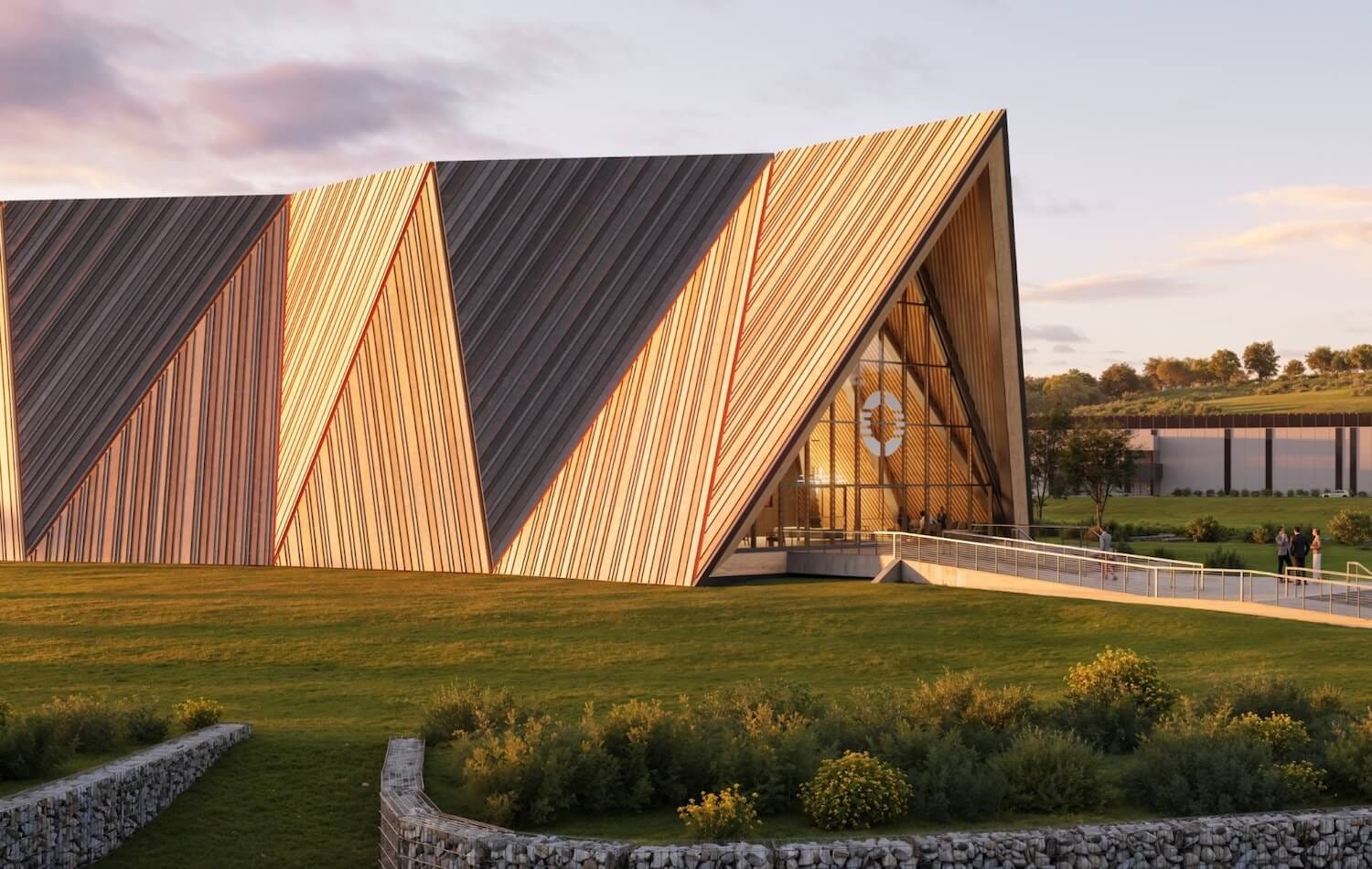
Source: Oklo.
Vistra’s three plants — Perry, Davis-Besse (northern Ohio), and Beaver Valley (western Pennsylvania) — sit in PJM’s ATSI (FirstEnergy) zone. All four feed the same PJM Regional Transmission Organization (RTO) that serves the campus, in different transmission zones within it.
Workforce
Meta’s New Albany site disclosures cite 300+ full-time operational jobs and 5,000+ peak construction jobs across the campus buildout to date.
Google — Central Ohio
Google’s four-campus Central Ohio cluster currently has approximately 1 GW of total compute capacity, with ~500+ MW dedicated to AI, and is on a trajectory to 1 GW of AI compute by the end of 2026. Since opening its first New Albany data center in 2019, Google has invested $20 billion+ in Ohio.
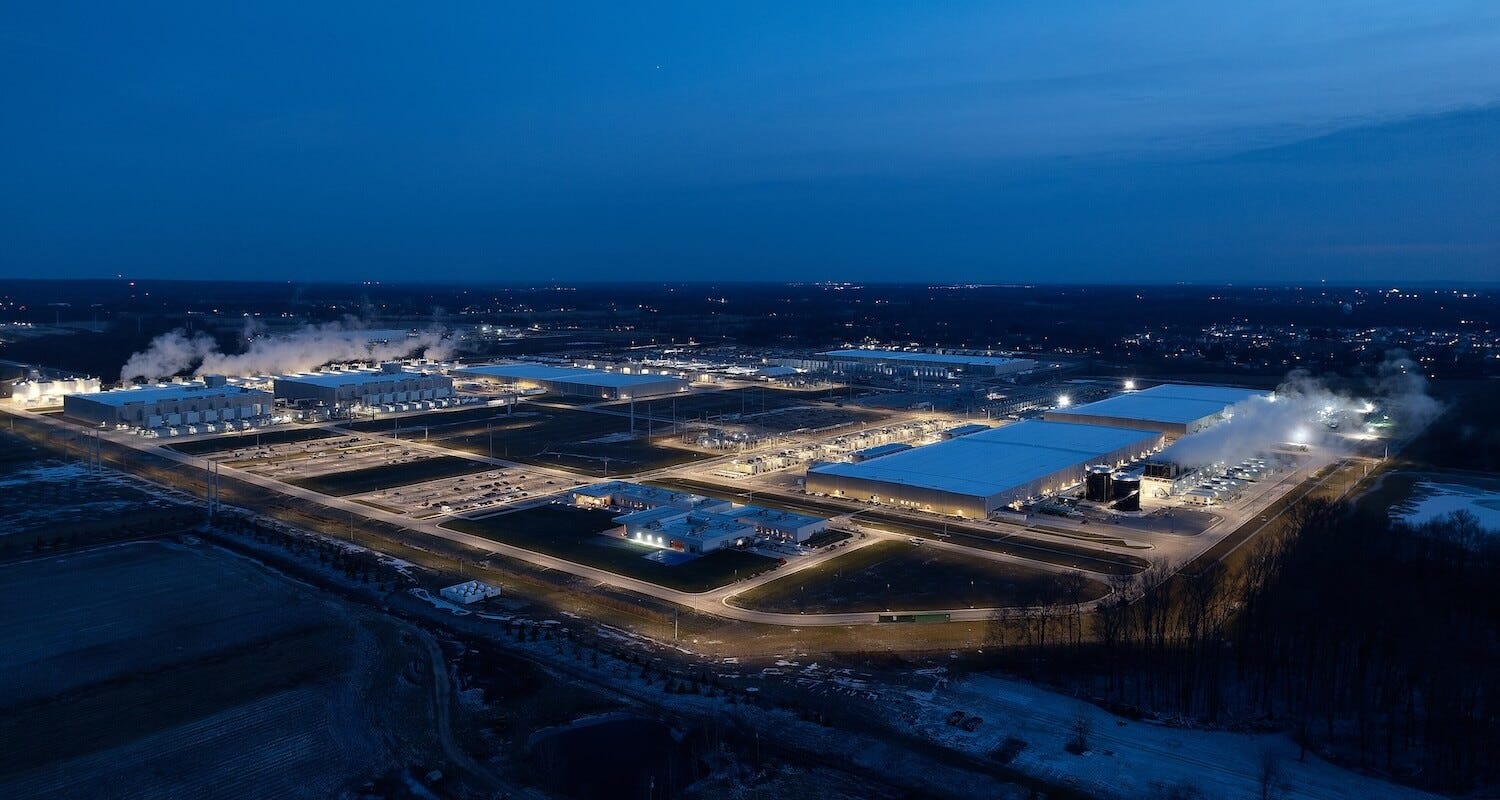
Source: Google.
Locations and Land Holdings
1101 Beech Road SW, New Albany (Licking County) — 447 acres, 7 data centers (6 operational, 1 under construction) totaling 1.6 million sq ft. Entity: Montauk Innovations, LLC.
5076 S. High Street, Columbus (Franklin County) — 480 acres, 5 data centers (4 operational, 1 under construction) totaling 1.3 million sq ft. Entity: Magellan Enterprises LLC.
105 Whiley Road, Lancaster (Fairfield County) — 121.5 acres, 2 data centers (1 operational, 1 under construction) totaling 600,000 sq ft. Entity: Table Mountain Industries LLC.
2565 Harrison Road NW, New Albany (Licking County) — 84.7 acres, 1 data center under construction totaling 275,000 sq ft at an expected investment of $500 million and a construction window of December 2025 through June 30, 2027. Entity: Montauk Innovations, LLC.
Cooling Infrastructure
Cooling at the New Albany campus is centralized in a modular global central utilities building (gCUB) with rooftop cooling towers mounted on numbered Modular Cooling Plants.
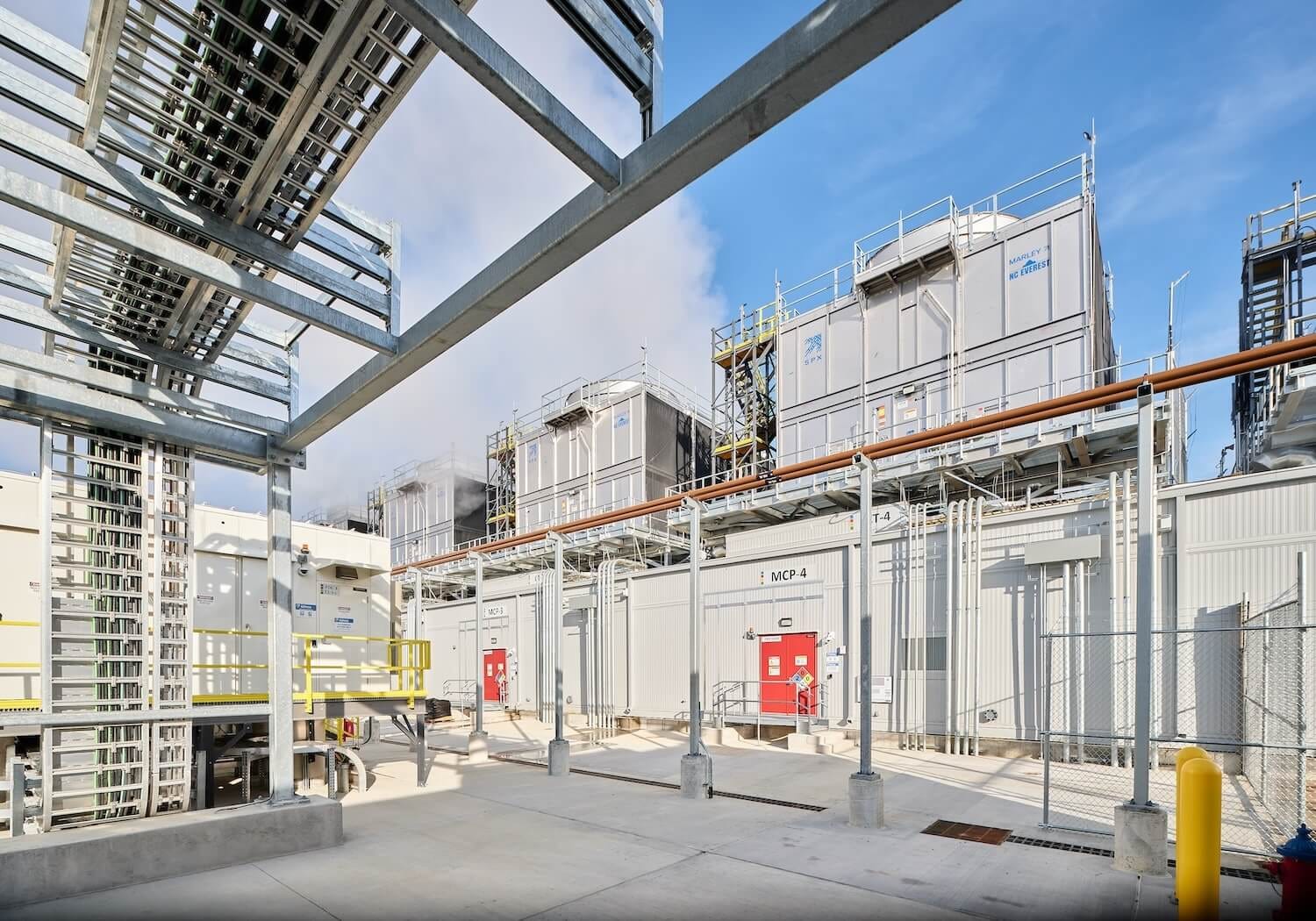
Source: Google.
Chilled water is distributed across buildings via overhead pipe-rack gantries, and a centralized facility water system spans the buildings to reject heat.
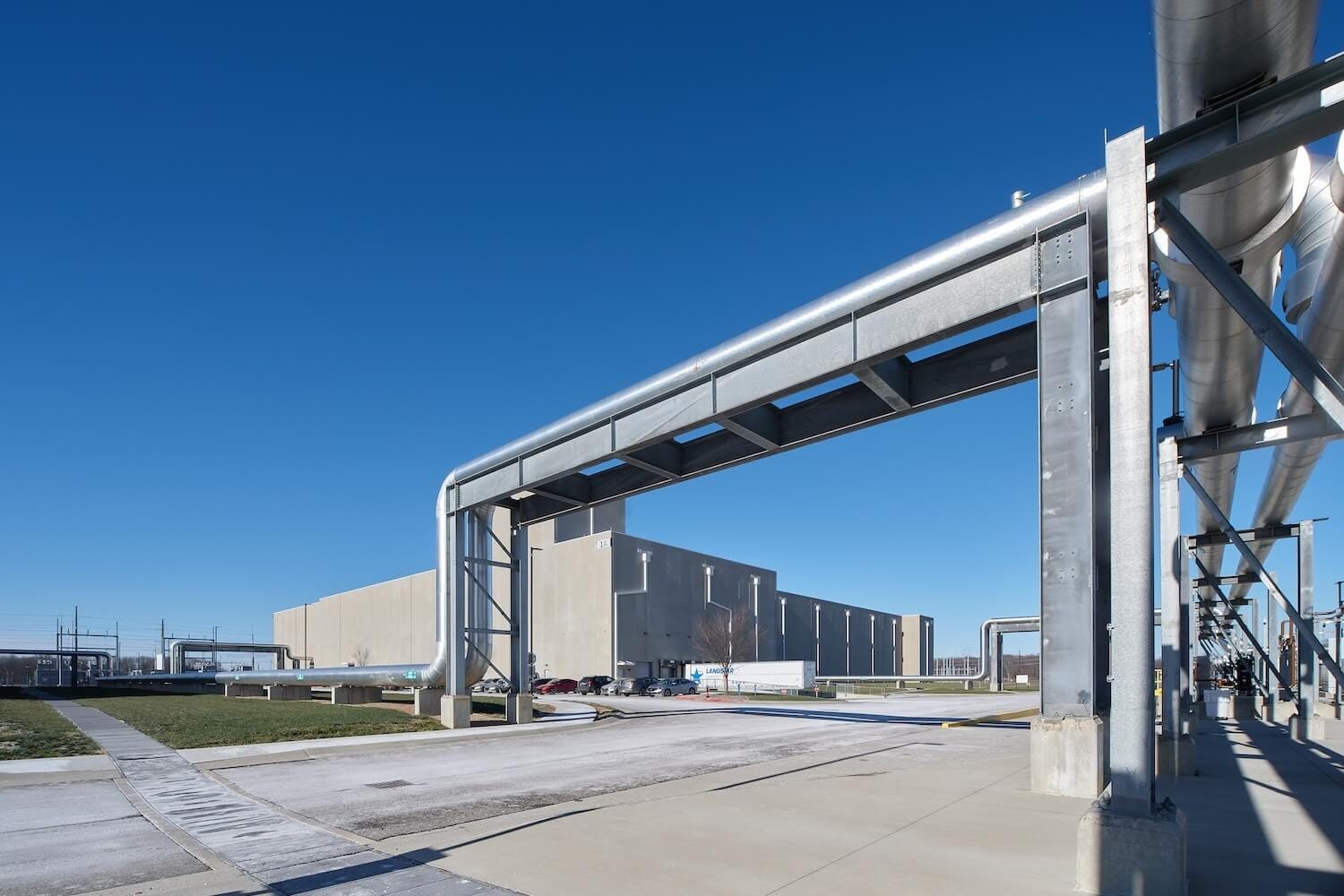
Source: Google.
In 2024, Google’s New Albany, Ohio data center reported a Power Usage Effectiveness (PUE) of 1.07, while its Columbus (Lockbourne), Ohio data center reported a PUE of 1.06 — both well below the current industry average of 1.54.
Electrical Systems and Backup Power
Each building has its own electrical yard with main power building, substation infrastructure, and backup generators wired into the halls via elevated cable bridges.
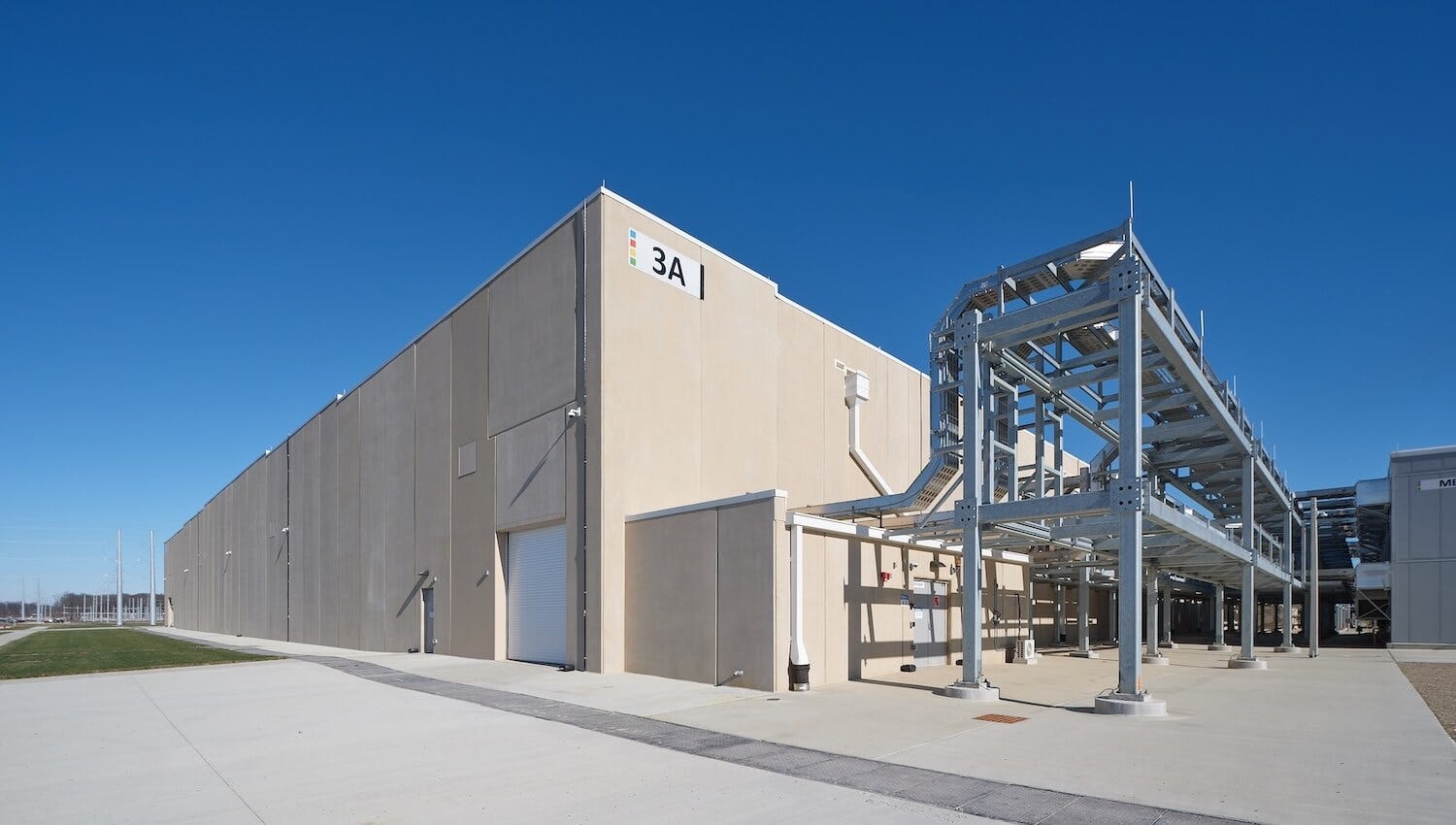
Source: Google.
Cooling Tower Noise Incident
In July 2025, Google activated 28 commercial cooling-tower fans at its 1101 Beech Road SW site that proved audible at 0.46 miles, exceeding New Albany’s 50-foot plainly-audible noise rule. After resident testimony before New Albany City Council in September 2025 and a zoning-enforcement review by the city’s law director, Google committed to deconstructing and reconstructing the cooling towers between June and August 2026, and in the interim installed temporary sound walls along the Morse Road and Babbitt Road frontages.
Server Hall Architecture
Inside the halls, Coolant Distribution Units (CDUs) sit at the head of each aisle, providing direct-to-chip liquid cooling.
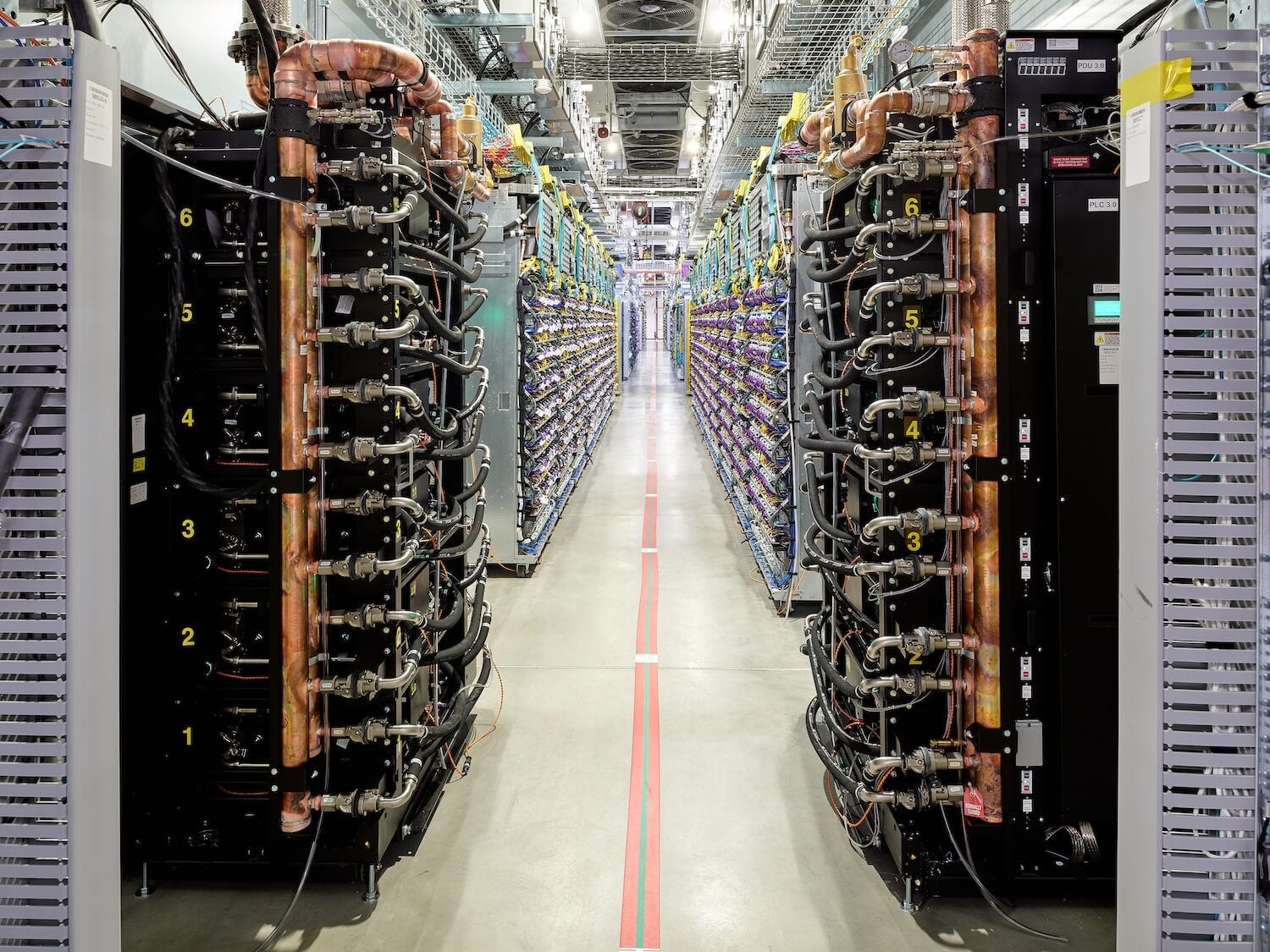
Source: Google.
Cold plates at rack level use a liquid-to-liquid heat exchanger to transfer heat into the central facility water system, with active flow-rate control via valves on the TPU rack — coolant flow adjusts to per-chip workload in real time.
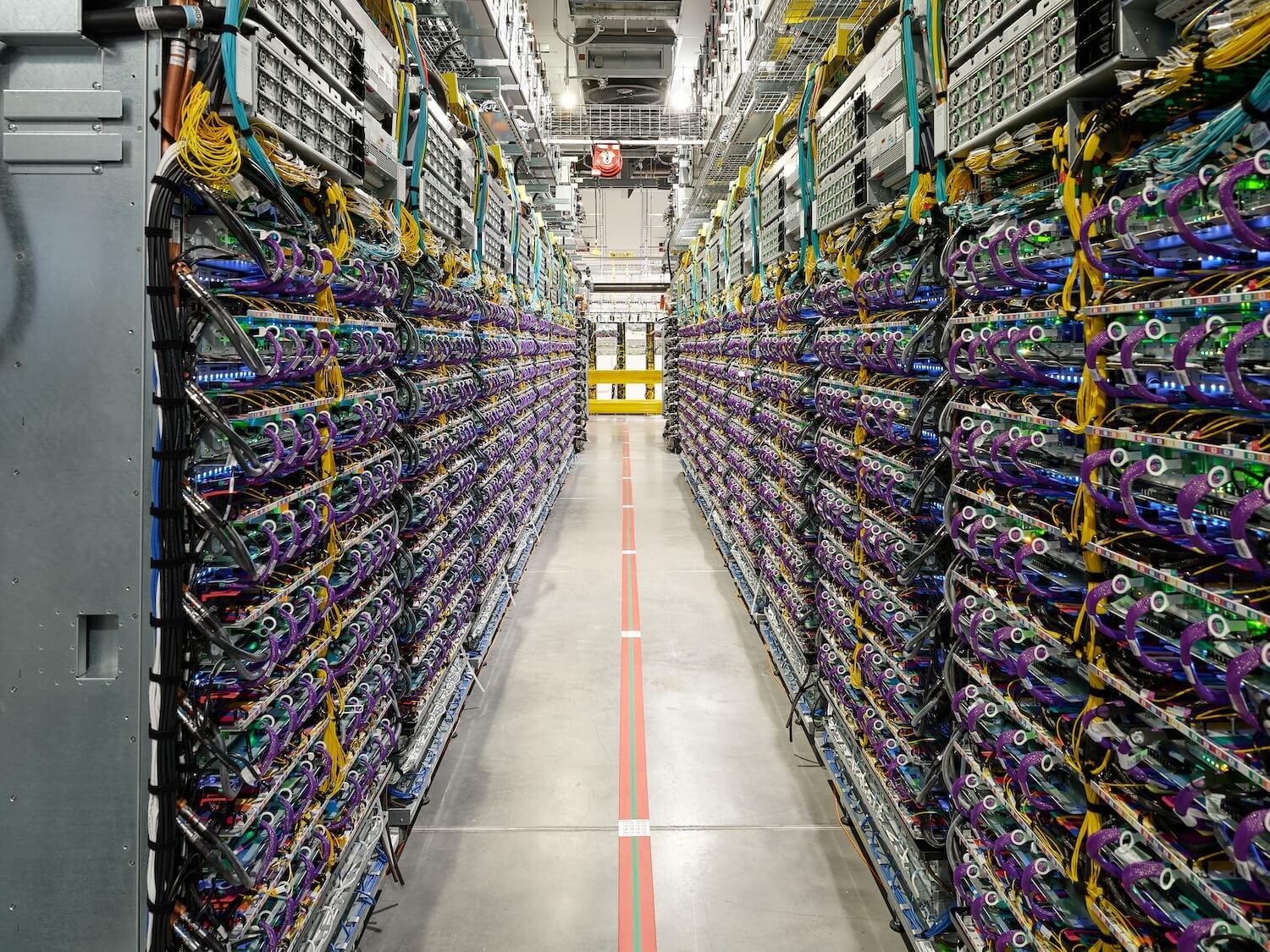
Source: Google.
Hot-aisle containment sits behind transparent rack doors, while overhead fiber-optic plant runs across the ceilings.
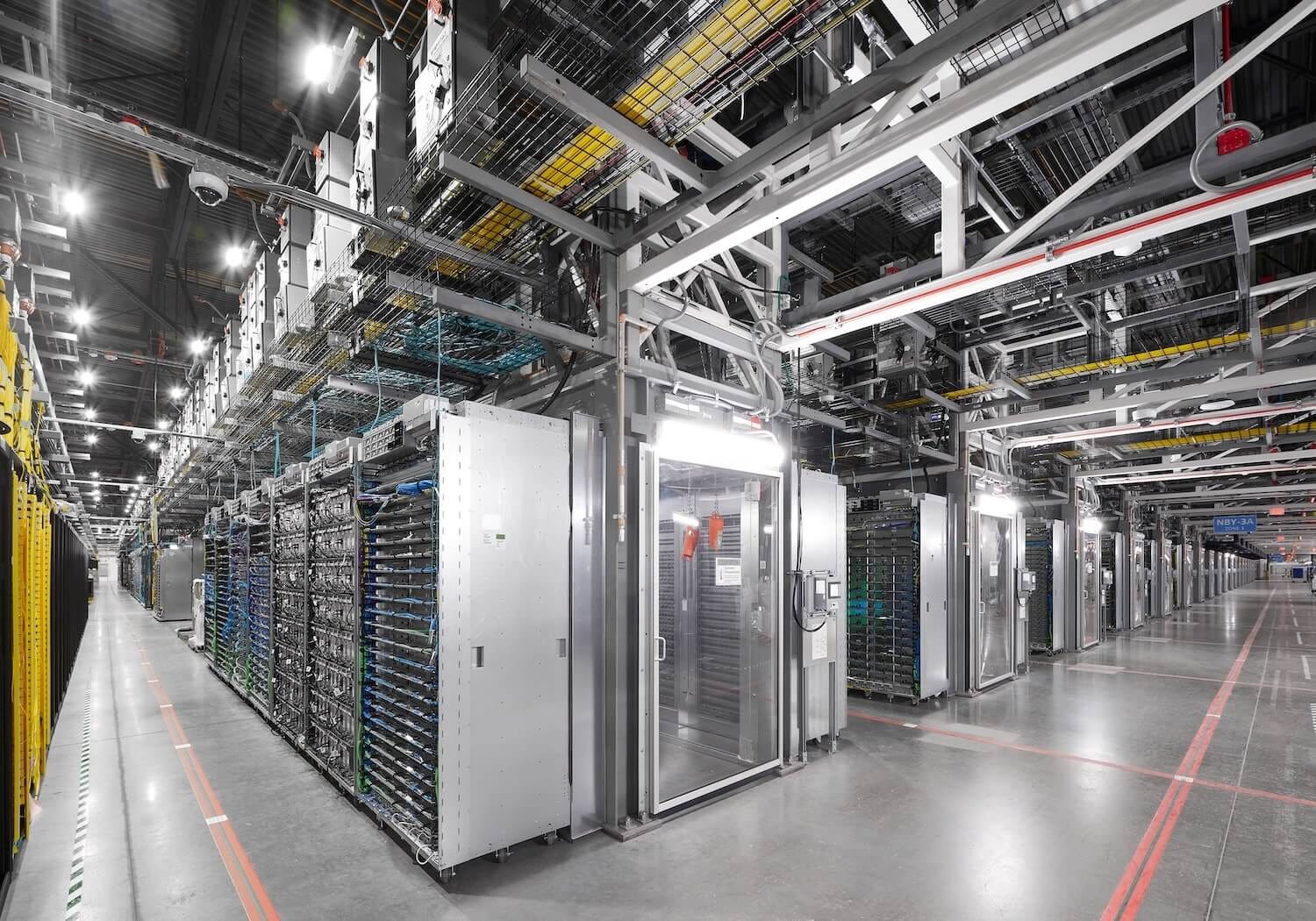
Source: Google.
TPU Hardware
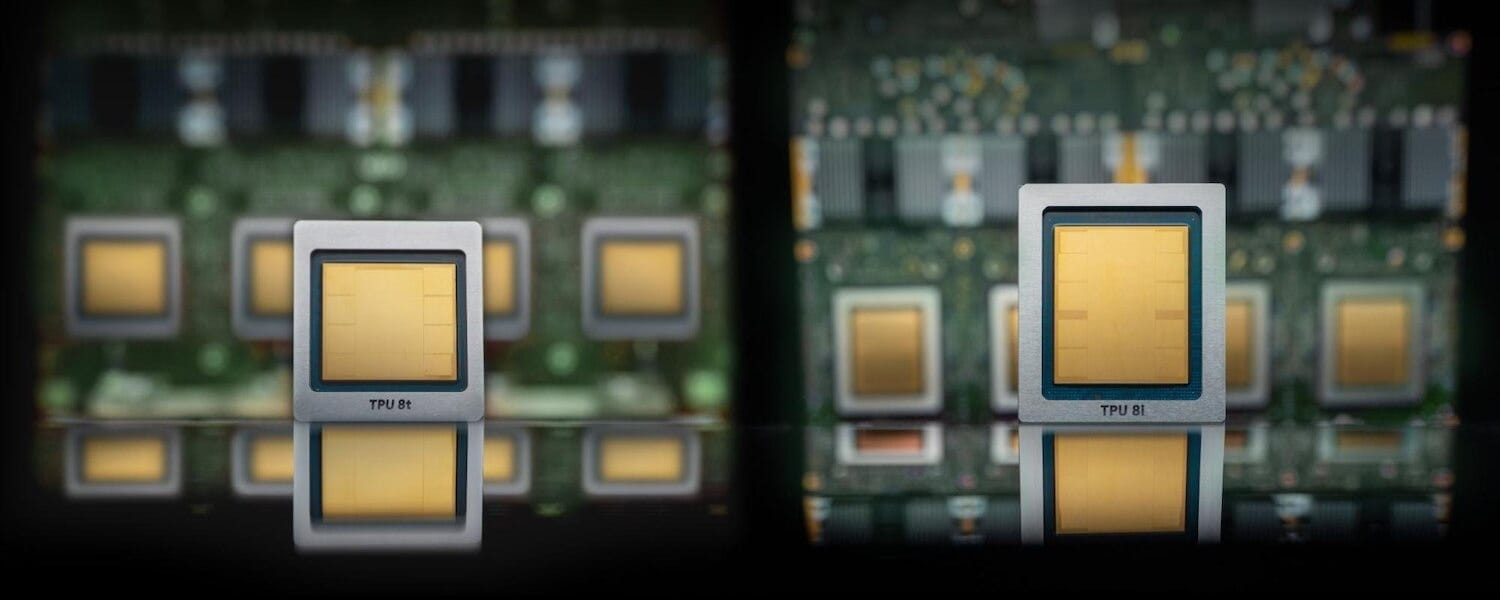
Hardware deployed across multiple buildings at New Albany includes TPU v4, v5, v6 (Trillium), and v7 (Ironwood). Google’s 8th-generation TPUs, announced in April 2026, comprise two architectures: the TPU 8t for large-scale model training and the TPU 8i optimized for low-latency inference and agentic AI workloads.
Source: Google.
Production Workloads and Cloud Services
The Central Ohio cluster serves production workloads including Search, Gmail, Maps, Cloud, and YouTube — not exclusively AI. The Google Cloud us-east5 region in Columbus, Ohio launched in 2022 with three availability zones.
Gemini Training and Multi-Data Center Architecture
Gemini training runs on TPUs end-to-end. Gemini 3 (released November 2025) was trained entirely on TPUs, as was every prior version of Gemini, and New Albany and Columbus are the primary training sites for current Gemini generations.
Source: Google.
Google’s multi-data center training relies on:
MegaScaler: Google’s internal system for splitting model training across many TPU pods and data centers.
Pathways: Google’s fault-tolerant training runtime, running over high-speed private fiber links.
Jupiter: Google’s front-end north-south network in the AI data center architecture, which is used to scale across multiple data centers for very large training runs.
Optical Transport: ZR/ZR+ optics — long-reach optical networking modules and DWDM for multiple data channels over a single fiber.
This architecture allows Gemini training to span Columbus together with its Iowa (Council Bluffs) and Nebraska (Omaha and Papillion) clusters, without network latency becoming a binding bottleneck.
Renewable Energy Portfolio
EDP Renewables. Google partnered with EDP Renewables on a 500 MWac community-based distributed solar portfolio — roughly 650 MWp — across 80+ projects primarily in Ohio and connected to the PJM grid. The portfolio supports Google’s clean-energy procurement for the New Albany campus and the Columbus Google Cloud region.
TotalEnergies. A 15-year power purchase agreement with TotalEnergies supplies 1.5 TWh of certified renewable electricity from the Montpelier solar farm in Williams County, Ohio — a 49 MW facility connected to the PJM grid.
Water Use
Source: Google.
Google’s 2024 reported water use across its Ohio data center sites:
New Albany is by far Google’s largest water-using Ohio site.
Municipal Water Architecture
New Albany’s data center water is supplied wholesale by the City of Columbus and circulates through closed-loop cooling systems that return effluent to real-time-monitored sewer infrastructure. In 2015–2016, New Albany contracted with Columbus for 16 million gallons per day of capacity to serve the Licking County portion of the International Business Park; as of April 2026, total system draw across all New Albany data center tenants peaks at ~8 million gallons per day — half of contracted capacity.
Per-operator contractual caps limit data center water use even on peak days; the city coordinates with Columbus on the ~5–6 annual peak days when data center cooling demand spikes and on-site tanks are refilled. This is the architecture underlying the campus-level withdrawal and consumption figures Meta and Google disclose.
Grid and Regulation
Service Territory and Load Trajectory
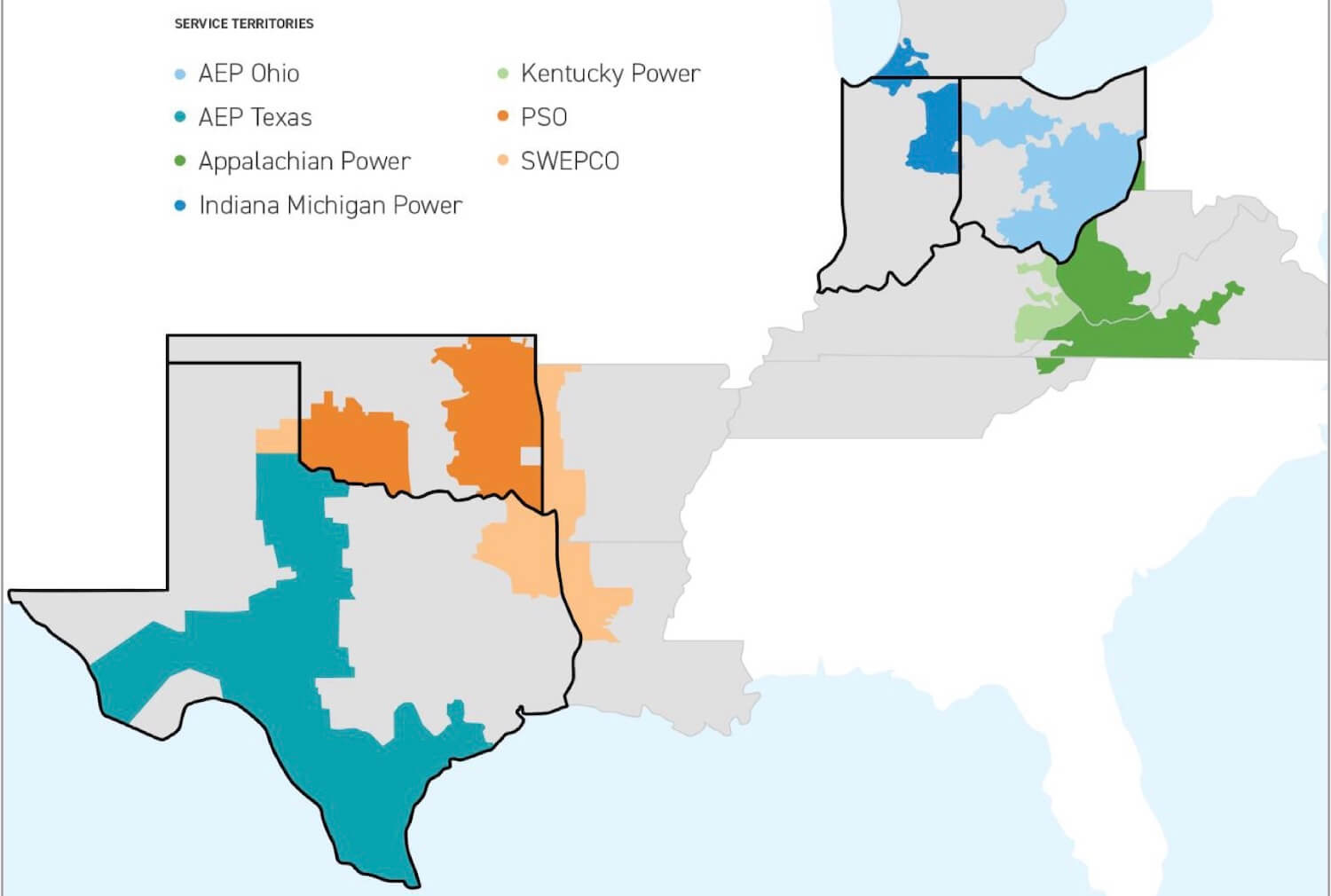
Both Meta and Google’s data center campuses sit inside AEP Ohio’s service territory within the PJM Interconnection footprint. American Electric Power (AEP) is the dominant transmission owner-operator and utility serving the Central Ohio cluster.
Source: American Electric Power (AEP).
AEP has 63 GW of incremental contracted load by 2030, with nearly 90% from data centers. Ohio accounts for roughly 12 GW — 19% of AEP’s total — second only to Texas.
AEP-reported Central Ohio data center load trajectory:
~100 MW (2020)
~600 MW (2024)
~5 GW (2030, projected)
AEP expects the New Albany area specifically — a subset of the Central Ohio trajectory above — to exceed 2 GW by the end of 2027, with more than 10 new customer requests in the area driving the buildout.
Transmission Investment
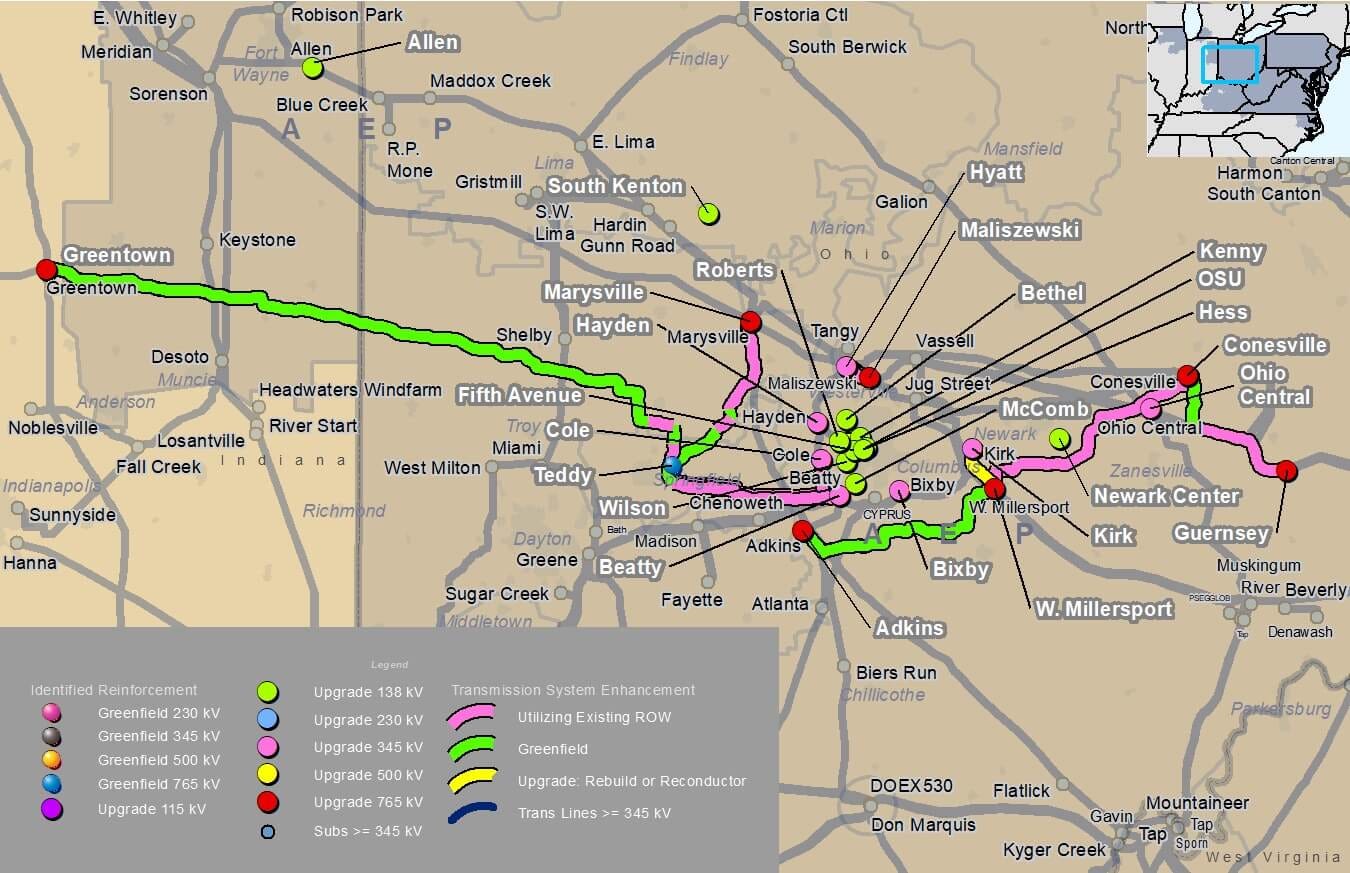
AEP, together with FirstEnergy and Evergy, has committed through their Grid Growth Ventures Ohio joint venture to a roughly $1.2 billion transmission project in Central Ohio, approved by the PJM Board in February 2026. The project will add roughly 300 miles of new 765-kV transmission lines — including the Greentown–Teddy (~137 miles), Teddy–Marysville, Guernsey–Conesville, and West Millersport–Adkins corridors — along with a new Teddy 765/345 kV substation and supporting 345 kV ties around Columbus, targeting a June 2030 in-service date, primarily to serve surging electricity demand from data centers.
Source: PJM.
Within the Meta-tied portion, AEP’s regulatory filings itemize approximately $296 million of customer-driven transmission specifically supporting the Green Chapel interconnection:
~$87 million for the Green Chapel 138 kV greenfield substation and eight associated network upgrades.
~$209 million for two new 345 kV transmission lines — Vassell–Green Chapel (~13 miles) and Vassell–Curleys (~12 miles) — both originating at AEP’s existing Vassell 345 kV Station in Delaware County, Ohio.
Tariffs and Taxes
AEP Ohio established the electric utility industry’s first approved data center tariff, requiring hyperscalers with loads of 25 MW or more to sign 12-year take-or-pay contracts carrying an 85% minimum-demand charge. The framework is designed to ensure data center customers cover their own infrastructure costs rather than shifting them onto residential ratepayers.
Both Meta and Google benefit from Ohio’s data center sales-tax statute (ORC §122.175), which exempts qualifying data center equipment from sales tax — covering operational property, cooling systems, electrical infrastructure (generation, transformation, transmission, distribution), and construction materials incorporated into the data center. Eligibility requires $100 million+ in capital investment over the qualifying period and $1.5 million+ in annual payroll at the project site.
At the municipal level, both Meta (via Sidecat, LLC) and Google (via Montauk Innovations, LLC) hold City of New Albany Community Reinvestment Area (CRA) agreements that grant 100% real-property tax abatement for 15 years. Meta’s CRA expanded the abated footprint from 200 acres at $750 million to a cumulative ~488 acres across Green Chapel Road and Clover Valley Road, while Google’s CRA covers the Jug Street/Harrison Road parcel.
In 2025, Ohio’s House Bill 15 carved “self-generators” and “mercantile customer self-power systems” out of the state’s “public utility” definition, placing on-site generation that serves a single large customer outside PUCO jurisdiction and explicitly permitting third-party ownership and power purchase agreements (PPAs) — the enabling framework for Meta’s Socrates South behind-the-meter gas plant. The same year’s biennial budget bill, House Bill 96, added complementary data center sales- and use-tax provisions plus a narrow grandfather clause for certain pre-HB15 utility BTM applications. Together, HB15 and HB96 position Ohio as one of the strongest U.S. jurisdictions for on-site data center power.
Outlook
Source: Meta Platforms.
Columbus and New Albany today represent the leading edge of gigawatt-class AI infrastructure. For Meta, Prometheus is the first 1 GW cluster in a generation that extends to Hyperion — a disclosed 5 GW successor in Richland Parish, Louisiana, beginning in 2028 — signaling that Prometheus is the floor of gigawatt-scale AI, not the ceiling. For Google, Columbus’s role as the primary Gemini training site is reinforced by MegaScaler and Pathways running over high-bandwidth optical transport links, enabling continued Gemini scaling by interconnecting Columbus with other Google regions rather than relying on single-site expansion alone.
Across Google’s nine major data center states, Ohio’s footprint is growing the fastest. The company has invested $20 billion+ in Ohio since 2019 — the same cumulative figure Iowa (Council Bluffs, since 2007) reached over roughly 18 years. Oklahoma ($15 billion), South Carolina ($13 billion), and North Carolina ($4 billion) — all operating since 2007 — trail Ohio despite earlier starts.
Meta and Google’s campuses sit inside a broader New Albany cluster of close to 40 data centers, alongside Intel, Amazon, Amgen, and a Health & Beauty campus — totaling $47 billion+ in private investment, 36 million square feet of development, and 26,000 new jobs across the New Albany International Business Park. Meta and Google are the largest data center anchors within this cluster.
Announcing Google’s 8t and 8i TPUs in April 2026, Google’s SVP and Chief Technologist for AI and Infrastructure, Amin Vahdat, observed: “In today’s data centers, power, not just chip supply, is a binding constraint.” The Central Ohio cluster’s AEP transmission buildout, Socrates South gas generation, and the Vistra–Oklo–TerraPower–Constellation nuclear agreements are therefore not ancillary disclosures — they are the core gating factor on AI scale.
Measured AI provides institutional-grade analysis of the physical infrastructure powering AI data centers. For access to our full research library, regulatory intelligence, and weekly briefings, visit MeasuredAI.com.