


SpaceX’s Super Intelligence segment — formerly xAI, then SpaceXAI, now SpaceXSI — has changed names faster than it fills data centers with GPUs, which, by its own standards, is saying something.
That deployment speed has become a commercial advantage: customers are paying a premium for immediately available capacity in large, tightly interconnected GPU clusters, with SpaceX reporting pricing slightly above $50 per watt annually for short-duration contracts. At current pricing, the company says, new compute deployments pay back in less than a year, and Elon Musk has suggested payback could shorten to six months in 2027.
Newly activated cloud agreements with Anthropic, Google, and Reflection AI have transformed SpaceXSI’s revenue trajectory, while the growth of internal applications like Grok and Cursor creates another source of demand. The resulting investment program in 2026 spans 1.44 million NVIDIA GPUs, industrial building retrofits, purpose-built AI data centers, dedicated on-site generation, gas transportation, and battery storage.
The build is already at gigawatt scale: SpaceX reported 1.7 GW of installed nameplate compute capacity as of September 30, 2026. Measured AI’s estimates, based on SpaceX’s disclosed NVIDIA GPU counts and chip-specific server/rack power assumptions, suggest Colossus I and II could reach a combined 2.7 GW by year-end 2026. Moreover, Musk said he is “highly confident” that SpaceX will bring online 10 GW of additional compute during 2027, reaching 13 GW of total compute capacity by year-end 2027. Separately, SpaceX aims to build 20 GW of incremental power and cooling infrastructure ahead of that deployment.
The central infrastructure questions are whether these ambitious expansion targets are achievable — requiring an average of more than 800 MW a month of new compute capacity to come online in 2027 — and how quickly commercial demand can be translated into energized, cooled, and operational computing capacity. Colossus I and the rapidly expanding Colossus II campus illustrate the approach: accelerate initial deployment through retrofits, scale up by acquiring land for purpose-built AI data centers, assemble power infrastructure ahead of GPU arrivals, and build America’s largest grid-connected battery storage system to smooth GPU power fluctuations and stabilize generation.
SpaceX has recently accelerated its near-term build-out of data centers and supporting infrastructure, particularly around Memphis, Tennessee, and neighboring Southaven, Mississippi. In total, SpaceX has five operational or under-construction data center locations, a possible sixth retrofit where site work is underway, and hundreds more acres of developable land. Supporting them are the 1.24 GW Southaven Power Plant, advancing gas pipeline infrastructure, and about 1,200 Tesla Megapack 2 XL battery energy storage systems that can store up to 4.7 GWh.
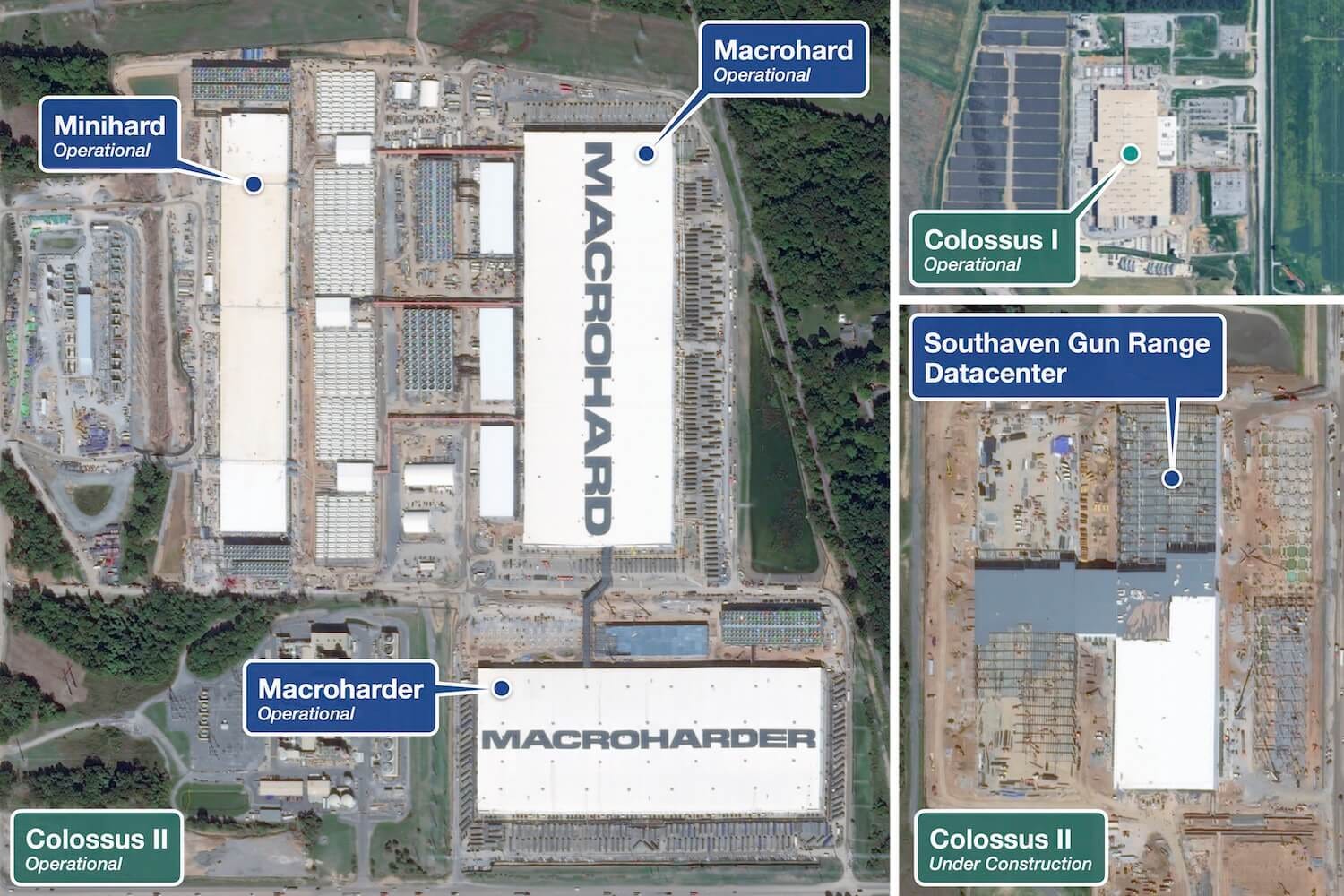
SpaceX’s five operational or under-construction data center locations across Memphis, Tennessee, and Southaven, Mississippi, as of October 2026. Colossus I (upper right); Macrohard, Macroharder, and Minihard (left); and the Southaven Gun Range Datacenter under construction (lower right). Source: Vantor, October 8, 2026, annotated by Measured AI.
I. Commercial Rationale: Monetizing Scarce Capacity
Super Intelligence, formerly reported as AI, generated $7.56 billion of revenue in Q3 2026, up 195% from the prior quarter. That was approximately 52% of SpaceX’s revenue, making the segment the company’s largest. Newly activated cloud agreements drove most of the increase. SpaceX’s consolidated backlog rose from $47.5 billion at the end of Q2 2026 to $63.0 billion at the end of Q3, with approximately $42 billion expected to be recognized within 12 months.
SpaceX’s cloud agreements, including those with Anthropic and Google, show how scarce capacity is being contracted: they typically run three years, yet either party can walk away on 90 days’ notice after an initial period.
Across five cloud agreements, SpaceX has contracted over 700,000 NVIDIA GPUs representing more than 1.2 GW of power capacity and $54.5 billion in annualized revenue, equivalent to $76,494 per GPU annually, $8.73 per GPU-hour, and $44 per watt annually.
Anthropic’s May 2026 agreement for 325,000 NVIDIA GPUs generates $15 billion of annual revenue for SpaceX, or about $33 per watt. Google’s June 2026 agreement covers a more modern fleet of 110,000 NVIDIA GPUs for $11 billion annually, or nearly $50 per watt.
The four non-Anthropic agreements account for just 54% of contracted GPUs but 72% of annualized revenue, generating more than twice the revenue per GPU and highlighting the substantial monetization premium associated with the latest NVIDIA GB300 systems. By contrast, Anthropic’s original 325,000 contracted GPUs are largely older hardware: Colossus I’s H100s and H200s, which SpaceXSI freed up by moving Grok training to newer Blackwell clusters.
II. Compute and Data Centers: Retrofits, Higher Density, and a Cross-Border Campus
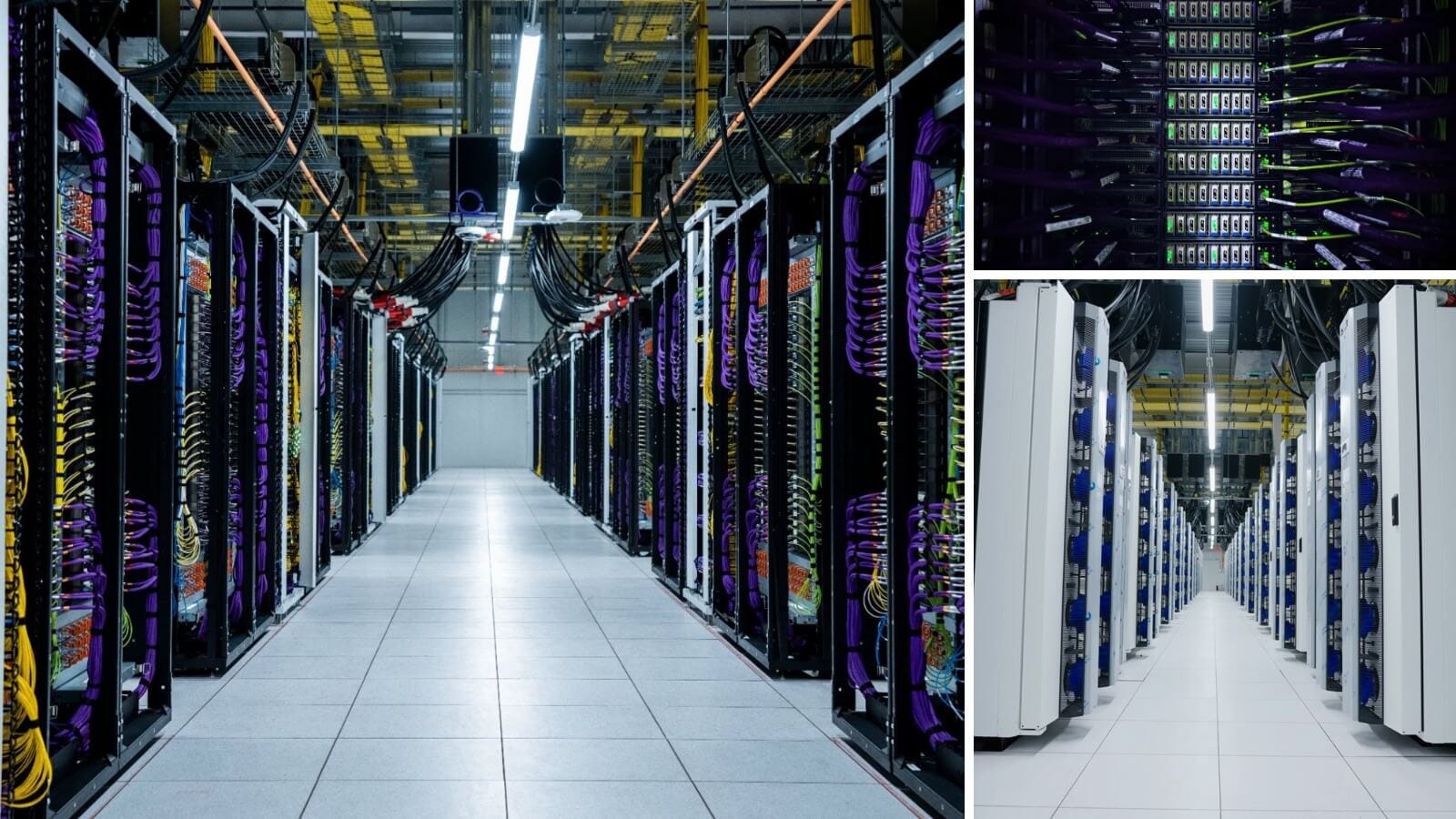
SpaceXSI builds exclusively on NVIDIA GPUs, and NVIDIA considers it a “lead partner.” As of October 2026, its inventory totals 1 million NVIDIA GPUs: 230,000 at Colossus I and 770,000 at its Colossus II campus. The GPU mix has transitioned from primarily H100 and H200 systems at Colossus I to GB200 and, increasingly, GB300 deployments at Colossus II.
Source: SpaceX.
Two More GB300 Tranches: 1.44 Million GPUs and 2.7 GW by Year-End
Two more GB300 tranches are expected: 220,000 GPUs in November 2026 and another 220,000 potentially operational by late December 2026. Together, these deployments would add 886 MW of compute capacity, bringing the combined Colossus fleet to as many as 1.44 million GPUs and approximately 2.7 GW by year-end 2026, in line with Musk’s own estimate of 2.5–3.0 GW by year-end.
SpaceX’s current deployment cadence is 220,000 NVIDIA GB300s a month, and Musk said, “That pace will obviously accelerate next year. We’re not going to slow down.”
In 2027, deployment is expected to be “primarily” Vera Rubin compute, including a planned 440,000-GPU Vera Rubin training cluster by the end of Q2 2027.
Colossus I Establishes the Retrofit Model
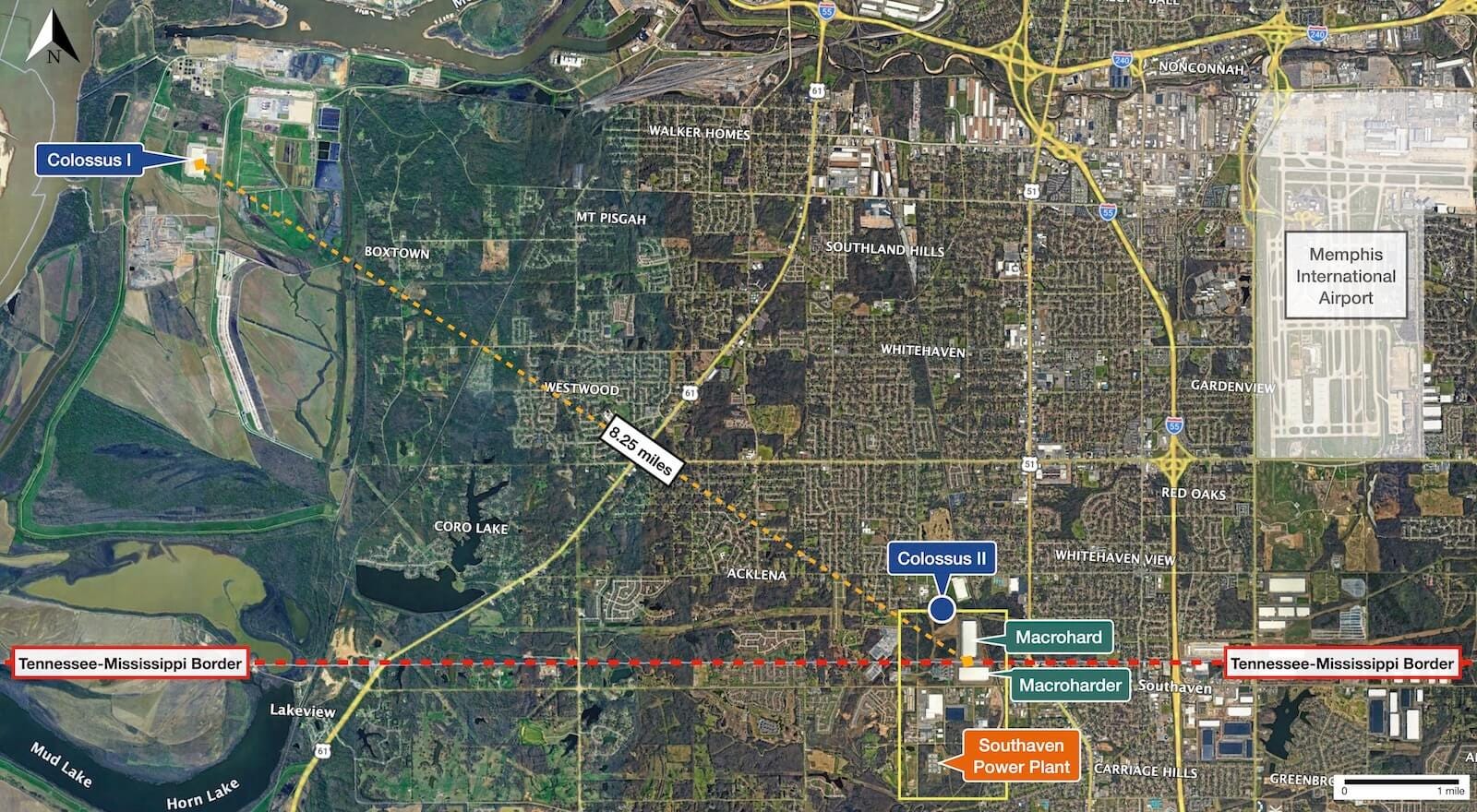
Colossus I occupies the former Electrolux appliance plant at 3231 Paul R. Lowry Road in Memphis, approximately eight miles from Colossus II.
Source: Google Earth, annotated by Measured AI.
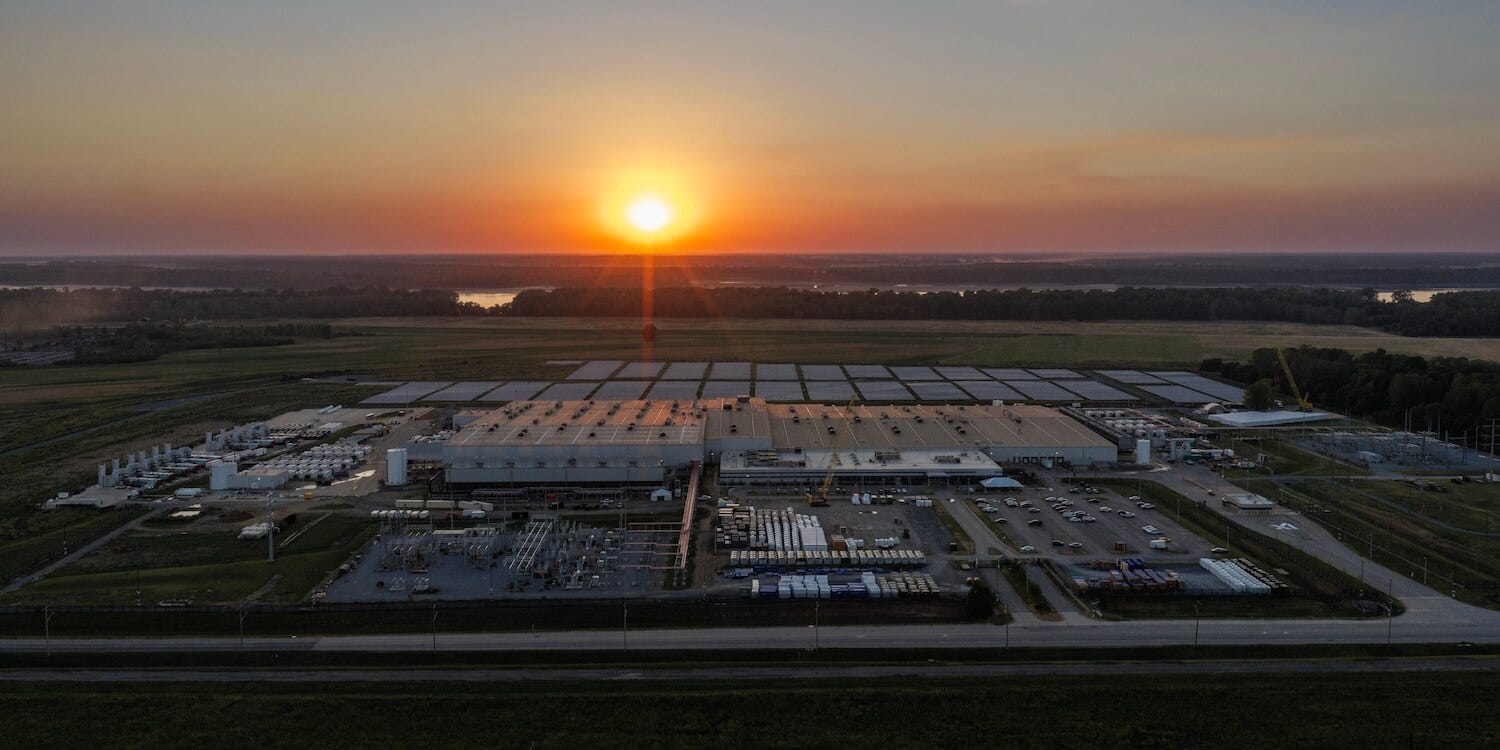
Retrofitting of the 785,000-square-foot building began in April 2024; compute operations started in July 2024, and the building reached full capacity in July 2025.
Source: SpaceX.
The site draws 150 MW of grid power from the Tennessee Valley Authority (TVA), delivered through Memphis Light, Gas and Water, with capacity to increase to 300 MW once a second substation is completed and energized. Grid supply is supplemented by approximately 247 MW of on-site natural gas generation from 15 Solar Turbines SMT-130 units, each rated at 16.5 MW. Supporting infrastructure includes 240 Megapacks and an 88-acre solar photovoltaic installation.
The Colossus I facility houses 230,000 NVIDIA H100, H200, and GB200 GPUs, equivalent to about 294 MW of compute capacity. Its network uses NVIDIA Spectrum-X Ethernet, with 400GbE BlueField-3 SuperNICs and SN5600 switches. Anthropic has contracted the site’s entire GPU fleet as part of its 325,000-GPU agreement, which spans both the Colossus I and II campuses.
Colossus II Extends the Model Across Memphis and Southaven
Colossus II is a collection of data centers and supporting infrastructure near the Tennessee–Mississippi border, rather than a single building. Its development combines warehouse conversions with purpose-built data center space and a dedicated generation site, known as the Southaven Power Plant. This configuration ties each new block of floor space to a largely off-grid power system that serves several nearby data centers.
The satellite imagery below illustrates how Colossus II’s data centers, generation, battery storage, and expansion properties are distributed across the Tennessee–Mississippi border. Macrohard and Minihard occupy adjacent sites in Memphis, while Macroharder, the Southaven Power Plant, and the two-building Southaven Gun Range Datacenter now under construction are in Mississippi. The campus also includes two Tesla Megapack installations totaling 960 units and approximately 3.7 GWh of energy storage, alongside recently acquired industrial properties offering potential retrofit and new-build opportunities.
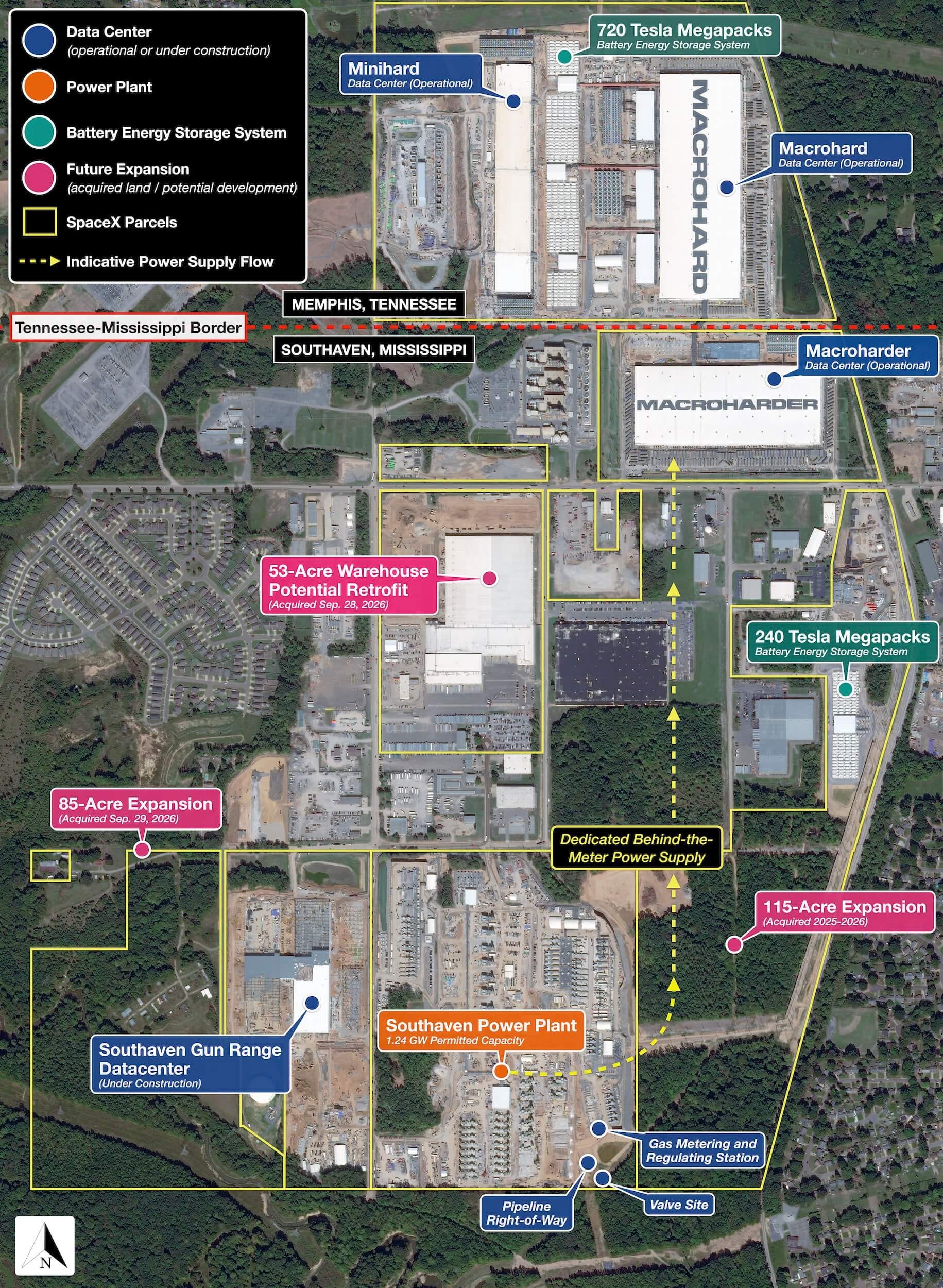
SpaceX’s Colossus II infrastructure footprint across Memphis, Tennessee, and Southaven, Mississippi, in October 2026. Blue markers identify four data center sites; orange identifies the Southaven Power Plant; green identifies existing battery storage; pink identifies potential expansion properties; and yellow outlines SpaceX-affiliated landholdings. Gas infrastructure annotations identify recorded easements. Source: Vantor, October 8, 2026, annotated by Measured AI.
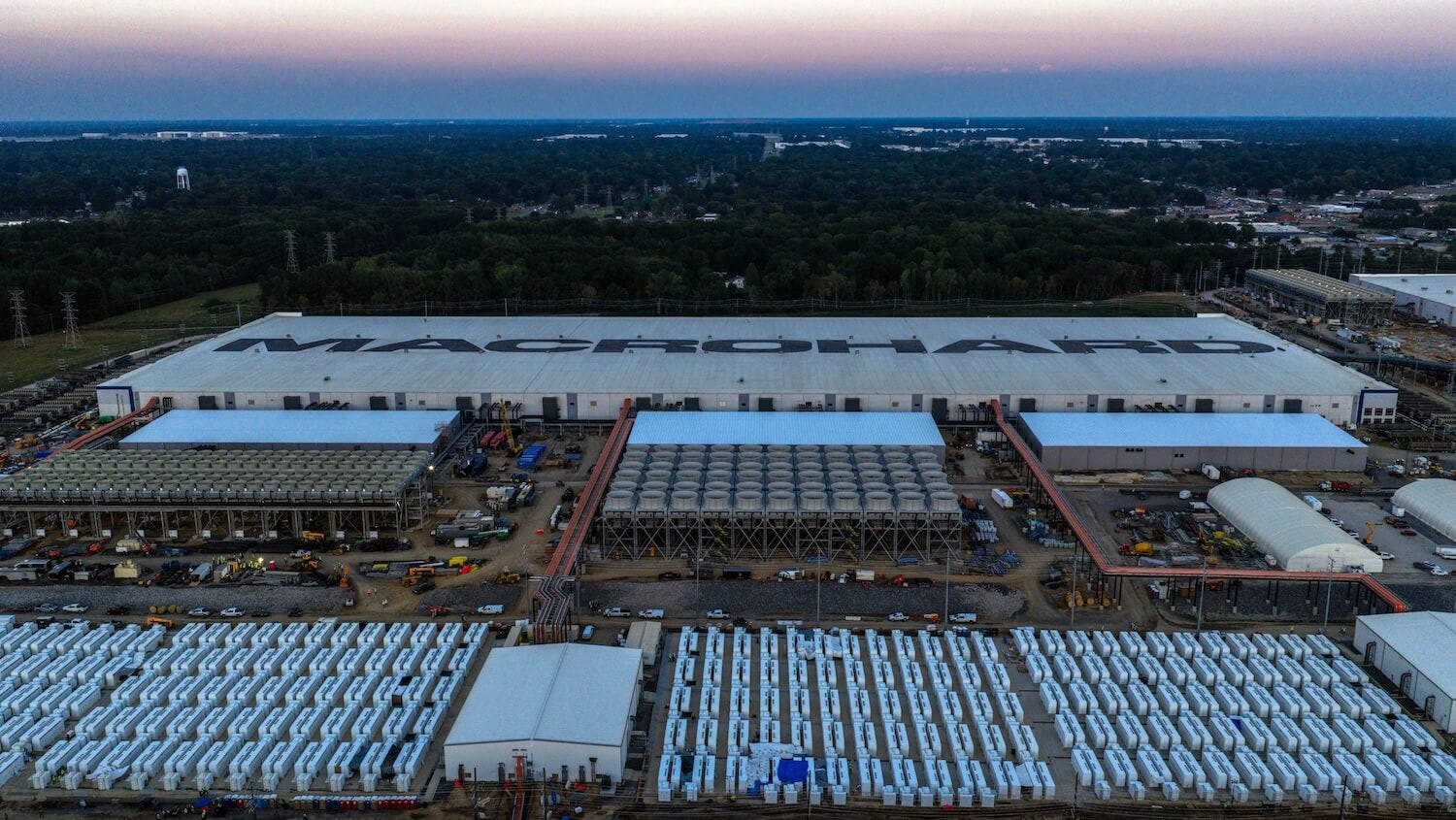
Macrohard, at 5420 Tulane Road in Memphis, occupies a 1-million-square-foot former logistics and distribution warehouse. Retrofitting began in February 2025, and the facility came online in January 2026.
Source: SpaceX.
Macrohard operates substantially off-grid, receiving dedicated behind-the-meter electricity from the 1.24 GW Southaven Power Plant at 2875 Stanton Road South, across the border in Southaven, Mississippi. It houses 330,000 NVIDIA GPUs (110,000 GB200s and 220,000 GB300s), equivalent to 634 MW of compute capacity.
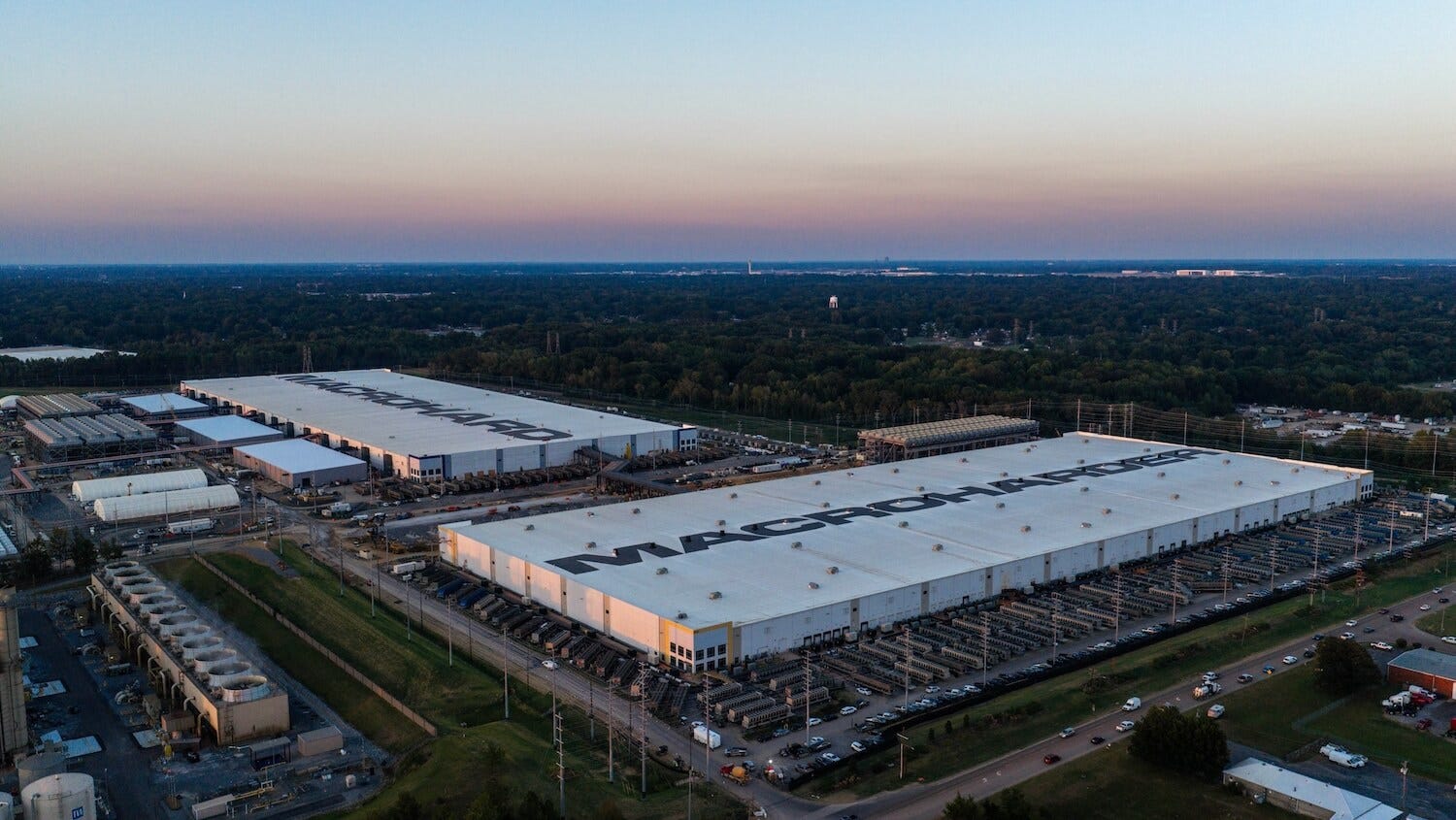
Macroharder, at 2400 Stateline Road West in Southaven, extends the retrofit approach into Mississippi. The former GXO Logistics warehouse is located across the street from Macrohard and provides 810,225 square feet of space.
Source: SpaceX.
Conversion began in December 2025. Macroharder houses 220,000 GB300 GPUs, equivalent to 443 MW of compute capacity, and uses 800 Gbps network interface cards. Like Macrohard, it draws power from the dedicated Southaven Power Plant.
A Shift Toward Purpose-Built AI Capacity
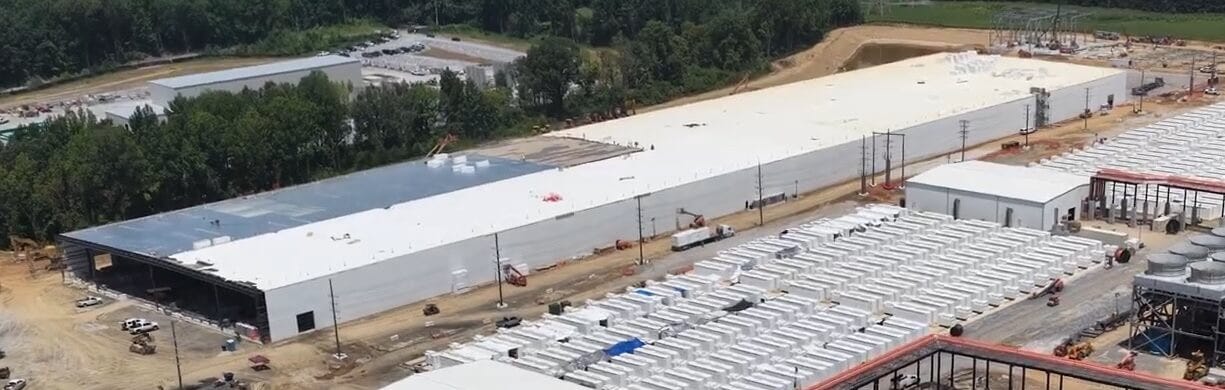
Minihard, immediately adjacent to Macrohard at 5414 Tulane Road, represents the start of SpaceX’s purpose-built phase. Built as a pre-engineered metal building rather than as a retrofit of an existing industrial facility, Minihard shows how SpaceX is accelerating data center construction. Its building permit was issued in March 2026, and it became operational just seven months later, in October 2026.
Source: Tom Wright.
The 312,365-square-foot facility houses 220,000 GB300 GPUs with 800 Gbps network interface cards. The contrast with Macroharder, a retrofit, is significant: both hold 220,000 GB300 GPUs and 443 MW of compute capacity, but Minihard fits them into a far smaller building at much higher density. Between the two Memphis buildings sit 720 Megapacks, arranged in six clusters of 120 units each.
SpaceX’s latest confirmed project continues Musk’s penchant for unconventional data center names. The Southaven Gun Range Datacenter at 8325 Tulane Road is under construction as of October 2026, after Southaven’s Board of Aldermen approved the design on September 1, 2026.
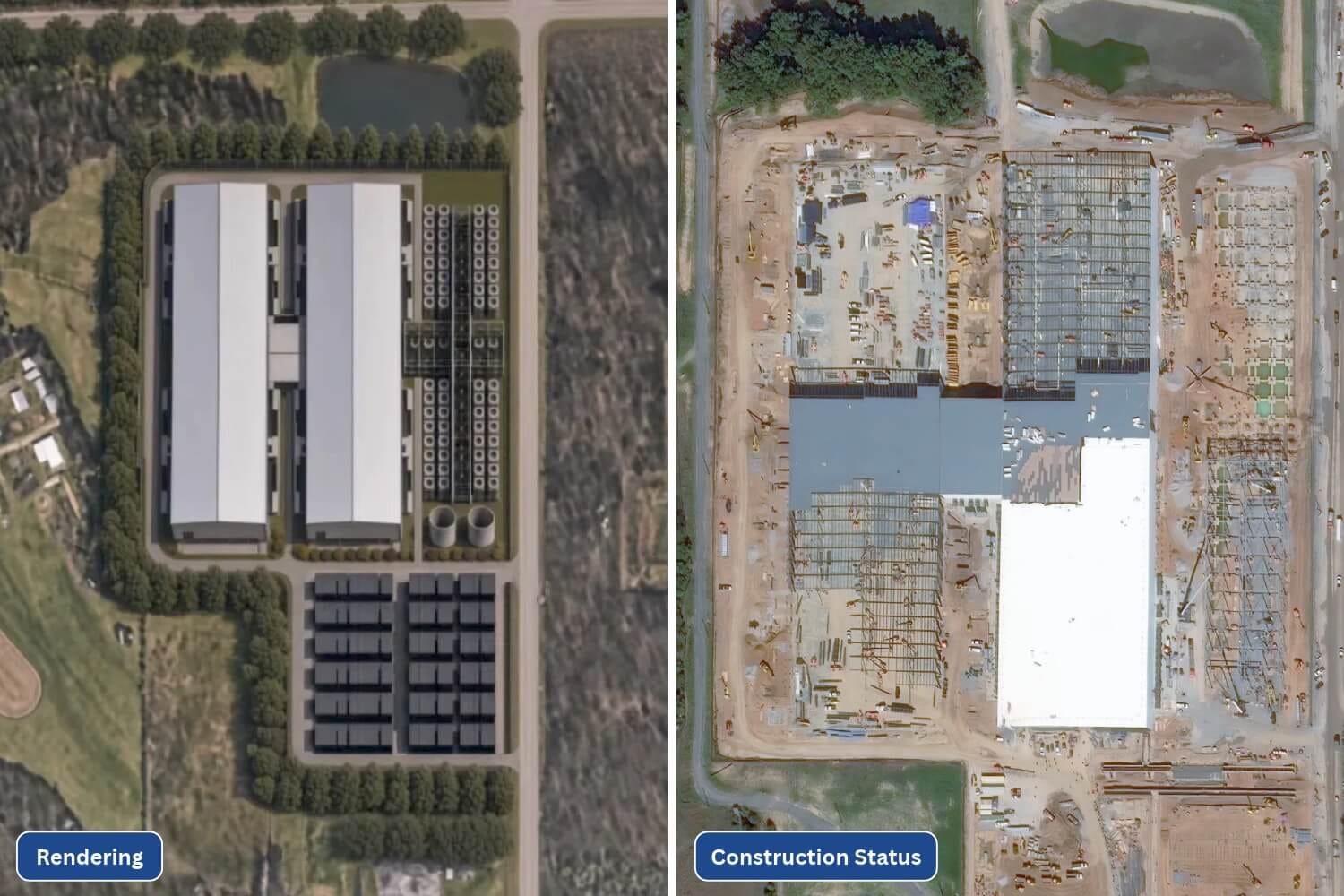
Source: City of Southaven, Mississippi; Vantor, October 8, 2026.
Situated immediately west of the Southaven Power Plant, the Southaven Gun Range Datacenter comprises two parallel, single-story pre-manufactured metal buildings totaling 642,660 square feet, reflecting SpaceX’s growing preference for purpose-built data centers over industrial retrofits to shorten construction timelines. Its design also includes a southern battery-storage pad, which appears capable of accommodating approximately 180 Megapacks.
Southaven Retrofits and Developable Land Create Optionality
Recent acquisitions have expanded SpaceX’s room to grow in Southaven. On September 28, 2026, SpaceX subsidiary MZX Tech acquired 53 acres at 2929 Stateline Road West in the Freeport Industrial Park, just 1,000 feet southwest of its Macroharder data center. The property holds a 776,000-square-foot multi-temperature cold-storage warehouse, creating a possible future retrofit for SpaceXSI.
Satellite imagery from October 2026 shows that extensive site clearing, grading, and excavation have already replaced parking lots and greenfield areas, while the warehouse itself remains largely unchanged.
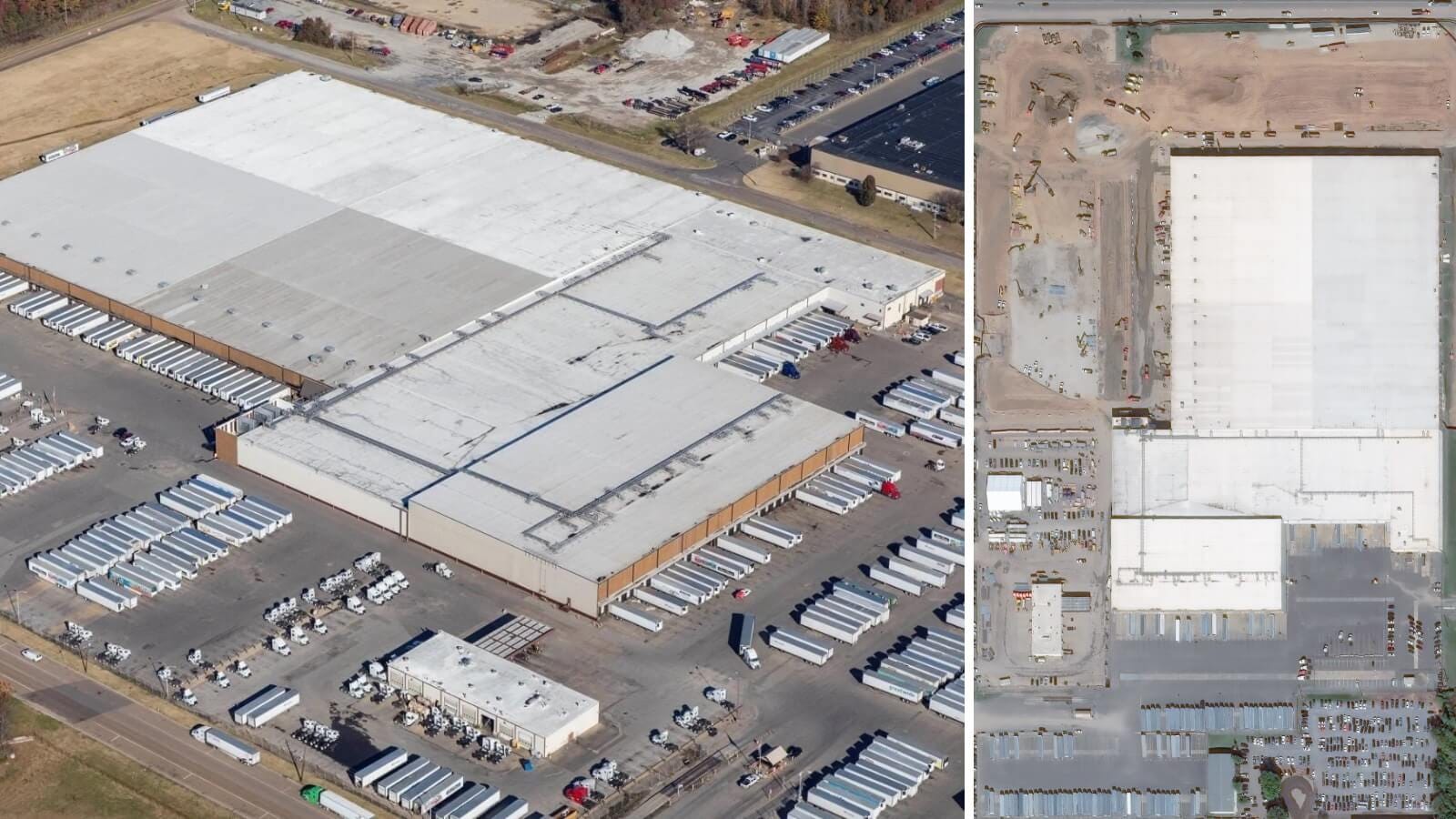
Source: Mandich Group and Vantor, October 8, 2026.
On September 29, 2026, SpaceX’s MZX Tech acquired 85.2 acres at 3275 Stanton Road South, directly west of its Southaven Gun Range Datacenter development. SpaceX also owns at least 130 more acres nearby in Southaven, from purchases of 104.6 acres in December 2025 and 26.5 acres in February 2026. Part of this land already holds 240 Megapacks.
III. Power Infrastructure: Building Beyond Grid Availability
SpaceXSI’s power strategy combines utility service, dedicated generation, mobile equipment, long-lead turbine procurement, and storage. Relying heavily on behind-the-meter supply lets facilities come online quickly without waiting on new grid deliveries. That reliance also makes fuel, generation equipment, and electrical controls direct dependencies of the compute business.
The table below identifies approximately 8.7 GW of potential power infrastructure across SpaceX and Musk-affiliated entities:
Excludes the 57 temporary turbines, about 1.5 GW of nameplate capacity, still operating at Southaven as of September 2026, all of which will be retired by July 2027.
The portfolio’s value lies in offering SpaceXSI several routes to electricity, but those routes do not all open at once. The largest category, gas and steam turbines from Doosan Enerbility, is contracted equipment with deliveries extending into 2029.
SpaceX has also been linked to a $1.465 billion contract announced by FTAI Aviation on July 22, 2026, for Mod-1 CFM56 aeroderivative gas turbine generator sets, each rated at 25 MW, with deliveries scheduled through November 2027. FTAI expects the contract to account for a substantial portion of its 2027 delivery target of approximately 100 units (2.5 GW). The order was placed through FTAI’s joint venture with China’s Jereh Group.
Southaven’s Off-Grid Generation Anchors Colossus II
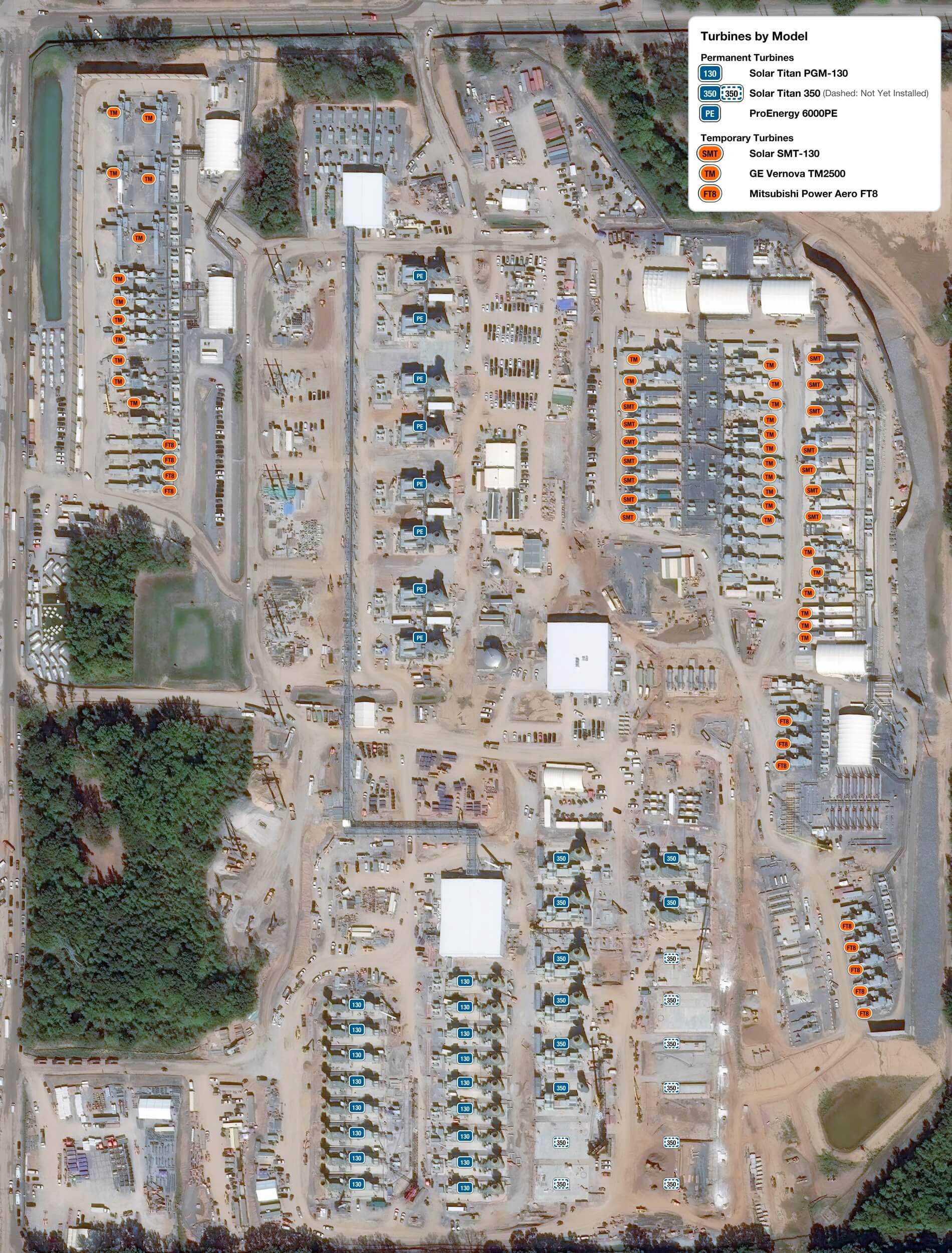
Source: Vantor, October 8, 2026.
The permanent Southaven Power Plant has a permitted capacity of 1.24 GW across 41 turbines:
Stateline Power, a joint venture between SpaceX and Solaris Energy Infrastructure, leases SpaceX 33 of the plant’s Solar Turbines units, with a combined permitted rating of 840 MW.
57 Temporary Turbines Must Retire by July 2027
Beyond the permanent plant, SpaceX deployed 68 temporary, trailer-mounted turbines at the Southaven Power Plant between August 2025 and July 2026 (a 69th was never delivered). The Mississippi Department of Environmental Quality (MDEQ) issued an amended turbine inventory on September 11, 2026. It lists each unit at its OEM nameplate rating, 1.88 GW in total, and shows that 11 units have already been retired, leaving 57 turbines and about 1.53 GW in operation:
Many of these turbines came with SpaceX’s $2 billion acquisition of APR Energy in May 2026, which brought in a 1.1 GW fleet that included 20 GE TM2500 turbines and 10 Mitsubishi FT8 packages.
Under an agreed order signed on July 30, 2026, between SpaceX’s MZX Tech and MDEQ, SpaceX committed to retire every temporary turbine by July 2027. By August 28, 2026, 11 turbines, about 350 MW, had been retired. By December 31, 2026, 16 more will be retired: the 14 SMT-130s and two TM2500s, about 290 MW. The remaining 41 temporary units, about 1.2 GW, will retire between March and July 2027, by which point Colossus II must run on the permanent plant, TVA supply, and whatever Doosan capacity has arrived.
Doosan: 18 Turbines and 6.78 GW on Order Through 2029
SpaceX’s largest long-term procurement program is with Doosan Enerbility, a South Korean manufacturer of power-generation equipment.
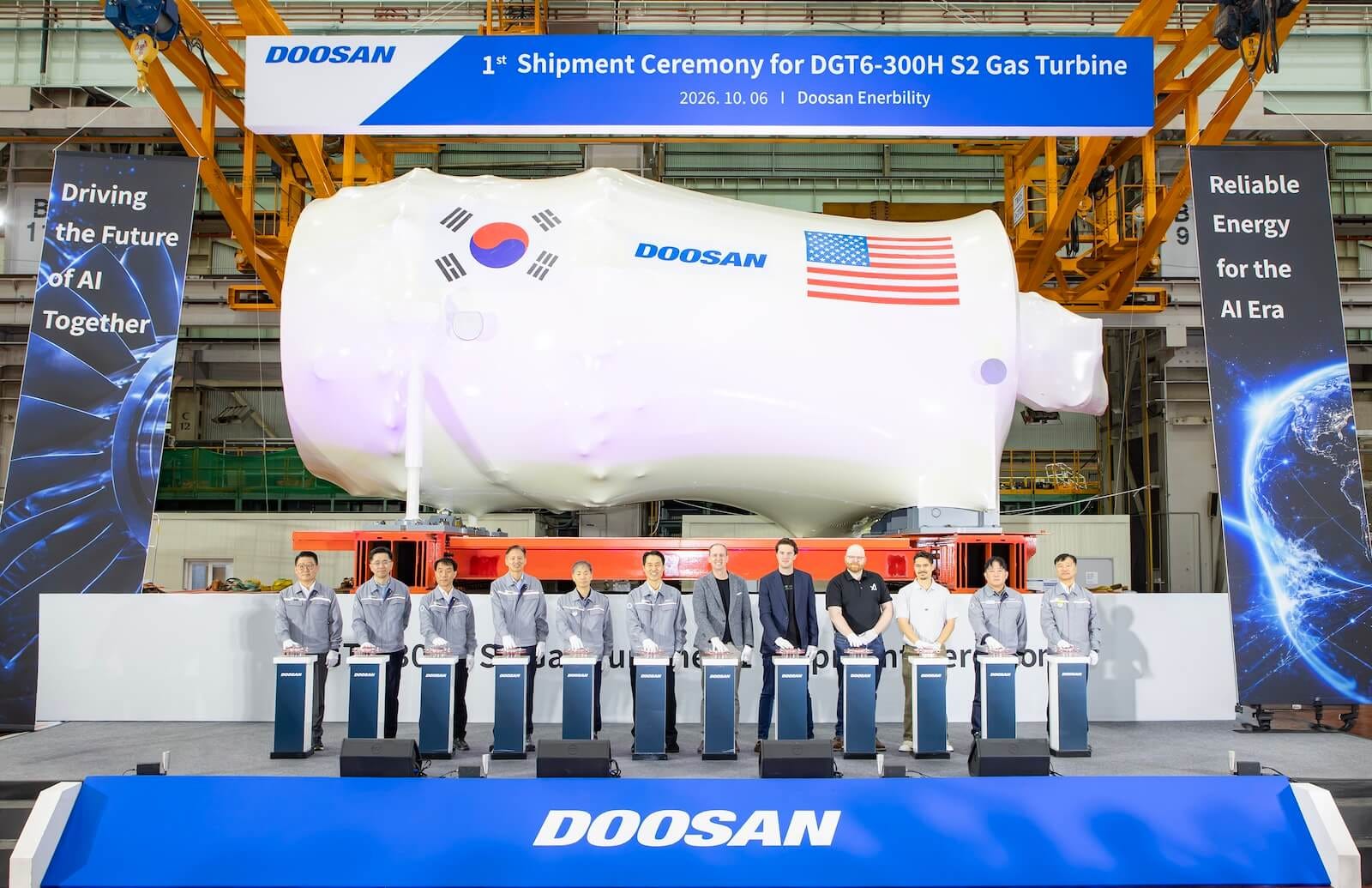
Source: Doosan Enerbility.
SpaceX’s orders to date comprise 12 Doosan DGT6-300H S2 gas turbines rated at 380 MW each and six 370 MW-class steam turbine generators. The delivery sequence is staged from late 2026 through 2029:
Gas Transportation Makes Generation Usable
Fuel infrastructure is taking shape inside the Southaven Power Plant site. Three easements recorded on October 19, 2026, grant Texas Gas Transmission, a pipeline operator owned by Loews Corporation through its Boardwalk group, rights to install and operate pipelines, meters, and valves at 2875 Stanton Road South. Survey drawings indicate easements for a 75-foot-wide pipeline right-of-way, a gas metering and regulating station, and a valve site.
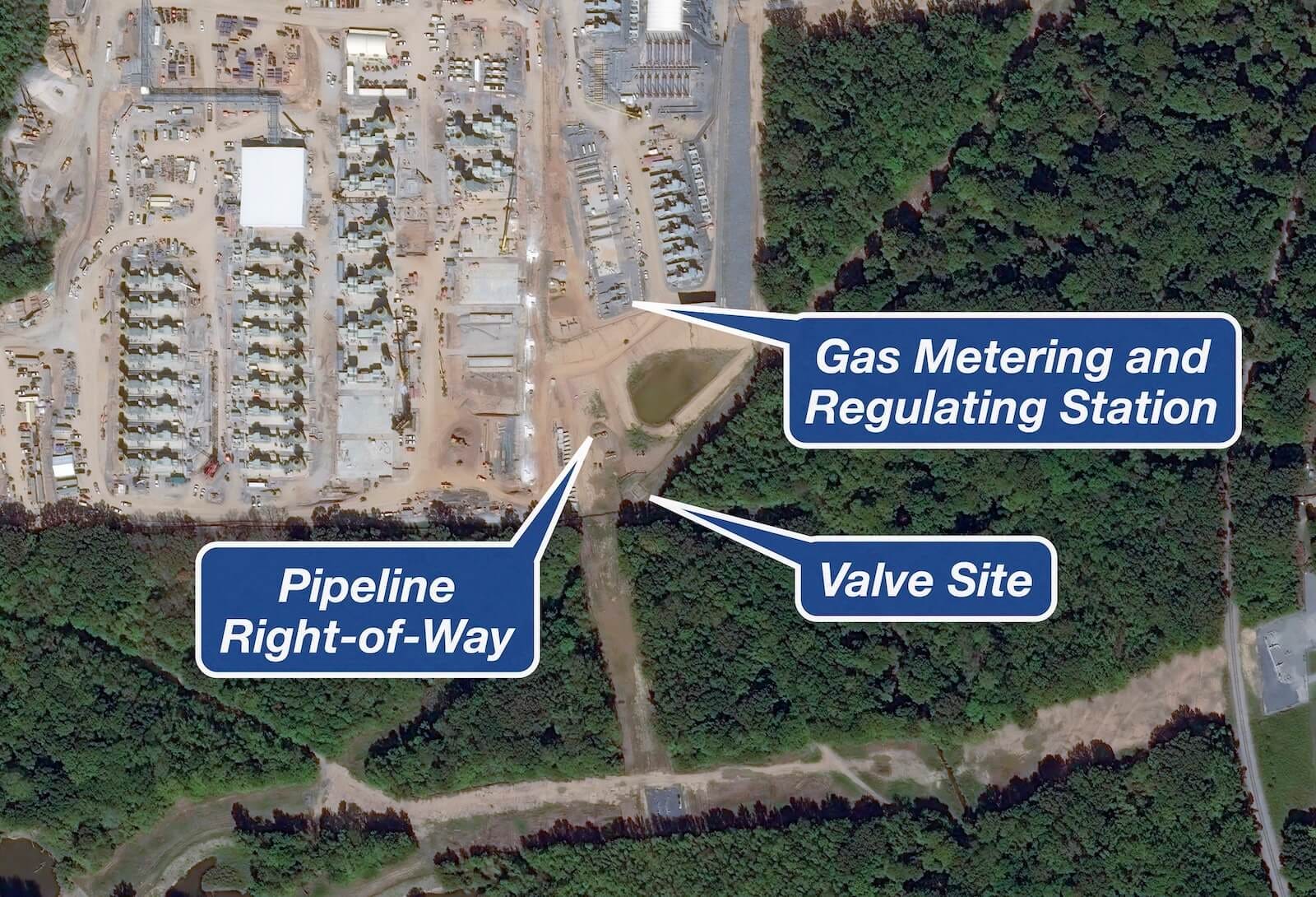
Source: Vantor, October 8, 2026.
Texas Gas customer records list three transportation contracts with SpaceX’s MZX Tech, including one extending through June 2035, with Tenaska Marketing Ventures acting as agent. Scheduled deliveries for October 20 totaled 278,000 MMBtu, with two delivery points administered under “MZX Deduct.” Together, these records tie the plant’s permitted turbines to physical gas supply.
Megapacks Help Control Rapid AI Load Swings
Battery storage performs two distinct functions for SpaceXSI: keeping compute running through supply interruptions or peak-demand curtailment, and smoothing rapid changes in AI computing loads.
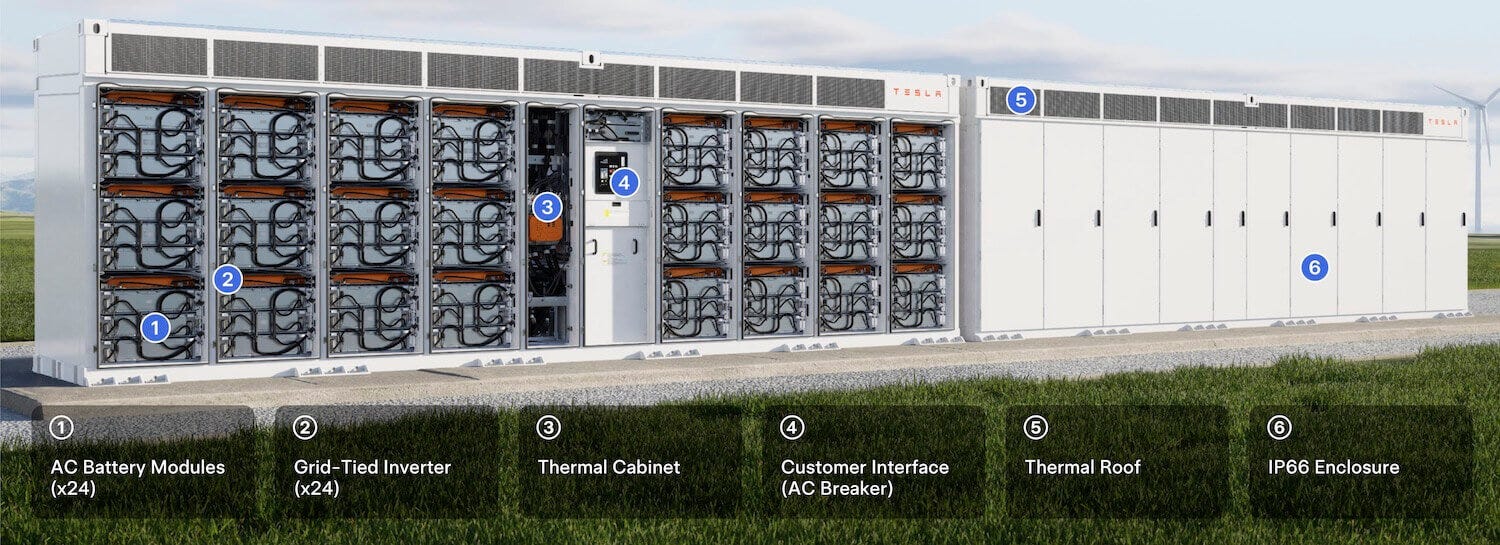
Source: Tesla.
Across the Colossus I and Colossus II campuses, Measured AI has identified 1,200 Megapacks in three distinct locations, which together comprise 4.7 GWh of energy storage capacity. The Colossus II battery deployments alone would constitute America’s largest grid-connected battery installation, according to SpaceX.
Load smoothing is particularly important for SpaceX’s dedicated generation architecture. Synchronized training loads can change by 10–20 MW several times per second. Batteries wired in parallel can discharge during load spikes and charge during dips, reducing the variation presented to the generating equipment. Megapack grid-forming control is credited with removing more than 70% of this variability.
Beyond the 1,200 Megapacks already deployed across Colossus I and II, company renderings suggest about 1,380 more will follow as future data centers are built out. Based on the rendering below, Measured AI estimates that about 1,200 will go at the southwest corner of the Southaven Power Plant property and about 180 on the southern portion of the Southaven Gun Range Datacenter site.
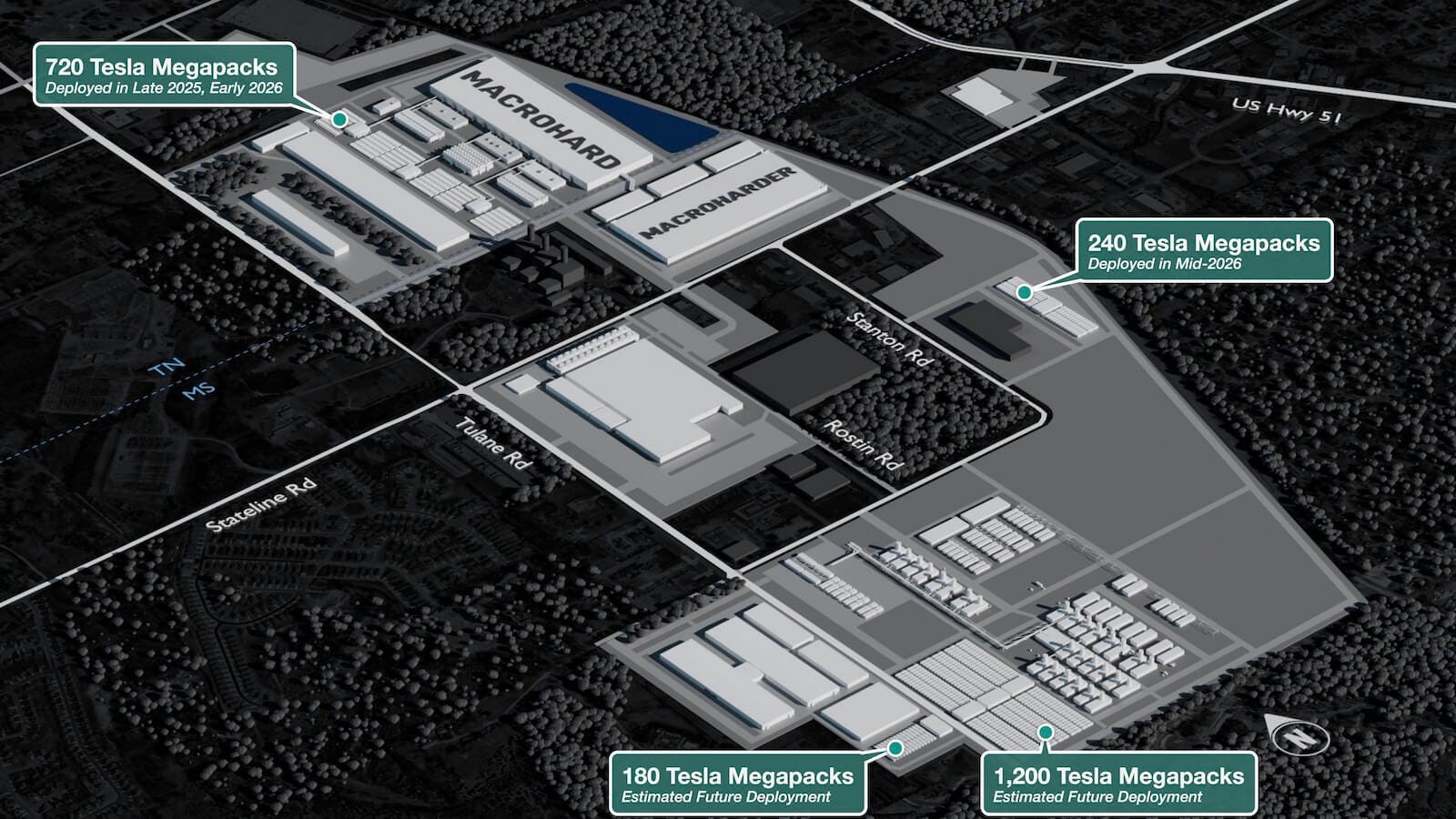
Source: SpaceX, annotated by Measured AI.
IV. Future Expansion: Capital, Sequencing, and Execution Constraints
One Path to 10 GW in 2027: 3.8 Million GPUs
SpaceX aims to deploy approximately 10 GW of additional compute capacity in 2027, bringing its total to nearly 13 GW by year-end, up from an estimated 2.7 GW at year-end 2026. The chart below shows one illustrative path to Musk’s 10 GW target. From January through April, it assumes SpaceX keeps deploying GB300s at its current cadence of 220,000 GPUs a month. From May onward, every new GPU is a Vera Rubin, and the 440,000 deployed in May and June match the training cluster SpaceX plans to have in place by the end of Q2 2027.
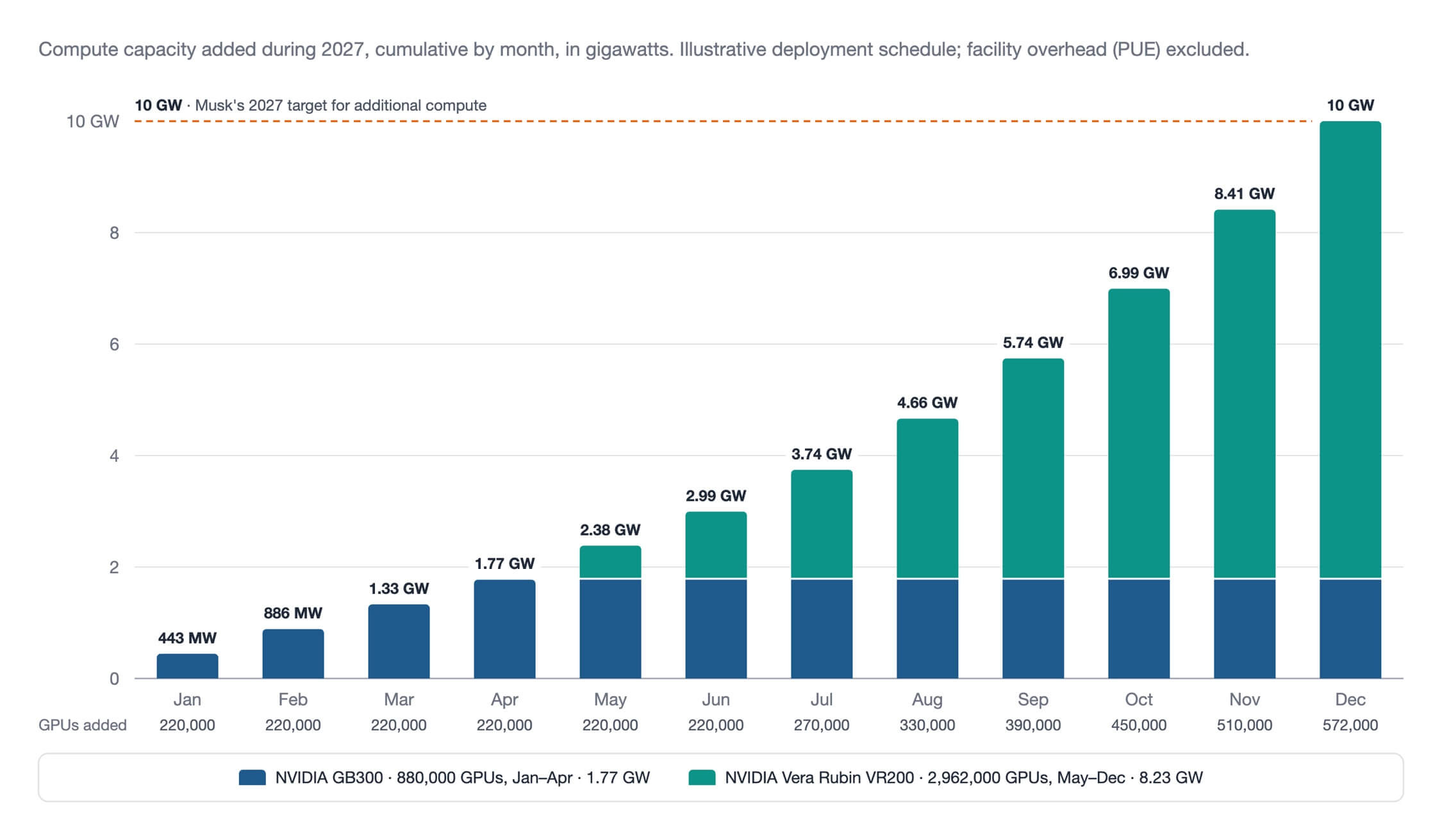
Source: Measured AI estimates. Assumes 145 kW per 72 GB300 GPUs and 200 kW per 72 Vera Rubin GPUs; facility PUE excluded.
To reach 10 GW by December 2027, monthly Vera Rubin deployments have to grow by roughly 60,000 GPUs each month, from 220,000 in June 2027 to about 570,000 in December 2027, nearly 1.6 GW in a single month and 2.6 times today’s monthly GPU deployments. Vera Rubin supplies 8.2 GW of the 10 GW, and 70% of the capacity arrives in the second half of the year.
In all, this path takes 3.8 million GPUs, 2.7 times the 1.44 million SpaceX expects to have running at the end of 2026. Because these gigawatt figures exclude facility overhead, the power and cooling behind them must be larger still. Even if the facilities are ready, the ramp also depends on high-bandwidth memory supply, advanced chip-packaging capacity, and sufficient NVIDIA GPU allocations for SpaceX amid competition from other buyers.
Power and Cooling Built Ahead of the GPUs
SpaceX separately aims to build 20 GW of additional power and cooling infrastructure ahead of GPU deployment, continuing its strategy of developing behind-the-meter power generation to support its data centers. The company is exploring solar and wind alongside natural gas to meet its electricity needs.
Musk also believes SpaceX’s advanced metal-casting capabilities, developed for its rocket business, could help bring gas-fired generation online faster. SpaceX is already applying this expertise to manufacturing gas turbine blades and vanes, which have lead times 12–18 months longer than other turbine components. Producing these parts in-house could help SpaceX get around industry-wide gas turbine shortages.
$300–$350 Billion of Capital and 6-Month Payback Test
The capital required to support this expansion is enormous. Fully equipped AI data centers cost approximately $40–$50 billion per GW, including NVIDIA GPUs, servers, networking equipment, data center construction, and supporting electrical and cooling infrastructure. Even assuming SpaceX can achieve a substantially lower cost of $30–$35 billion per GW, adding 10 GW of compute capacity in 2027 would imply $300–$350 billion of investment.
SpaceX’s economic case rests on building infrastructure more cheaply and rapidly than competitors while earning more than $50 per watt annually on short-duration contracts for its next-generation Vera Rubin GPUs. With demand for advanced AI compute continuing to outstrip supply, Musk believes this combination could produce a payback period as short as six months for compute deployed in 2027.
At $30–$35 billion per GW, each watt of compute costs $30–$35 to build. At an illustrative rental rate of $50 per watt annually, fully contracted capacity recovers that cost through gross revenue in 7.2–8.4 months, before operating costs. With an illustrative 70% site cash operating margin, the simple operating-cash payback stretches to roughly 10–12 months, before financing costs and taxes. Even under these aggressive assumptions, Musk’s six-month payback target appears difficult to achieve.
Financing the Expansion: $40 Billion GPU Lease Commitment
Funding a $300–$350 billion build-out will require SpaceX to raise substantial additional capital. On its October 20 earnings call, CFO Bret Johnsen identified operating cash flow as the first source of funding, supplemented by investment-grade debt markets and potential financing partnerships with suppliers and customers. Large upfront payments from customers such as Anthropic and Google could fund part of that spending, reducing the amount SpaceX would otherwise need to raise through debt or equity. SpaceX intends to preserve its investment-grade credit status throughout the expansion.
SpaceX has already set two financing precedents. In June 2026, it issued $25 billion of investment-grade bonds, largely to refinance existing borrowings. Separately, it has secured $12.9 billion of GPU-specific financing from Valor Equity Partners, using sale-leaseback arrangements that allow it to finance computing equipment over time.
On October 24, 2026, SpaceX signed a binding commitment letter with an Apollo Global Management-managed entity for $40 billion in GPU financing. Under the proposed arrangement, Apollo would purchase GPU pods and related equipment and lease them to SpaceX over approximately five years, with quarterly payments covering principal, interest, and expenses. The deal is expected to close before year-end 2026, with GPU deliveries beginning in the first half of 2027.
Even that $40 billion would cover only 11%–13% of the estimated 2027 investment requirement. SpaceX will therefore need to combine repeated debt issuances, additional equipment financing, and rapidly growing operating cash flows. The central financing challenge is bridging the gap between paying for new infrastructure upfront and realizing the short payback periods Musk expects, without taking on so much debt that SpaceX jeopardizes its investment-grade rating.
Measured AI provides institutional-grade analysis of the physical infrastructure powering AI data centers. For access to our full research library, regulatory intelligence, and weekly briefings, visit MeasuredAI.com.
The 90-day walk-away clause stopped me. These are three-year agreements adding up to $54.5 billion in annualized revenue across more than 700,000 GPUs, yet either side can leave on 90 days' notice after an initial period. That is a very different thing from $54.5 billion locked in. I saw the same gap in Generac's SEC filing on its Amazon deal: $8 billion headlined, $2.4 billion in scheduled deliveries for 2027-28, the rest a ceiling, with warrants vesting only as Amazon spends. Does your payback table — 10 to 12 months on an operating-cash basis, not six — assume that scarce capacity re-lets instantly if a customer uses that exit?